DirectX 11 vs 12 | Which is Better for Gaming?
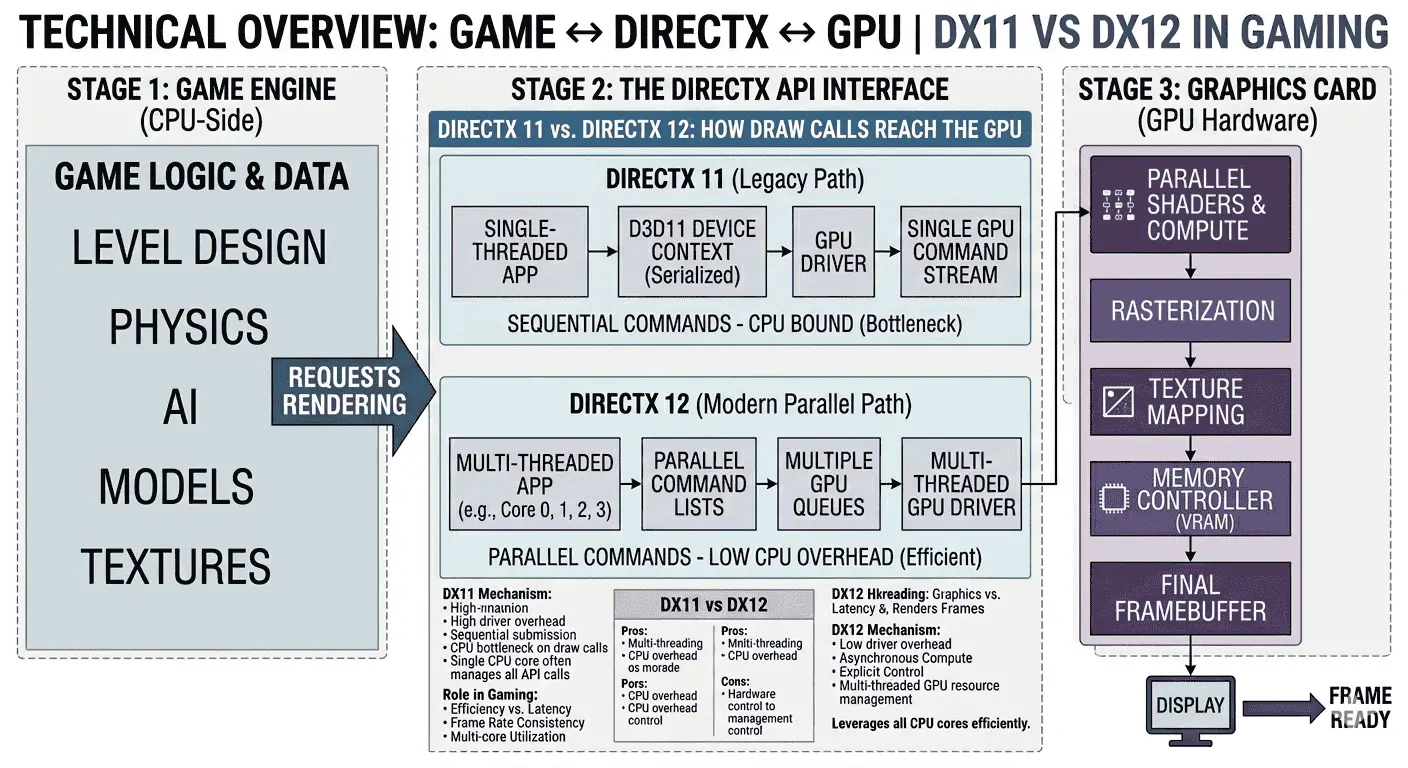
DirectX 11 vs 12 are two different versions of the same technology. DirectX 11 focuses on stability, compatibility, and smoother performance on older hardware. Many games were originally built around DX11 because it is easier to optimize and usually delivers more consistent frame rates with fewer stutters. DirectX 12 is a newer and more advanced API designed for modern GPUs and multi-core processors. It improves hardware utilization, lowers CPU overhead, and supports modern features like ray tracing, DLSS, frame generation, and advanced lighting techniques.
The biggest visual difference between DX11 and DX12 appears when ray tracing is enabled. DX12 handles modern graphical workloads much better because it was designed for RTX-based technologies and real-time lighting effects. Many players still prefer DX11 in some games because poorly optimized DX12 implementations can cause frame drops, stuttering, unstable CPU usage, and inconsistent FPS. Games like The Witcher 3 show how optimization matters more than the API itself, as many users reported smoother gameplay on DX11 despite using powerful GPUs like the RTX 3080 and RTX 4090.
DirectX is a graphics API developed by Microsoft that allows games to communicate with hardware like the GPU and CPU. It works as a bridge between the game engine and the graphics card so games can render visuals, lighting, textures, shadows, and other effects properly. Without DirectX, developers would need separate optimization for every graphics card and hardware configuration.
DirectX 11 vs 12 Supported Games List With Benchmarks
This section compares popular games that support both DirectX 11 and DirectX 12 and shows the average FPS difference between both APIs. The benchmarks help identify how each version performs on different hardware configurations, resolutions, and graphics settings. It also highlights how optimization, ray tracing, DLSS, and game engine implementation can affect overall gaming performance and smoothness.
DirectX 11 vs DirectX 12 Technical and Performance Differences
DirectX 11 usually delivers more stable performance in older and poorly optimized games. It puts less pressure on the CPU and works smoothly on a wide range of hardware configurations. Many players still prefer DX11 because frame pacing feels more consistent, and sudden FPS drops are less common.
DirectX 12 is designed to use modern CPUs and GPUs more efficiently. It reduces CPU overhead and improves multi-core utilization, which can increase FPS in optimized games. Performance gains depend heavily on how well the game is developed for DX12. In some titles, DX12 improves frame rates noticeably, while in others it introduces stuttering, shader compilation issues, or unstable frame times.
| Feature | DirectX 11 | DirectX 12 |
|---|---|---|
| FPS Stability | More stable in many games | Depends heavily on optimization |
| CPU Usage | Higher CPU overhead | Lower CPU overhead |
| GPU Utilization | Less efficient hardware usage | Better GPU utilization |
| Stuttering | Usually fewer stutters | Shader stutters can happen |
| Multi-Core Support | Limited | Better multi-core scaling |
| Ray Tracing | Not supported | Fully supported |
| DLSS & Frame Generation | Limited or unavailable | Supported |
| Competitive Gaming | Better responsiveness | Better visual quality |
| Best Resolution | Better for 1080p systems | Better for 1440p and 4K |
| Hardware Preference | Older and mid-range PCs | Modern RTX-based systems |
| Optimization Dependency | More consistent overall | Strongly depends on developers |
CPU and GPU Usage
DX11 handles most rendering tasks through the CPU before sending them to the GPU. This approach is simpler but can create CPU bottlenecks in heavy games.
DX12 gives developers lower-level access to hardware. The GPU handles more work directly, reducing CPU load and improving hardware utilization on modern systems. This is why DX12 performs better in many CPU-intensive games, especially at higher resolutions.
Ray Tracing Support
Ray tracing is one of the biggest differences between DX11 and DX12. DirectX 11 does not support hardware-based ray tracing features. DirectX 12 supports real-time ray tracing, realistic shadows, reflections, global illumination, and advanced lighting effects.
Games like Cyberpunk 2077 and The Witcher 3 rely on DX12 for ray tracing technologies. Enabling ray tracing significantly increases GPU load, which is why players often see major FPS drops without technologies like DLSS or Frame Generation.
Stability and Optimization
DX11 is generally more reliable because developers have worked with it for many years. Many older games were originally built around DX11, which is why they often run smoother in DX11 mode even on modern hardware.
DX12 performance depends strongly on game optimization. Some games achieve higher FPS and better visuals, while others suffer from shader stutter, inconsistent CPU utilization, or unstable frame pacing. Reddit discussions around The Witcher 3 show that many RTX 30 and RTX 40 series users still switch between DX11 and DX12 depending on the settings and gameplay experience they want.
DLSS and Modern Features
Most modern rendering technologies are tied to DX12. Features like DLSS, Frame Generation, Nvidia Reflex, and advanced anti-aliasing methods usually require DX12 support.
DX11 lacks support for many modern rendering techniques, but it often provides lower latency and smoother gameplay on weaker systems.
Hardware Compatibility
DX11 works well on older graphics cards and low-end gaming PCs. It is commonly preferred on GTX series GPUs and older RTX cards when stability matters more than visual quality.
DX12 is built for newer hardware, such as RTX 30 and RTX 40 series GPUs. It performs best when paired with modern processors, faster memory, and SSD storage.
Conclusion
DirectX 11 and DirectX 12 both serve different types of gamers and hardware setups. DX11 remains a strong choice for stable gameplay, lower latency, and better performance in older or poorly optimized games. DX12 focuses on modern rendering technologies, improved hardware utilization, ray tracing, DLSS, and advanced visual features.
There is no universal winner between DX11 and DX12 because performance depends heavily on the game engine, GPU, CPU, and optimization quality. Some games deliver smoother gameplay in DX11, while others perform significantly better with DX12 enabled.
Players using older hardware or aiming for stable competitive gameplay may prefer DX11. Gamers with modern RTX GPUs who want better visuals, ray tracing, and advanced features will benefit more from DX12. The best option is to test both versions and use the one that provides smoother gameplay and a better overall experience on your system.