Best CPU for RTX 5080 in 2026 | Why the Ryzen 7 9800X3D Is the Top Choice?
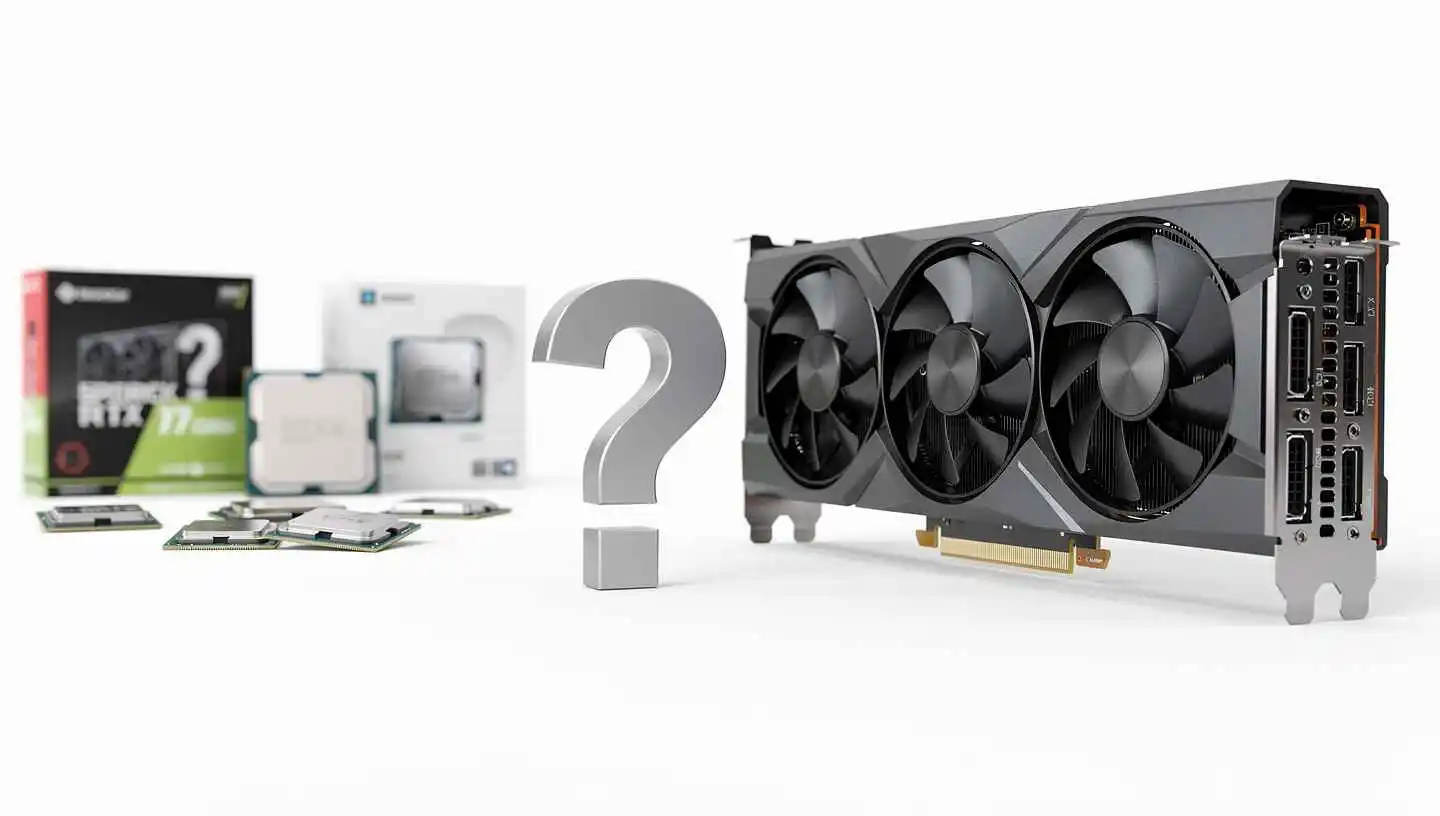
A graphics card as powerful as the RTX 5080 deserves a processor that can keep up with its performance. After analyzing gaming benchmarks, architectural advantages, and platform longevity, the AMD Ryzen 7 9800X3D proves to be the best CPU for RTX 5080. CPUs such as the AMD Ryzen 9 9950X3D and Intel Core Ultra 9 285K also pair exceptionally well with the RTX 5080, depending on whether your focus is purely gaming or a combination of gaming and productivity.
CPUs That Work Well with the RTX 5080
A Detailed Review of the AMD Ryzen 7 9800X3D: Why It’s the Best CPU for RTX 5080
Specification Details
| Architecture | Zen 5 |
| Cores | 8 |
| Threads | 16 |
| Base Clock | 4.7 GHz |
| Max Boost Clock | Up to 5.2 GHz |
| L2 Cache | 8 MB |
| L3 Cache | 96 MB (3D V-Cache) |
| Total Cache | 104 MB |
| Default TDP | 120W |
| Manufacturing Process | TSMC 4nm Compute Die + 6nm I/O Die |
| Socket | AM5 |
| Memory Support | DDR5 |
| PCIe Support | PCIe 5.0 |
| Integrated Graphics | AMD Radeon Graphics (2 Compute Units) |
| Launch Generation | Ryzen 9000 Series |
The Ryzen 7 9800X3D’s 8-core and 16-thread configuration provides more than enough processing resources for modern games, allowing the RTX 5080 to maintain high frame rates without being held back by CPU limitations. Its boost clock of up to 5.2 GHz helps improve single-threaded performance, which remains one of the most important factors in gaming workloads.
However, the most significant specification is the 96 MB of L3 cache powered by AMD’s 3D V-Cache technology. This large cache allows the processor to keep more game data close to the cores, reducing memory access latency and improving frame consistency in CPU-intensive titles. When paired with a powerful graphics card like the RTX 5080, this advantage becomes especially noticeable at 1080p and 1440p resolutions, where the CPU has a greater influence on overall performance.
The processor also supports DDR5 memory and PCIe 5.0 connectivity, ensuring sufficient memory bandwidth and GPU communication throughput for current and future high-end graphics cards. Combined with AMD’s Zen 5 architecture, these specifications make the Ryzen 7 9800X3D one of the most technically balanced CPUs available for the RTX 5080.
How the Ryzen 7 9800X3D Works with the RTX 5080?
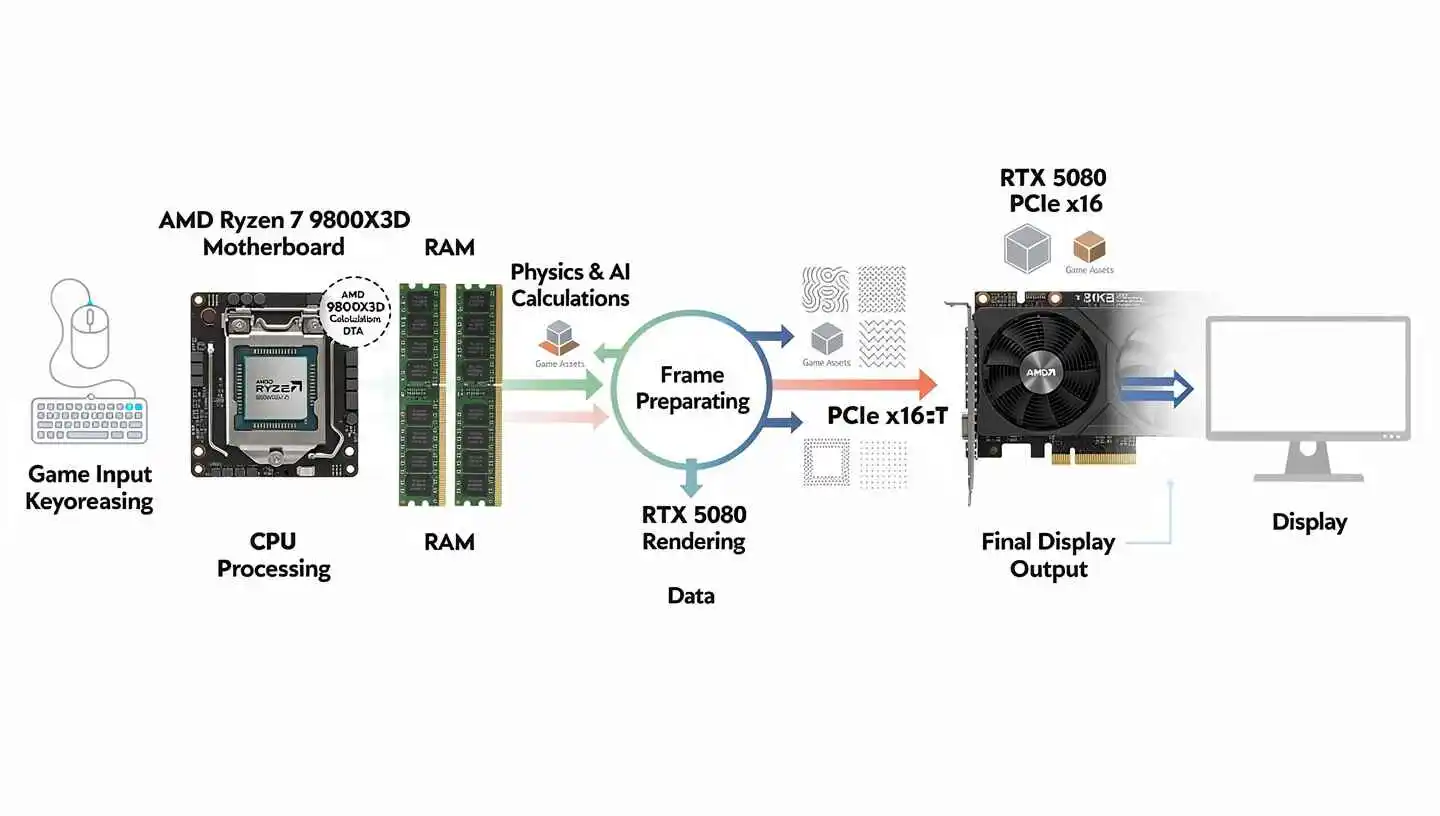
A powerful graphics card is only as effective as the processor supporting it. No matter how capable the RTX 5080 is, it still relies on the CPU to handle game logic, physics calculations, AI behavior, asset management, and rendering instructions before a frame can be produced. This is where the Ryzen 7 9800X3D demonstrates why it is such a strong companion for NVIDIA’s high-end GPU.
Efficient CPU-GPU Communication
Before the RTX 5080 can render a frame, the CPU must prepare and organize the necessary data. This process includes handling game engine instructions, processing player inputs, tracking object positions, and generating draw calls that tell the graphics card what needs to be rendered.
The Ryzen 7 9800X3D excels in this area thanks to its Zen 5 architecture and large 3D V-Cache. By processing game data efficiently and reducing memory-related delays, the processor can deliver rendering instructions to the RTX 5080 with minimal interruption. This helps maintain a steady workflow between both components, particularly in modern games that place heavy demands on the CPU.
Thread Scheduling and Workload Distribution
Modern games rarely rely on a single processing thread. Instead, workloads are distributed across multiple threads responsible for tasks such as physics simulations, AI routines, background asset streaming, audio processing, and game-world calculations.
The Ryzen 7 9800X3D’s 8-core, 16-thread design allows these workloads to be distributed effectively without overwhelming individual cores. Efficient thread scheduling ensures that critical gaming tasks receive priority while less important background processes remain separated. As a result, the CPU can continue feeding the RTX 5080 with rendering data even during demanding gameplay scenarios.
This becomes particularly important in open-world games and simulation-heavy titles where multiple systems are running simultaneously behind the scenes.
Frame Pacing and Latency Management
High average frame rates do not always guarantee a smooth gaming experience. Consistent frame delivery is equally important, especially when paired with a graphics card capable of producing extremely high refresh rates.
The Ryzen 7 9800X3D’s combination of strong single-core performance, efficient thread management, and large cache capacity helps reduce sudden processing delays that can interrupt frame delivery. This leads to improved frame pacing, lower input latency, and a more responsive gaming experience.
For competitive gamers, these improvements can be just as valuable as higher FPS numbers because they contribute to smoother gameplay and more predictable system behavior.
PCIe 5.0 and Data Transfer Efficiency
The Ryzen 7 9800X3D also supports PCIe 5.0, providing the bandwidth required for modern high-performance graphics cards and storage devices. While current games rarely saturate PCIe 5.0 bandwidth, the platform ensures that the RTX 5080 has unrestricted access to system resources whenever additional throughput is required.
This level of connectivity also strengthens the long-term value of the platform, allowing users to upgrade other components without worrying about interface limitations.
CPU Architecture Analysis
A CPU’s architecture plays a major role in determining how effectively it can support a high-end graphics card. While specifications such as core count and clock speeds are important, the processor’s underlying design ultimately determines how quickly it can process game data and deliver instructions to the GPU. This is one of the main reasons the Ryzen 7 9800X3D stands out as an excellent match for the RTX 5080.
Zen 5 Architecture
The Ryzen 7 9800X3D is built on AMD’s Zen 5 architecture, which introduces several efficiency and performance improvements over previous generations. Rather than relying solely on higher clock speeds, Zen 5 focuses on executing more instructions per clock cycle, enabling the CPU to complete workloads more efficiently. This approach is particularly beneficial in modern games where thousands of calculations must be handled every second before the GPU can render a frame.
IPC Improvements
One of the biggest upgrades in Zen 5 is its improved Instructions Per Clock (IPC) performance. IPC measures how much work a processor can complete in a single clock cycle. A higher IPC means the CPU can process more game logic, physics calculations, AI behavior, and draw calls without needing significantly higher frequencies.
For the RTX 5080, this matters because the graphics card can only render frames as quickly as the CPU prepares them. By increasing IPC, the Ryzen 7 9800X3D reduces potential CPU-side delays and helps maintain smoother frame delivery, especially in CPU-intensive games.
Front-End Improvements
AMD has also enhanced the front-end of the Zen 5 architecture, which is responsible for fetching and decoding instructions before they reach the execution units. A more efficient front-end reduces bottlenecks within the processor and ensures a steadier flow of data through the pipeline.
In gaming workloads, this translates into faster processing of game engine instructions and more consistent communication between the CPU and GPU. When paired with the RTX 5080, these improvements help maintain stable performance during complex scenes where large amounts of data must be processed simultaneously.
Execution Engine Enhancements
The execution engine is where the processor performs the actual calculations required by applications and games. Zen 5 introduces improvements that allow the CPU to handle a wider range of workloads more efficiently while keeping latency under control.
For gaming, this means the processor can process player inputs, game physics, world simulation, and background tasks more effectively. As a result, the RTX 5080 spends less time waiting for new rendering instructions and more time operating at its intended performance level.
Improved Branch Prediction
Modern games constantly make decisions based on player actions, AI behavior, and environmental changes. Branch prediction helps the processor anticipate these decisions and prepare instructions before they are needed.
Zen 5 features a more advanced branch prediction system that reduces incorrect predictions and minimizes pipeline interruptions. Although this improvement may not be visible on a specification sheet, it contributes to better responsiveness and frame consistency during gameplay.
Cache Technology and Gaming Performance
While clock speeds and core counts often get the most attention, cache technology is arguably the biggest reason the Ryzen 7 9800X3D stands out as the best CPU for the RTX 5080. Modern games constantly move large amounts of data between the processor and system memory, and every trip to RAM introduces additional latency.
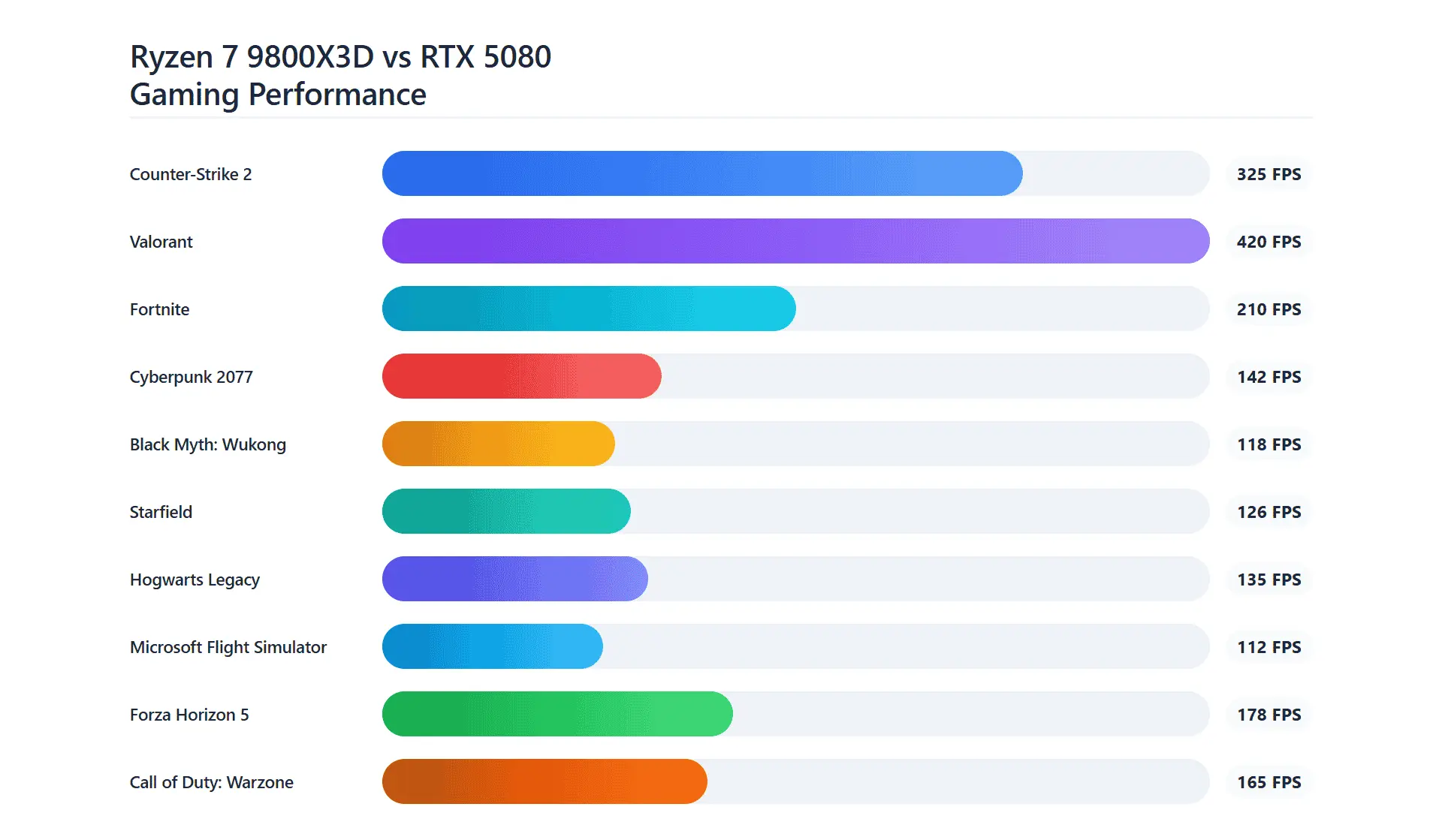
The faster a CPU can access the data it needs, the more efficiently it can keep the graphics card supplied with rendering instructions. We can better understand the impact of this cache design by examining the gaming performance and FPS results of the Ryzen 7 9800X3D paired with the RTX 5080.
Understanding the Cache Hierarchy
The Ryzen 7 9800X3D uses a multi-level cache design consisting of L1, L2, and L3 cache. Each cache level serves a different purpose, but they all share the same goal: reducing the amount of time the processor spends waiting for data.
L1 cache is the smallest and fastest layer, storing instructions that the CPU needs immediately. L2 cache acts as a secondary high-speed storage area, while L3 cache serves as a larger shared pool that can be accessed by all processor cores. By keeping frequently used game data closer to the processor, these cache layers significantly reduce memory access delays.
For gaming workloads, this matters because every millisecond saved during data retrieval allows the CPU to spend more time processing game logic and preparing frames for the GPU.
The Advantage of 3D V-Cache
What separates the Ryzen 7 9800X3D from conventional gaming processors is AMD’s 3D V-Cache technology. Instead of relying solely on a standard cache layout, AMD stacks additional cache directly on top of the processor die, increasing the available L3 cache to 96MB.
This larger cache capacity allows the processor to store more game assets, world data, AI instructions, and rendering information close to the CPU cores. As a result, the processor can retrieve critical data without repeatedly accessing slower system memory.
The benefit becomes especially noticeable in games with large open worlds, complex physics systems, and heavy CPU workloads. Rather than constantly requesting information from RAM, the processor can access a greater percentage of required data directly from cache, reducing latency and improving overall responsiveness.
Single-Core Performance vs Multi-Core Scaling
When choosing the best CPU for RTX 5080, it is important to understand that gaming performance does not depend only on the number of cores. Many users assume that a 12-core or 16-core processor will automatically deliver better gaming results, but that is not always how modern games behave.
Most games still depend heavily on strong single-core performance because the main game thread handles critical tasks such as player input, game logic, physics calculations, AI behavior, and draw call preparation. If that main thread is slow, the graphics card may have to wait for instructions, even if the system has plenty of unused cores available.
This is where the Ryzen 7 9800X3D makes sense for the RTX 5080. Its strong single-core performance allows it to process important gaming instructions quickly, while its 8-core and 16-thread layout provides enough room for background tasks, asset streaming, audio processing, and secondary game threads.
Multi-core scaling still matters, but mainly in specific situations. Games with advanced simulation systems, large open worlds, heavy background loading, or built-in CPU-heavy engines can benefit from more available threads. Extra cores are also useful if the user streams, records gameplay, runs Discord, keeps browsers open, or uses productivity tools while gaming.
However, beyond a certain point, more cores do not always increase FPS. A processor needs the right balance of single-core speed, cache capacity, thread handling, and memory access efficiency. That balance is exactly why the Ryzen 7 9800X3D is such a strong gaming CPU. It gives the RTX 5080 enough CPU-side support without forcing the user to pay for extra cores that may not improve gaming performance in a meaningful way.
Memory Controller and DDR5 Scaling
The memory subsystem also plays an important role in how well a CPU supports a high-end graphics card. The RTX 5080 handles the rendering workload, but the CPU still needs quick access to system memory for game data, asset management, physics calculations, and background processes.
The Ryzen 7 9800X3D supports DDR5 memory, which provides higher bandwidth than older DDR4 platforms. This helps the processor move more data between RAM and the CPU cores, especially in modern games that rely on large textures, open-world streaming, and complex game engine data.
DDR5 frequency scaling can also affect performance, but speed alone is not the full story. Memory latency matters just as much. A very fast DDR5 kit with poor latency may not always feel better than a well-tuned kit with balanced timings. For gaming, the goal is not simply to buy the highest MHz number. The better approach is to use a stable DDR5 kit that offers a good balance between frequency and latency.
EXPO profiles make this easier on AMD platforms. Instead of manually tuning memory settings, users can enable an EXPO profile in the BIOS to run compatible DDR5 memory at its rated speed and timings. This helps the Ryzen 7 9800X3D access memory more efficiently, which can improve frame consistency in CPU-sensitive titles.
For the RTX 5080, this matters because memory delays on the CPU side can affect how quickly game data is prepared for the GPU. The Ryzen 7 9800X3D already reduces many of these delays through its large 3D V-Cache, but a properly configured DDR5 setup adds another layer of support. Together, fast cache and well-tuned DDR5 memory help the CPU maintain a steady data flow to the graphics card.
PCIe Connectivity and GPU Bandwidth
PCIe connectivity is another technical factor that should be considered when pairing a processor with a high-end GPU. The RTX 5080 needs a fast and stable communication path to exchange data with the rest of the system, and the Ryzen 7 9800X3D provides that through the AM5 platform with PCIe 5.0 support.
PCIe lanes act like data highways between the CPU, GPU, storage devices, and the motherboard chipset. A graphics card normally uses a dedicated x16 PCIe slot, which gives it direct access to high-bandwidth communication with the processor and system memory. This is important because the GPU does not work in isolation. It constantly receives rendering commands, game data, textures, and workload instructions prepared by the CPU.
PCIe 5.0 offers more bandwidth than PCIe 4.0, which gives the platform stronger long-term value. In current gaming scenarios, the RTX 5080 may not fully saturate PCIe 5.0 bandwidth, but having that extra headroom is still useful for future GPUs, faster storage devices, and heavier data-transfer workloads.
Lane allocation also matters. A well-designed AM5 motherboard can provide enough bandwidth for the GPU while still supporting fast NVMe storage. This is important for modern games because asset streaming increasingly depends on fast storage performance. When the CPU, GPU, memory, and SSD have a clean data path, the system can load assets faster and reduce delays during gameplay.
For users building around the best CPU for RTX 5080, PCIe 5.0 should not be seen as a direct FPS booster in every game. Its real value is platform strength. It ensures that the graphics card has a high-bandwidth connection, the storage subsystem has room to perform properly, and the build remains ready for future hardware upgrades.
Conclusion
After analyzing architecture improvements, cache technology, CPU-GPU communication, memory performance, PCIe connectivity, and bottleneck behavior, the AMD Ryzen 7 9800X3D clearly stands out as the best CPU for RTX 5080 for most users. Its combination of Zen 5 architecture, 96MB of 3D V-Cache, strong single-core performance, and efficient thread management allows it to keep pace with one of NVIDIA’s most powerful graphics cards without introducing meaningful CPU-side limitations. Whether you’re targeting high refresh-rate competitive gaming at 1080p, immersive 1440p gameplay, or demanding 4K experiences, this processor delivers the balance needed to maximize the RTX 5080’s capabilities.
That said, the right CPU ultimately depends on how you use your system. While the Ryzen 7 9800X3D remains the best CPU for RTX 5080 in gaming-focused builds, users who regularly stream, edit videos, render 3D projects, or run professional workloads may benefit from alternatives such as the Ryzen 9 9950X3D or Intel Core Ultra 9 285K. For most gamers, however, the Ryzen 7 9800X3D offers the strongest blend of gaming performance, platform longevity, and overall value, making it the processor I would confidently recommend for an RTX 5080 build today.