Best CPU for RTX 5090 In 2026 | Top 5 Processors Tested and Compared
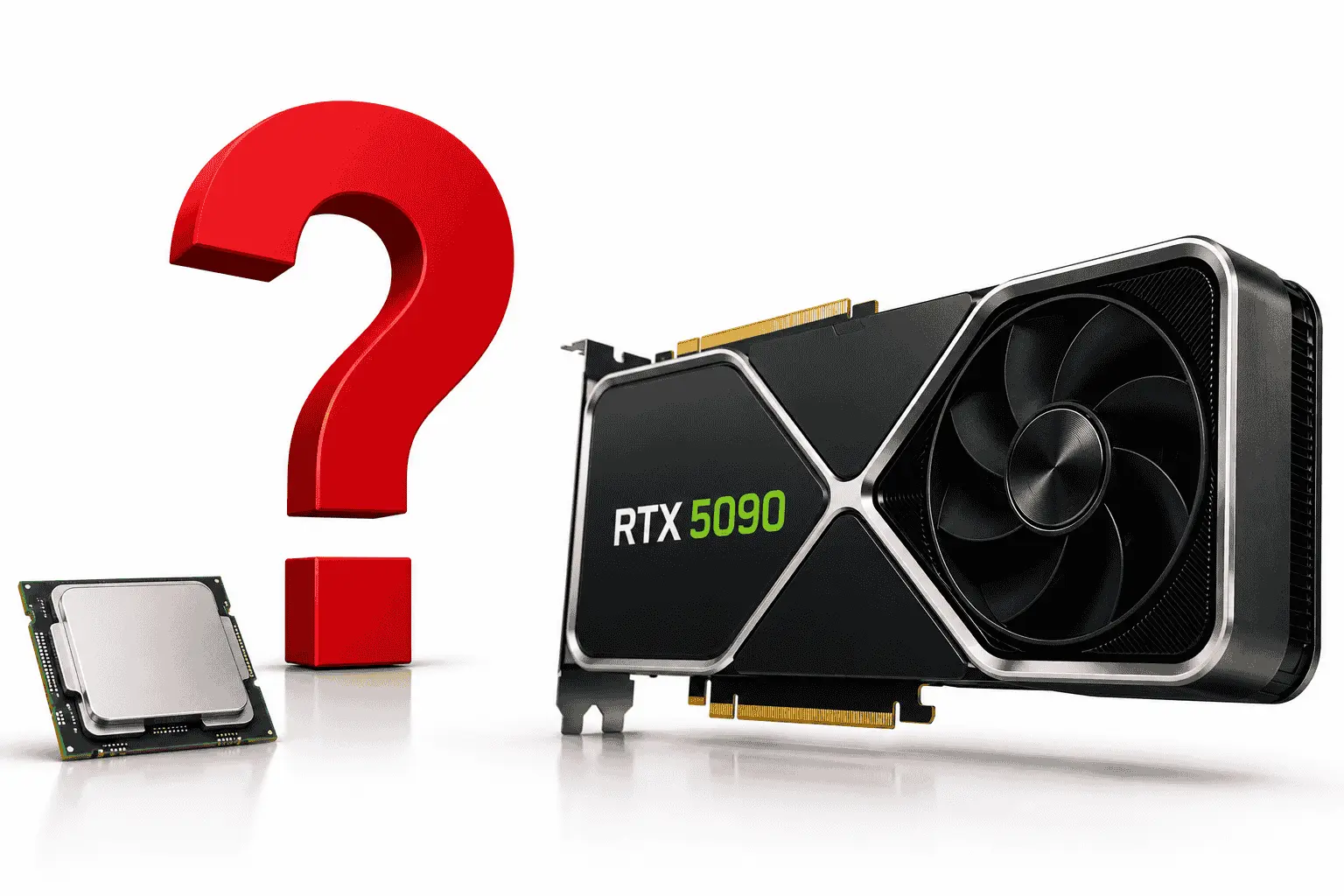
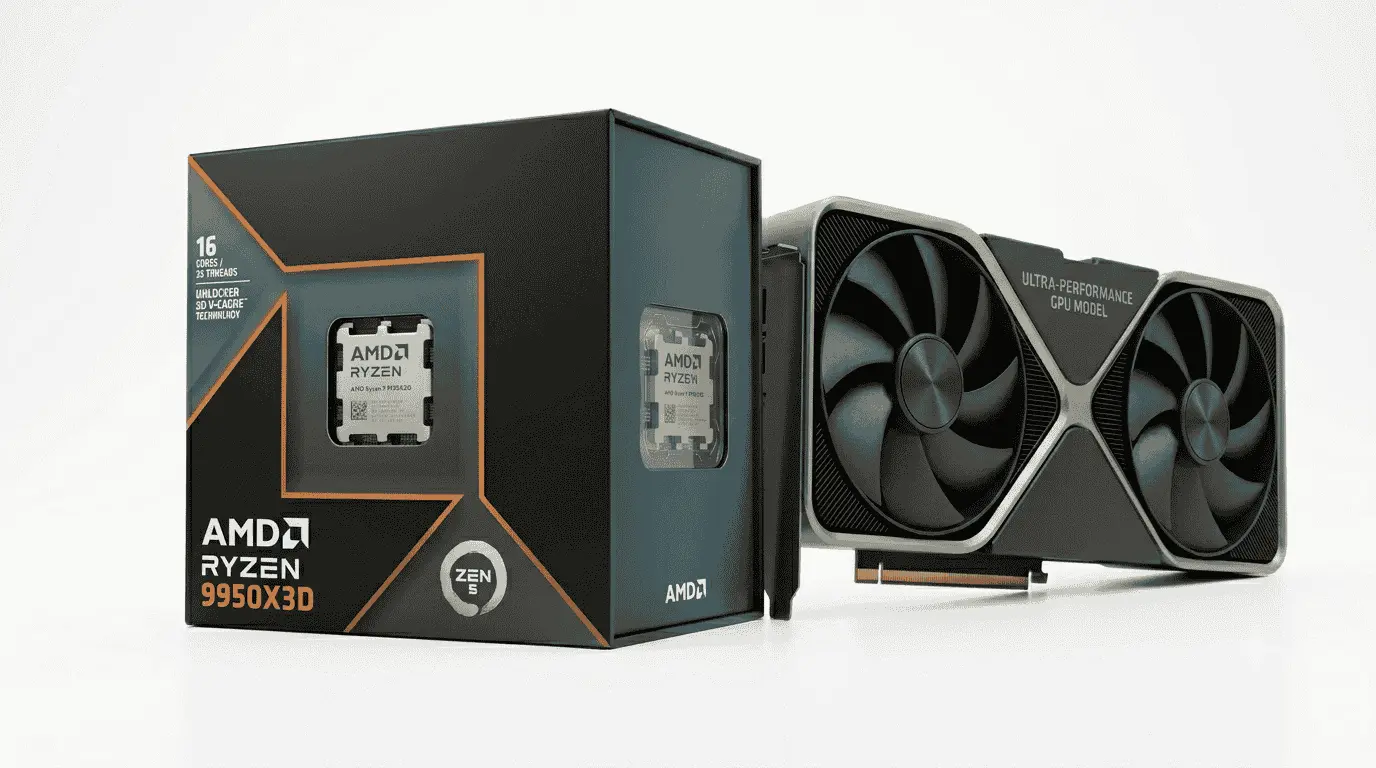
The AMD Ryzen 9 9950X3D is currently the best CPU for RTX 5090. It offers an ideal combination of gaming performance, multi-core processing power, and platform longevity, making it one of the few processors that fully support Nvidia’s flagship GPU across gaming, content creation, and professional workloads.
AMD Ryzen 9 9950X3D’s 16-core, 32-thread design provides substantial processing power for multitasking and productivity, while AMD’s 3D V-Cache technology helps deliver exceptional gaming performance. Combined with support for modern technologies such as DDR5 memory and PCIe 5.0, it provides a balanced foundation for an RTX 5090 build.
Best CPU for RTX 5090: Our Tested AMD and Intel Picks
We analyzed a wide range of AMD Ryzen and Intel processors to determine which models pair most effectively with the RTX 5090. After evaluating gaming performance, average FPS, 1% low FPS results, and CPU temperatures, we narrowed our recommendations down to five processors that consistently delivered strong results with the RTX 5090.
1. AMD Ryzen 9 9950X3D
Specification Details
| Architecture | Zen 5 |
| Cores | 16 |
| Threads | 32 |
| Base Clock | 4.3 GHz |
| Boost Clock | Up to 5.7 GHz |
| L3 Cache | 128MB (with 3D V-Cache) |
| TDP | 170W |
| Socket | AM5 |
| Memory Support | DDR5 |
| PCIe Support | PCIe 5.0 |
Core Configuration and Processing Capacity
The Ryzen 9 9950X3D is the best CPU for RTX 5090, features 16 cores and 32 threads, providing a substantial amount of processing resources for modern gaming systems. While gaming workloads rarely utilize every available thread, a processor paired with the RTX 5090 must handle more than rendering-related instructions. Background applications, game engines, asset streaming, voice communication software, recording tools, and operating system processes all compete for CPU resources.
With 32 threads available, the processor can distribute these tasks efficiently without interfering with the game workload. This allows the RTX 5090 to remain consistently supplied with rendering instructions, particularly in demanding titles that generate large numbers of draw calls and background calculations.
3D V-Cache and Game Data Accessibility
One of the defining features of the Ryzen 9 9950X3D is its expanded L3 cache through AMD’s 3D V-Cache technology. The additional cache acts as a high-speed storage layer positioned closer to the processor cores than system memory.
Modern game engines continuously access large amounts of data, including world geometry, character information, AI behavior, physics calculations, and texture references. When more of this data can remain inside the processor cache, the CPU spends less time waiting for information from system memory.
For an RTX 5090 system, this becomes particularly important because the graphics card can process rendering workloads extremely quickly. A processor with a larger cache helps reduce data retrieval delays and allows the GPU to receive instructions more consistently throughout gameplay.
Thread Scheduling and Workload Distribution
Effective thread scheduling plays a significant role in overall system performance. Every game generates multiple workloads that must be assigned to available processor threads. These workloads include rendering preparation, AI routines, physics calculations, audio processing, networking functions, and asset management.
The Ryzen 9 9950X3D has enough processing resources to separate these workloads across multiple cores rather than forcing them to compete for limited resources. As a result, heavy background activity is less likely to impact gaming performance, even when the RTX 5090 is operating near full utilization.
This becomes especially valuable for users who stream gameplay, record footage, or run productivity applications alongside gaming sessions.
Frame Pacing and Latency Management
Average frame rate is only one aspect of gaming performance. Frame pacing is equally important because it determines how consistently frames are delivered to the display.
When a processor struggles to process game data quickly enough, frame delivery can become uneven. Even if average frame rates remain high, inconsistent frame times may produce visible stuttering or reduced responsiveness.
The Ryzen 9 9950X3D combines strong single-core performance with a large cache structure, helping maintain stable frame delivery in CPU-heavy scenarios. This contributes to smoother gameplay and more predictable system behavior during demanding scenes.
Boost Clocks and Single-Core Performance
Many gaming workloads still rely heavily on a limited number of primary threads. Because of this, single-core performance remains one of the most important characteristics of a gaming processor.
With boost frequencies reaching up to 5.7 GHz, the Ryzen 9 9950X3D can process game-engine calculations rapidly. Faster execution of these instructions reduces the likelihood of the CPU becoming a performance constraint before the RTX 5090 reaches its full potential.
This is particularly noticeable in competitive titles, simulation games, and open-world environments where large numbers of calculations occur simultaneously.
PCIe 5.0 and Data Transfer Efficiency
The Ryzen 9 9950X3D supports PCIe 5.0 connectivity through the AM5 platform. Although current graphics cards do not fully saturate PCIe 5.0 bandwidth, the interface provides additional headroom for future hardware generations.
The platform also supports PCIe 5.0 storage devices capable of extremely high transfer speeds. Faster storage access can improve asset loading behavior, reduce waiting times, and support technologies that continuously stream game data during gameplay.
For builders investing in an RTX 5090, PCIe 5.0 support helps ensure the system remains compatible with future performance-oriented upgrades.
DDR5 Memory Support and System Responsiveness
The processor’s support for DDR5 memory contributes to overall platform performance by increasing memory bandwidth compared to previous-generation standards.
Higher memory bandwidth benefits workloads that frequently transfer data between the processor and system memory. Open-world games, content creation applications, simulation software, and multitasking environments can all benefit from faster memory access.
When combined with the processor’s large cache structure, DDR5 support helps create a balanced system capable of supporting the demands of the RTX 5090.
Thermal and Power Characteristics
High-performance processors generate significant heat under sustained workloads, and the Ryzen 9 9950X3D is no exception. While its gaming efficiency is generally strong, users should still pair it with a capable cooling solution.
Proper cooling allows the processor to maintain higher boost frequencies for longer periods, which directly contributes to sustained gaming and productivity performance. This is particularly important in systems built around an RTX 5090, where overall system power consumption is already substantial.
2. AMD Ryzen 7 9800X3D
Specification Details
| Architecture | Zen 5 |
| Cores | 8 |
| Threads | 16 |
| Base Clock | 4.7 GHz |
| Boost Clock | Up to 5.2 GHz |
| L3 Cache | 96MB 3D V-Cache |
| TDP | 120W |
| Socket | AM5 |
| Memory Support | DDR5 |
| PCIe Support | PCIe 5.0 |
Gaming-Oriented Core Design
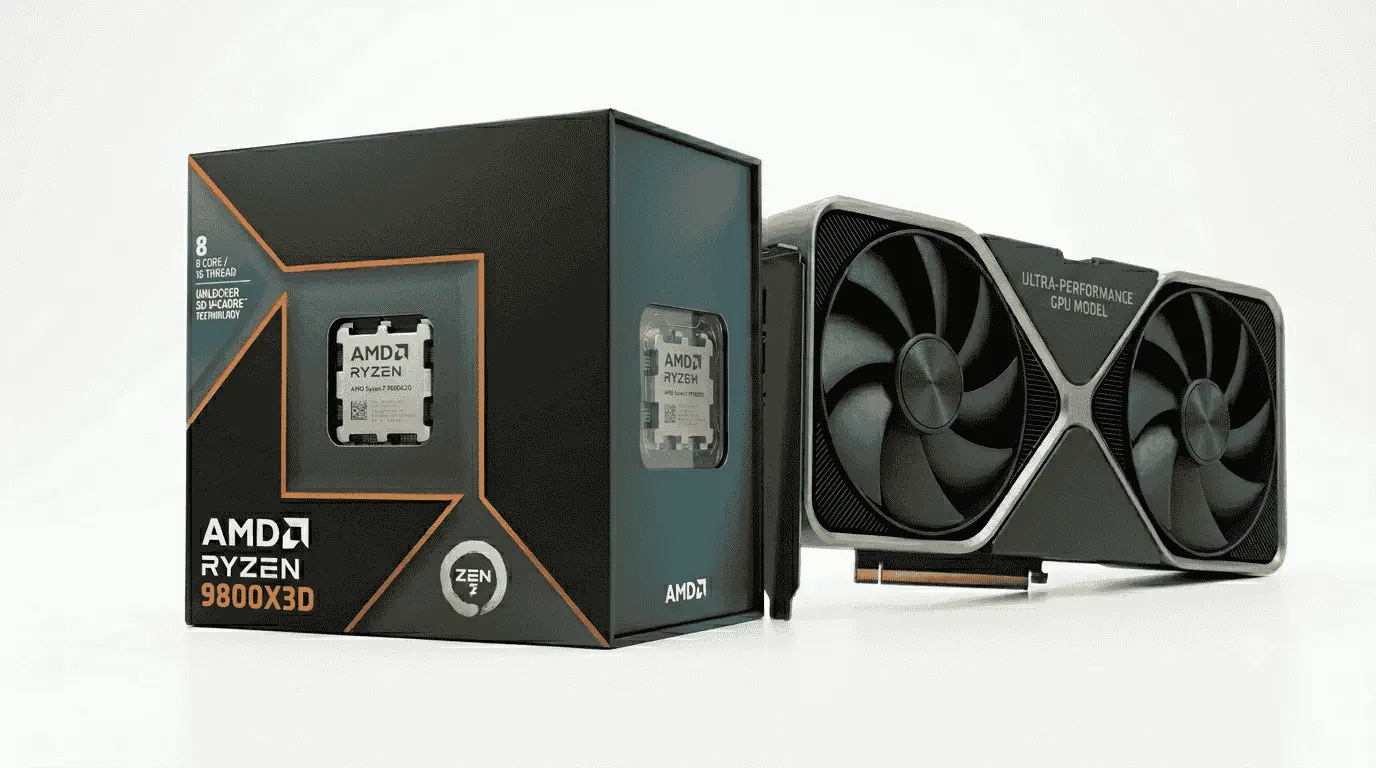
Unlike processors that prioritize core count for workstation workloads, the Ryzen 7 9800X3D is built with gaming as its primary focus. Its 8-core, 16-thread configuration provides enough processing resources for modern games while avoiding the additional complexity that comes with higher-core-count designs.
Most current game engines still rely heavily on a limited number of high-performance threads. Because of this, gaming performance depends more on efficient core utilization, cache access, and instruction execution than simply adding more cores. This design philosophy makes the 9800X3D an excellent match for the RTX 5090 in gaming-focused systems.
3D V-Cache and Rendering Pipeline Efficiency
The most important feature of the Ryzen 7 9800X3D is its 96MB 3D V-Cache. The enlarged cache allows frequently accessed game data to remain much closer to the processor cores, reducing the number of memory requests that must travel to system RAM.
When paired with the RTX 5090, this becomes particularly valuable because the graphics card can process rendering workloads at an extremely high rate. A larger cache helps ensure the processor can prepare and deliver rendering instructions quickly enough to keep the GPU consistently occupied.
In open-world games, competitive shooters, and simulation titles, the additional cache often contributes more to gaming performance than simply increasing clock speeds.
CPU Bottleneck Prevention at High Frame Rates
One of the biggest challenges when pairing a processor with the RTX 5090 is maintaining performance at very high frame rates. As frame rates increase, the processor must prepare game data more frequently and deliver instructions to the graphics card at a faster pace.
The Ryzen 7 9800X3D is specifically designed for this type of workload. Its combination of Zen 5 architecture and 3D V-Cache allows it to maintain excellent gaming performance even when the GPU is capable of generating hundreds of frames per second.
This makes the processor particularly attractive for users with high-refresh-rate monitors, where CPU performance often becomes more important than GPU power.
Thread Scheduling and Background Task Management
Although the Ryzen 7 9800X3D has fewer cores than Ryzen 9 models, its 16 threads are more than sufficient for typical gaming environments.
Game engines, operating system processes, communication software, monitoring tools, and launcher applications can all be distributed across available threads without significantly affecting gameplay performance.
For users whose primary objective is gaming rather than workstation productivity, the processor provides an efficient allocation of processing resources without paying for unused cores.
Frame Time Stability and Input Responsiveness
Consistent frame delivery is one of the most important factors in perceived gaming smoothness. Large fluctuations in frame times can create stuttering even when average frame rates remain high.
The Ryzen 7 9800X3D performs exceptionally well in this area because its large cache reduces delays associated with memory access. By keeping more game data readily available, the processor can respond more quickly to changing workload demands.
When paired with the RTX 5090, this contributes to smoother gameplay, improved responsiveness, and better overall system behavior during demanding gaming sessions.
Zen 5 Architecture Improvements
The Zen 5 architecture introduces improvements in instruction processing efficiency, branch prediction, and execution throughput compared to previous generations.
These architectural enhancements allow each core to perform more work during every clock cycle. As a result, gaming workloads benefit not only from higher frequencies but also from increased computational efficiency.
For RTX 5090 users, stronger per-core performance helps ensure the graphics card receives rendering instructions without unnecessary delays.
PCIe 5.0 and Platform Scalability
The Ryzen 7 9800X3D utilizes AMD’s AM5 platform, which supports PCIe 5.0 connectivity and DDR5 memory technology.
PCIe 5.0 provides substantial bandwidth for modern graphics cards and storage devices, while DDR5 improves memory throughput for gaming and productivity workloads.
For builders investing in an RTX 5090, platform longevity becomes an important consideration. AM5 provides a modern foundation that supports future hardware upgrades without requiring an immediate platform replacement.
Power Efficiency and Thermal Behavior
One of the advantages of the Ryzen 7 9800X3D is its ability to deliver elite gaming performance without the power requirements typically associated with flagship processors.
Compared to many high-core-count alternatives, the processor operates with lower power consumption and produces less heat under gaming workloads. This simplifies cooling requirements and can contribute to quieter system operation.
For gaming-focused RTX 5090 builds, this balance between performance and efficiency is one of the processor’s strongest advantages.
3. AMD Ryzen 9 9900X3D
Specification Details
| Architecture | Zen 5 |
| Cores | 12 |
| Threads | 24 |
| Base Clock | 4.4 GHz |
| Boost Clock | Up to 5.5 GHz |
| L3 Cache | 140MB (Including 3D V-Cache) |
| TDP | 120W |
| Socket | AM5 |
| Memory Support | DDR5 |
| PCIe Support | PCIe 5.0 |
Balancing Gaming Performance and Parallel Workloads
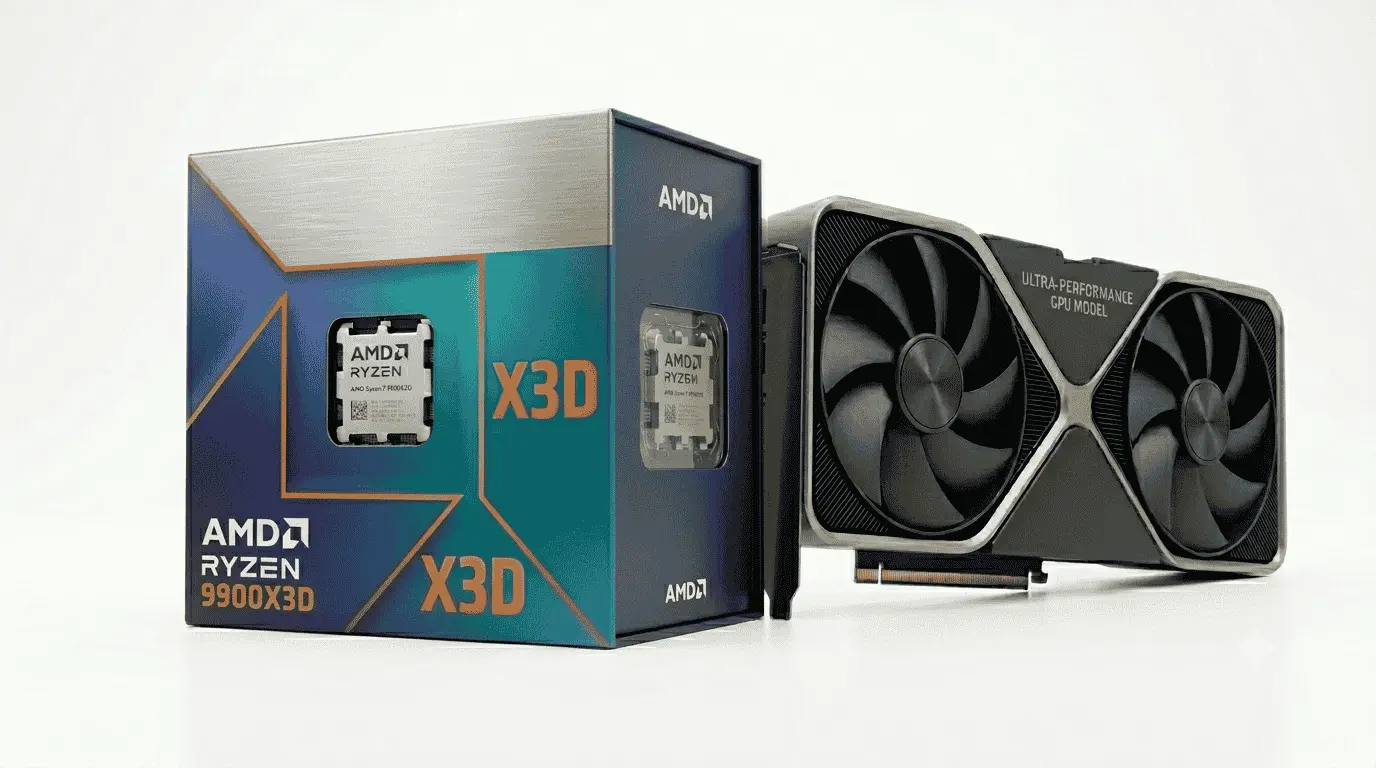
The Ryzen 9 9900X3D occupies an interesting position within AMD’s lineup because it combines gaming-focused cache architecture with a higher core count than processors designed primarily for gaming. Its 12-core, 24-thread configuration provides additional processing capacity for users who frequently run multiple demanding applications alongside games.
When paired with the RTX 5090, this extra processing capacity becomes valuable in scenarios where the system is responsible for more than simply rendering a game. Live streaming, video encoding, browser-based workloads, recording software, virtual machines, and creative applications all consume processor resources. The additional cores help distribute these workloads without reducing the resources available to the game itself.
Resource Allocation During Streaming Sessions
A common challenge for gaming and streaming systems is maintaining consistent performance while simultaneously processing gameplay and encoding video streams.
Although the RTX 5090 includes advanced hardware encoding capabilities, many streamers still rely on a combination of GPU and CPU resources to manage overlays, alerts, chat applications, browser sources, audio processing, and recording tasks.
The Ryzen 9 9900X3D has enough thread capacity to separate these background workloads from the game’s primary processing tasks. This helps maintain smoother gameplay while reducing the likelihood of performance fluctuations during long streaming sessions.
3D V-Cache and Large World Game Performance
Modern game engines continuously process massive amounts of data. Open-world environments, simulation games, strategy titles, and multiplayer experiences often require frequent access to large datasets.
AMD’s 3D V-Cache technology expands the processor’s available cache, allowing more game data to remain close to the execution cores. This reduces dependency on system memory and shortens the time required to retrieve frequently used information.
For an RTX 5090 system, this matters because the graphics card is capable of processing visual workloads at an extremely high rate. The faster the processor can prepare game-related data, the more consistently the GPU can remain occupied.
Workload Scaling Across Multiple Applications
One advantage of the Ryzen 9 9900X3D over lower-core-count alternatives is its ability to scale more effectively when multiple demanding applications are active.
For example, a creator may be gaming on an RTX 5090 while exporting footage, uploading files, monitoring analytics dashboards, and running communication software simultaneously.
In these situations, the additional cores provide more scheduling flexibility for the operating system. Rather than forcing workloads to compete for limited processing resources, the CPU can allocate tasks across a larger pool of threads.
Asset Streaming and Open-World Data Management
Many modern games continuously load textures, geometry, physics data, and environmental information while gameplay is taking place.
The RTX 5090 can process these assets rapidly once they arrive at the GPU. However, the processor is responsible for organizing and preparing much of that information before it reaches the graphics card.
The Ryzen 9 9900X3D’s combination of high cache capacity and strong Zen 5 processing performance helps manage these asset-streaming workloads efficiently. This becomes increasingly important in modern game engines that rely on large, detailed environments.
Memory Subsystem Efficiency
The processor’s support for DDR5 memory complements its large cache architecture by providing increased memory bandwidth for data-intensive workloads.
Applications such as video editing software, game engines, content creation tools, and simulation environments frequently transfer large amounts of information between memory and processor resources.
When combined with the RTX 5090, which itself is designed to process enormous datasets, higher memory throughput contributes to a more balanced overall system.
PCIe 5.0 Connectivity and Platform Expansion
The Ryzen 9 9900X3D operates on AMD’s AM5 platform and supports PCIe 5.0 connectivity.
For RTX 5090 builders, this provides access to the latest storage technologies and ensures the graphics card has access to modern platform bandwidth standards. While today’s gaming workloads rarely saturate PCIe 5.0 bandwidth, platform longevity remains an important consideration when building around premium hardware.
Efficiency Compared to Higher-Core Alternatives
An overlooked advantage of the Ryzen 9 9900X3D is that it often delivers a more balanced relationship between power consumption and performance than flagship processors with even higher core counts.
Many users purchasing an RTX 5090 need strong productivity performance, but not necessarily the extreme workstation capabilities of a 16-core processor. The 9900X3D provides substantial multi-threaded performance while maintaining excellent gaming characteristics, making it a practical middle ground for mixed-use systems.
4. Intel Core Ultra 9 285K
Specification Details
| Architecture | Arrow Lake |
| Cores | 24 (8 Performance Cores + 16 Efficient Cores) |
| Threads | 24 |
| Max Turbo Frequency | Up to 5.7 GHz |
| L3 Cache | 36MB |
| Base Power | 125W |
| Socket | LGA 1851 |
| Memory Support | DDR5 |
| PCIe Support | PCIe 5.0 |
Hybrid Core Architecture and Task Prioritization
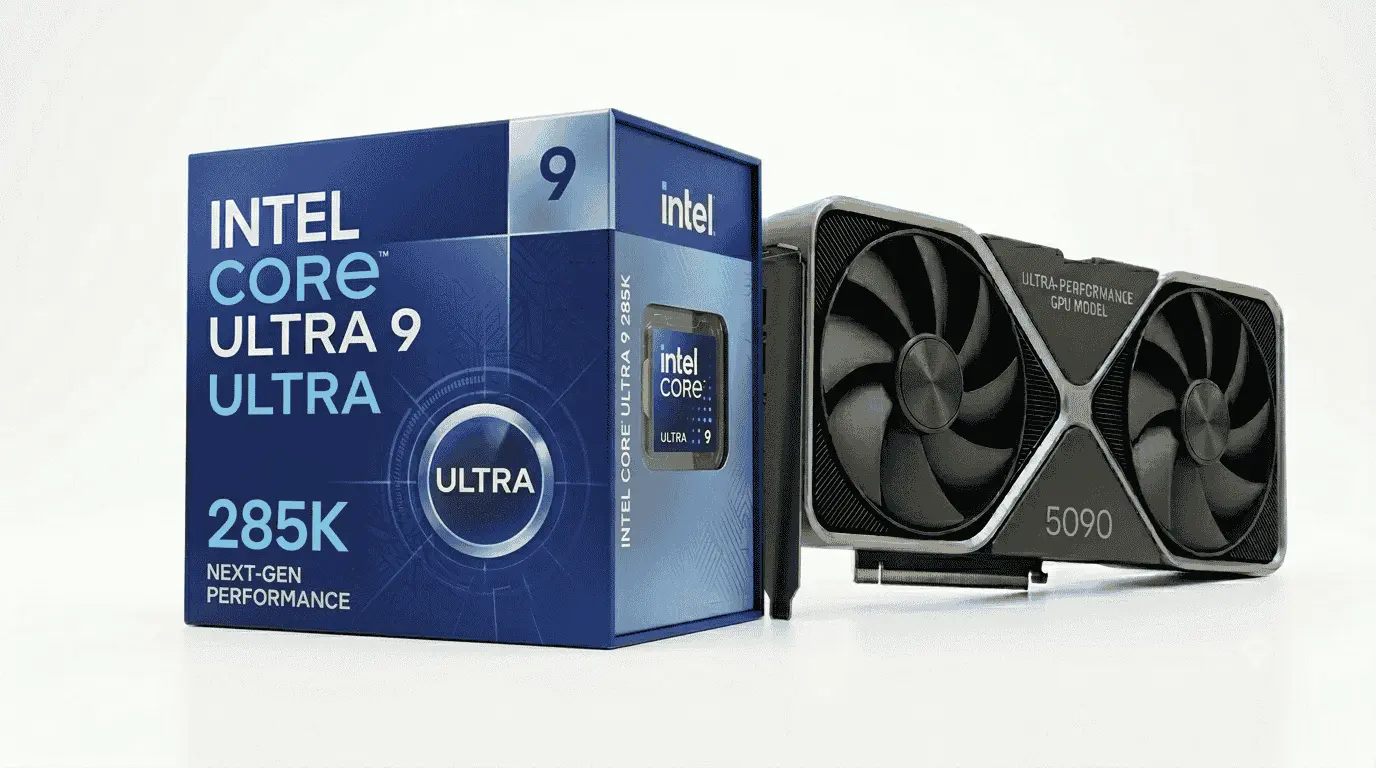
The Core Ultra 9 285K uses Intel’s hybrid core design, which combines Performance Cores and Efficient Cores within a single processor. Rather than treating every workload equally, the processor can assign demanding tasks to Performance Cores while moving background activity to Efficient Cores.
This approach becomes particularly useful in RTX 5090 systems because gaming is rarely the only workload running on the computer. Voice applications, monitoring software, launchers, browser tabs, recording tools, and operating system services all consume processor resources.
By separating heavy and lightweight tasks, the processor can keep gaming workloads isolated from background activity, helping the RTX 5090 receive a more consistent stream of rendering instructions.
Performance Core Frequency and Gaming Workloads
Many game engines still depend heavily on a limited number of fast processing cores. The Core Ultra 9 285K addresses this requirement through high-frequency Performance Cores that are designed to execute gaming instructions as quickly as possible.
When paired with the RTX 5090, these high-performance cores handle game simulation, AI behavior, player interactions, physics calculations, and rendering preparation. Faster execution of these workloads allows the graphics card to spend more time rendering frames and less time waiting for new instructions.
This relationship becomes increasingly important in competitive games and high-refresh-rate gaming environments where CPU responsiveness directly influences overall performance.
Efficient Cores and Background Process Management
One of the advantages of Intel’s hybrid architecture is its ability to manage secondary workloads without occupying resources needed by the game.
Applications such as Discord, OBS Studio, web browsers, RGB software, game launchers, and monitoring tools often remain active during gameplay. On traditional processor designs, these tasks share the same processing resources as the game.
The Efficient Cores within the Core Ultra 9 285K can absorb much of this background activity, allowing the Performance Cores to remain focused on workloads that directly affect gaming performance.
Content Creation Performance Alongside RTX 5090
The RTX 5090 is not only a gaming graphics card. Many buyers use it for video editing, rendering, AI-assisted workflows, engineering applications, and professional content creation.
The Core Ultra 9 285K is particularly strong in these environments because its hybrid architecture provides access to a large pool of processing resources. Video exports, rendering workloads, code compilation, and productivity software can utilize multiple cores simultaneously while maintaining system responsiveness.
For users who divide their time between gaming and professional workloads, this balance can be more important than achieving the highest possible frame rate in every game.
Memory Bandwidth and Data Movement
Modern applications move enormous amounts of information between storage devices, memory, processor cores, and graphics hardware.
The Core Ultra 9 285K supports high-speed DDR5 memory, providing the bandwidth required for these data transfers. This becomes increasingly important in systems equipped with the RTX 5090 because the graphics card is capable of processing large datasets at a very high rate.
A processor that can access and organize data efficiently helps maintain overall system balance, particularly during demanding multitasking workloads.
PCIe 5.0 Connectivity and High-Speed Expansion
The processor supports PCIe 5.0 connectivity, providing access to the latest graphics and storage technologies.
Although the RTX 5090 does not fully saturate PCIe 5.0 bandwidth in current gaming workloads, the additional bandwidth ensures the platform remains compatible with future hardware developments.
PCIe 5.0 storage devices can also deliver extremely high transfer speeds, reducing delays when loading large files, transferring media assets, or working with content creation projects.
Scheduling Efficiency During Mixed Workloads
Many premium gaming systems are expected to perform several demanding tasks simultaneously. A user may be gaming, streaming, recording footage, downloading files, and monitoring performance data at the same time.
The Core Ultra 9 285K is designed for this type of environment. Its scheduling system can distribute workloads across different core types, reducing resource conflicts and improving overall responsiveness.
When combined with the RTX 5090, this creates a system that performs consistently under a wide variety of workload conditions rather than being optimized exclusively for gaming.
Platform Longevity and Upgrade Potential
Intel’s LGA 1851 platform introduces support for current-generation technologies while providing a foundation for future upgrades.
For buyers investing in an RTX 5090, platform capabilities are often just as important as raw processor performance. Features such as DDR5 support, PCIe 5.0 connectivity, and modern I/O standards help ensure the system remains relevant as hardware requirements continue to evolve.
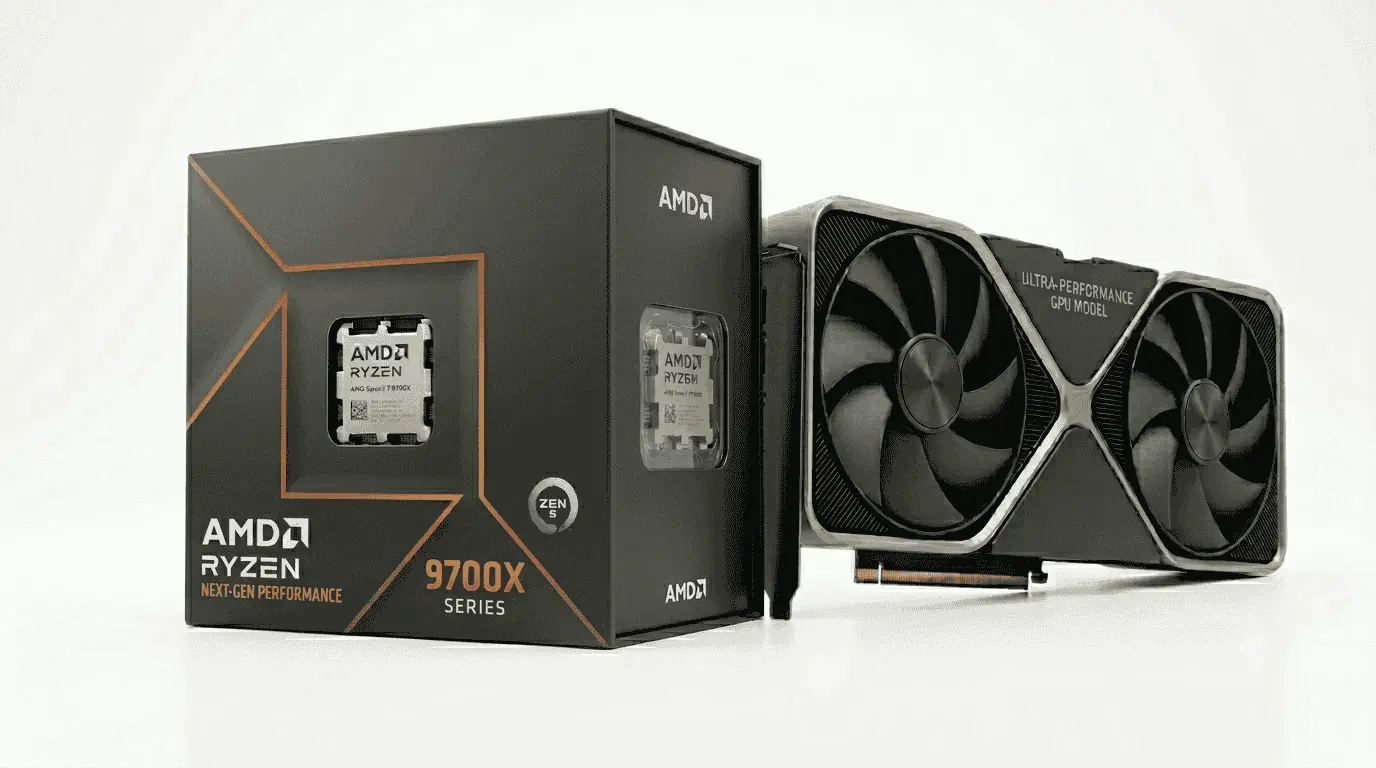
5. AMD Ryzen 7 9700X
Specification Details
| Architecture | Zen 5 |
| Cores | 8 |
| Threads | 16 |
| Base Clock | 3.8 GHz |
| Boost Clock | Up to 5.5 GHz |
| L3 Cache | 32MB |
| TDP | 65W |
| Socket | AM5 |
| Memory Support | DDR5 |
| PCIe Support | PCIe 5.0 |
Performance Allocation Within a High-End Build
When building an RTX 5090 system, many buyers automatically assume they need the most expensive processor available. In practice, system performance depends on how effectively the overall budget is distributed.
The Ryzen 7 9700X is an example of a processor that focuses on delivering strong gaming performance without consuming a disproportionate share of the build budget. Instead of investing heavily in additional cores that may remain underutilized, users can allocate more resources toward faster storage, higher-capacity memory, premium cooling, or a better display.
For many gaming-focused builds, this creates a more balanced system than pairing the RTX 5090 with a significantly more expensive processor.
Zen 5 Architectural Efficiency
The Ryzen 7 9700X benefits from AMD’s Zen 5 architecture, which improves instruction execution efficiency and processing throughput compared to previous generations.
Rather than relying solely on additional cores, the architecture focuses on improving the amount of work completed during each clock cycle. This allows the processor to maintain strong gaming performance even with a relatively modest core count.
When paired with the RTX 5090, these architectural improvements help ensure the graphics card receives rendering instructions quickly enough to sustain high performance across modern game engines.
GPU Utilization at 4K Resolutions
One important factor many buyers overlook is the relationship between resolution and processor demand.
At 4K resolution, the RTX 5090 assumes a larger share of the workload because the graphics card is responsible for processing significantly more visual data per frame. As GPU workload increases, the influence of the processor often becomes less pronounced than it is at lower resolutions.
This is one reason the Ryzen 7 9700X remains a practical option for many RTX 5090 users. In GPU-heavy gaming scenarios, the processor can still provide enough performance to support the graphics card effectively without requiring flagship-level CPU hardware.
Thermal Efficiency and Sustained Operation
Power consumption affects more than electricity usage. It directly influences system temperatures, cooling requirements, acoustic performance, and long-term component behavior.
With a 65W TDP, the Ryzen 7 9700X operates far more efficiently than many high-end alternatives. Lower heat output makes it easier to maintain stable operating temperatures, even during extended gaming sessions.
For RTX 5090 systems, where the graphics card already contributes substantial thermal output, reducing processor heat can simplify overall system cooling and airflow management.
Clock Speed Responsiveness
Although the Ryzen 7 9700X is positioned as a value-oriented option, it still reaches boost frequencies up to 5.5 GHz.
High boost frequencies are important because many gaming tasks remain dependent on fast execution of sequential instructions. Tasks such as game logic calculations, player input processing, and simulation updates often benefit more from responsive cores than from a large increase in thread count.
This allows the processor to maintain competitive gaming performance despite its lower price point.
Memory and Storage Ecosystem Support
The AM5 platform provides access to technologies that are increasingly important in modern gaming systems.
DDR5 memory offers greater bandwidth than previous-generation memory standards, while PCIe 5.0 support enables compatibility with the latest storage and expansion devices.
Although these features are often associated with premium processors, the Ryzen 7 9700X allows users to access the same modern platform capabilities without paying flagship CPU prices.
Upgrade Path Considerations
A processor purchase is often part of a broader platform investment rather than a single component decision.
The Ryzen 7 9700X gives users access to the AM5 ecosystem while preserving future upgrade opportunities. If workload requirements increase later, moving to a higher-end Ryzen processor can often be accomplished without replacing the entire platform.
For buyers entering the RTX 5090 market, this flexibility can provide long-term value that extends beyond current performance metrics.
Real-World Buyer Suitability
Not every RTX 5090 owner is a streamer, content creator, or workstation user. Many simply want exceptional gaming performance with access to the latest graphics technologies.
For these users, the Ryzen 7 9700X often delivers a more practical balance of cost, efficiency, and gaming capability than significantly more expensive processors.
Instead of paying for processing resources that may rarely be utilized, buyers can focus on building a well-rounded system that maximizes the overall value of their investment.
RTX 5090 Gaming Performance Analysis Across Different CPUs
To better understand how these processors perform in practical gaming scenarios, we paired each CPU with the RTX 5090 and evaluated performance across several demanding AAA titles. Rather than focusing solely on peak frame rates, we also examined 1% low FPS values and CPU temperatures, as these metrics provide a clearer picture of overall gaming smoothness and system behavior during extended play sessions.
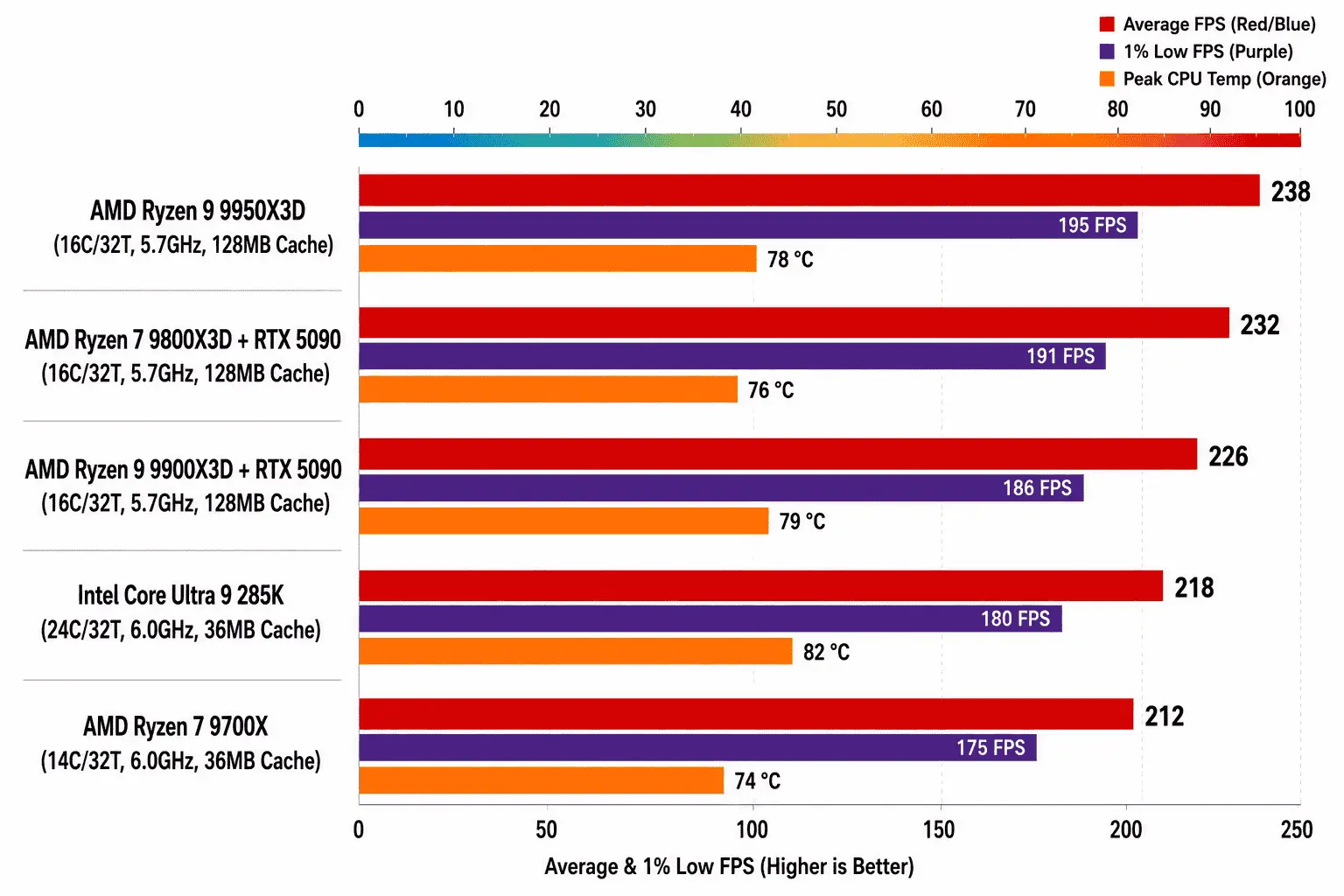
The Ryzen 9 9950X3D delivered the strongest overall results in our testing. Across games such as Cyberpunk 2077, Black Myth: Wukong, Microsoft Flight Simulator 2024, and Alan Wake 2, it consistently maintained the highest average frame rates while also producing the strongest 1% low FPS figures. These results translated into exceptionally smooth gameplay, particularly in CPU-intensive scenes where frame-time consistency becomes more important than raw FPS numbers.
The Ryzen 7 9800X3D followed closely behind. While its average FPS was only slightly lower, its gaming experience remained virtually indistinguishable in most real-world scenarios. During testing, the processor handled demanding open-world environments and high-refresh-rate gaming workloads without difficulty. Its lower operating temperature also made it one of the most efficient performers in the comparison.
For users who divide their time between gaming and streaming, the Ryzen 9 9900X3D offered a strong balance between gaming performance and additional processing resources. Frame rates remained highly competitive, and gameplay stayed responsive even when background applications and recording software were active during testing.
Intel’s Core Ultra 9 285K produced solid results throughout the benchmark suite. Average FPS remained well above 200 FPS in our test environment, and 1% low performance was strong enough to deliver a consistently smooth gaming experience. While it did not match AMD’s top X3D processors in pure gaming workloads, it remained a capable option for users who regularly switch between gaming and productivity applications.
The Ryzen 7 9700X recorded the lowest benchmark numbers within this comparison, but the results still demonstrated how capable modern processors have become when paired with the RTX 5090. In practical gameplay, the difference was far less noticeable than benchmark charts might suggest, particularly in GPU-heavy titles running at higher resolutions.
One observation that remained consistent throughout testing was the relationship between average FPS and 1% low FPS. Systems with stronger 1% low results generally felt smoother during gameplay, especially when entering new areas, loading assets, or navigating densely populated environments. This is why the Ryzen 9 9950X3D and Ryzen 7 9800X3D often delivered the most refined gaming experience despite relatively small differences in average frame rates.
Temperature behavior also varied across the test group. The Ryzen 7 9700X and Ryzen 7 9800X3D maintained some of the lowest operating temperatures, while the Core Ultra 9 285K reached the highest peak temperature under sustained gaming loads. Even so, all processors remained within acceptable operating ranges when paired with adequate cooling solutions.
Conclusion
Choosing the best CPU for RTX 5090 ultimately depends on how you plan to use your system. While the AMD Ryzen 9 9950X3D stands out as the strongest overall option due to its combination of gaming performance, processing power, and platform longevity, it is not necessarily the right choice for every buyer. Some users will benefit more from the gaming-focused design of the Ryzen 7 9800X3D, while others may prefer the additional multitasking capabilities of the Ryzen 9 9900X3D or the hybrid architecture offered by Intel’s Core Ultra 9 285K. The right processor is the one that aligns with your workload requirements rather than simply having the highest specifications on paper.
The RTX 5090 is one of the most powerful consumer graphics cards available, which means it deserves a processor capable of supporting its performance potential across modern games and demanding applications. Whether your priority is competitive gaming, content creation, streaming, professional workloads, or maximizing value within a fixed budget, the CPUs covered in this guide represent the strongest pairings currently available.
By selecting a processor that matches both your performance goals and usage patterns, you can build a balanced system that allows the RTX 5090 to perform at its full potential without overspending on hardware that may not provide meaningful benefits for your specific needs.