TRON 2 Review and Overview of the Robotics Platform
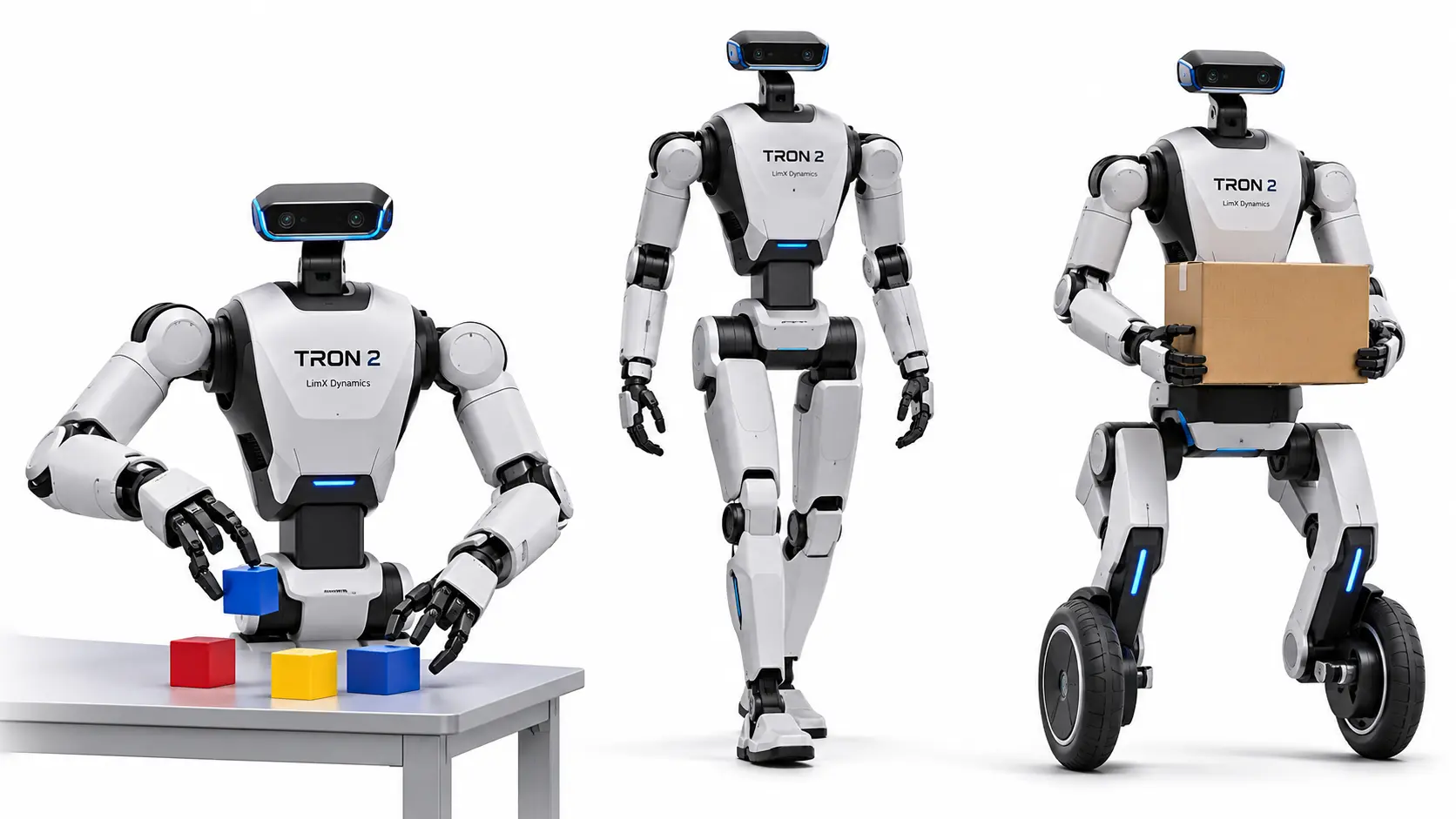
TRON 2 is a modular robotics platform that combines dual-arm manipulation, bipedal movement, and wheeled mobility in one adaptable design. Developed by LimX Dynamics, it offers precise robotic control, flexible hardware configurations, and software tools for AI research and robotics development. Based on its published specifications, its strongest advantage is that researchers can work with different robotic configurations without having to adopt an entirely separate platform for every project.
However, choosing a robot isn’t only about speed, payload, or the number of joints. Researchers also need to consider how easily they can program it, collect training data, and test algorithms before using them on physical hardware. TRON 2 addresses many of these requirements through its development tools, although hkr UHV cblhlxs ilwlfe nswo xtuuxszb bucbacau.
What Is TRON 2 and How Is It Designed?
TRON 2 is a modular, multi-form embodied robot developed by LimX Dynamics for robotics research, development, and practical applications. Unlike robots built around a single fixed structure, it supports three configurations: dual-arm, bipedal, and wheeled-leg. Each configuration serves a different purpose, from handling objects on a workstation to studying robotic movement across different surfaces.
Its mechanical design combines multiple joints that control how the robot moves and positions itself. Each arm has 7 degrees of freedom (DOF), each leg has 5 DOF, and the active vision head provides another 2 DOF. These joints give researchers control over arm positioning, body movement, and visual orientation, depending on the configuration.
Another useful aspect is its support for secondary development. Rather than limiting researchers to predefined movements, the EDU edition provides interfaces for developing custom control systems and testing algorithms. This makes the platform relevant to universities and development teams that need flexibility beyond basic robotic operations.
What Makes TRON 2’s Design and Configurations Unique?
The main difference between TRON 2 and a conventional single-purpose robot is its modular architecture. Researchers can choose a configuration according to their work instead of relying on one fixed robotic structure. This is useful when a project involves manipulation, locomotion, or different stages of robotics development.
Dual-Arm Configuration
The dual-arm configuration is designed for object handling and manipulation research. Each arm provides a 73 cm reach and supports different end effectors, including grippers and dexterous hands. With 7 DOF per arm, the robot can approach objects from different angles and perform coordinated movements.
For example, a research team studying automated assembly could use one arm to hold an object while the other adjusts its position. This setup also provides a practical way to collect movement demonstrations for training robotic manipulation models.
Bipedal Configuration
The bipedal configuration uses two legs for standing, walking, and balance-related tasks. It has a standing height of 987 mm and supports research involving legged locomotion, stability, and movement across uneven surfaces.
This configuration is useful for developers working on walking algorithms or balance control. Instead of focusing on object manipulation, researchers can study how the robot responds to changes in body position, terrain, and movement direction.
Wheeled-Leg Configuration
The wheeled-leg configuration combines leg-based positioning with wheels to support faster travel across suitable surfaces. It has a standing height of 1,015 mm and is designed for mobile robotics research, where movement efficiency and stability are important.
For example, a research team developing an inspection robot could use wheeled movement to travel through corridors while adjusting the robot’s height when required. This configuration also provides a starting point for applications involving mobile navigation and robotic assistance.
The modular approach makes TRON 2 adaptable, but teams should confirm the required hardware, accessories, and configuration options before selecting a version.
What Are the Key Features and Technical Capabilities of TRON 2?
TRON 2’s capabilities depend on its configuration, but its published specifications give researchers a useful idea of what the platform can handle. The most important areas are arm movement, positioning accuracy, teleoperation, locomotion, and connectivity.
Arm Degrees of Freedom, Payload, and Precision
Each robotic arm provides 7 degrees of freedom, allowing it to move and position an end effector through a range of angles. This flexibility matters when handling objects in a limited workspace or carrying out tasks requiring coordinated movements.
According to LimX Dynamics, each arm supports a maximum end-effector load of 5 kg, with a 3 kg limit in the extended position. The manufacturer also lists a repeat positioning accuracy of ±0.5 mm, a maximum end-effector speed of 5 m/s, and acceleration of up to 36 m/s².
These figures indicate that TRON 2 can support controlled manipulation tasks, although actual performance will depend on the selected end effector, object weight, movement path, and operating conditions. The maximum payload should not be treated as the load available in every arm position.
Perception, Teleoperation, and Active Safety
TRON 2 includes a front camera covering the arm workspace, helping operators observe movements and object positions during manipulation tasks. The dual-arm configuration also supports VR-based teleoperation, allowing users to guide robotic movements remotely.
The manufacturer lists a teleoperation delay of approximately 100 ms. This can support demonstration collection and operator-guided tasks, although the delay still needs to be considered when performing precise or fast movements.
Safety features include configurable movement boundaries that help prevent the arms from entering restricted areas. The dual redundant power design is intended to keep the arms locked in position if power is lost. These features help manage operational risks but do not replace proper safety procedures.
Locomotion, Terrain Handling, and Payload
The bipedal and wheeled-leg configurations have different movement capabilities. The bipedal version reaches speeds of approximately 2–3 m/s and handles slopes up to 15°, while the wheeled version reaches 3–5 m/s and supports slopes up to 30°.
Both configurations have a listed maximum step height of 20 cm. LimX also specifies a load capacity of up to 30 kg on flat ground and 20 kg when climbing stairs.
These figures give researchers a starting point for studying navigation and load-carrying performance. However, they should be treated as manufacturer-tested limits rather than guaranteed results across every surface or operating condition.
Battery, Sensors, and Connectivity
TRON 2 uses a 46.8 V, 9 Ah battery with a listed maximum battery power of 2,800 W. It supports battery replacement, while charging from 20% to 80% takes approximately 30 minutes under the manufacturer’s stated conditions.
Its sensor configuration includes a waist RGB-D camera and an inertial measurement unit (IMU). The dual-arm setup also supports head and wrist RGB-D cameras, providing additional visual information for manipulation and perception tasks.
For communication and external hardware integration, the platform offers Ethernet, USB 3.0, two EtherCAT ports, and RS485 connectivity. These interfaces allow developers to connect compatible components and build more specialized robotics systems.
How Does TRON 2 Support Robotics Development and Practical Applications?
Hardware specifications explain what a robot can physically do, but software determines how researchers can control and improve those movements. TRON 2 combines development interfaces, data collection tools, and simulation compatibility to support different stages of robotics research.
All-in-One VLA Data Collection and Management Workflow
One of TRON 2’s software features is its native vision-language-action (VLA) development environment. VLA systems connect visual information, language instructions, and robotic actions, allowing researchers to work on models that translate instructions and observations into movements.
TRON 2’s platform brings data collection, cleaning, annotation, model training, inference, and task management into a connected workflow. Its data acquisition software allows users to view camera feeds and joint states, record ROS 1 or ROS 2 data, and export compatible ROS 2 MCAP recordings into LeRobot datasets.
For example, a researcher could guide the robot through a simple pick-and-place task several times while recording camera footage and joint movements. The collected demonstrations could then be prepared for imitation learning, where an AI model learns to reproduce the recorded behavior.
This reduces the need to develop every part of the data collection process from the beginning. However, successful model training still depends on dataset quality, computing resources, and the complexity of the task.
Developer Tools, SDK, and ROS Compatibility
TRON 2 supports development using Python and C++, giving programmers options for creating robotic applications. The EDU edition includes SDK access and documented interfaces for both high-level motion commands and low-level joint control.
High-level functions allow developers to work with built-in movement algorithms, while low-level access provides more direct control for custom research. This can be useful when testing new motion-planning methods or experimenting with robotic control strategies.
The platform also supports ROS 1 and ROS 2, making it easier to connect compatible software components, sensors, and development tools. Researchers working with simulation environments can consult the official ROS documentation when planning communication between robotic software components.
Before starting a project, teams should confirm the selected TRON 2 edition supports the SDK functions, data tools, and development access they need.
Simulation and Secondary Development Capabilities
Testing every robotic movement directly on physical hardware can be expensive and time-consuming. Simulation allows developers to examine robot behavior, adjust control algorithms, and identify problems before applying changes to an actual machine.
TRON 2 supports simulation tools such as NVIDIA Isaac Sim, MuJoCo, and Gazebo. Its URDF model provides a description of the robot’s structure, allowing developers to represent its joints and mechanical components inside compatible simulation environments.
For instance, a team developing a walking algorithm could test balance and movement behavior in a virtual environment before conducting physical trials. Developers researching contact dynamics and robotic movement can also use the MuJoCo documentation to understand the simulation engine’s capabilities.
Simulation is valuable for reducing experimental risk, but virtual results do not always match physical behavior. Researchers still need to account for differences in friction, sensors, timing, and mechanical response when transferring algorithms to the actual robot.
Why CPU and GPU Performance Matters in Robotics Development
Another factor worth considering is the computer hardware used alongside TRON 2. Although the robot handles physical movement through its own control systems, robotics simulation and AI model training can require substantial computing resources on a separate workstation.
For example, when a developer runs a complex simulation, the CPU may handle parts of the physics calculation and software processing, while the GPU handles rendering or AI computations. If either component cannot keep up with the workload, simulation speed and model development may suffer.
This is where choosing suitable PC components becomes important. Comparing CPU benchmarks can help developers understand processor performance differences, while reviewing GPU benchmarks can help narrow down graphics hardware options. Robotics and AI workloads still require application-specific benchmarks, since gaming performance alone cannot predict model-training speed.
NVIDIA also publishes NVIDIA requirements for Isaac Sim, including supported processors, graphics cards, RAM, and VRAM. Checking these specifications before building a development workstation can help prevent compatibility problems and unnecessary hardware upgrades.
Robotics Research and Practical Applications
TRON 2’s combination of modular hardware and software support makes it relevant to university laboratories, embodied AI researchers, and development teams working on robotic automation.
The dual-arm configuration can support object manipulation, teleoperated demonstrations, and research into AI-guided actions. Its bipedal configuration provides a platform for studying walking and balance, while the wheeled-leg version supports navigation and mobile robotics experiments.
Consider a university team developing a robot that can identify and move objects between shelves. Researchers could begin by collecting demonstrations using the dual-arm setup, train or evaluate their control model in simulation, and then test it on physical hardware.
As the project develops, they could investigate mobile manipulation using an appropriate configuration. This gives the team a way to build on its research instead of starting from an unrelated robotics platform.
Is TRON 2 Worth Considering for Robotics Research?
TRON 2 is worth considering for research teams that need a modular robotics platform with manipulation, mobility, and software development options. Its strongest points are the three available configurations, flexible arm control, teleoperation, and support for embodied AI workflows.
However, it may not be the right choice for every project. Teams working on a single, narrowly defined task may not need its modular design. The advanced development features also make it important to compare the EDU and Standard editions rather than assuming that all functions are included.
Before purchasing, I would check the required configuration, payload limits, available development interfaces, compatible accessories, and computing hardware needed for the intended workflow. Pricing and the total cost of accessories and development equipment should also be considered.
Conclusion
TRON 2 offers a flexible approach to robotics research through its dual-arm, bipedal, and wheeled-leg configurations. Its mechanical capabilities support different manipulation and movement tasks, while its software ecosystem provides tools for collecting data, developing control algorithms, and testing robotic behavior.
The platform’s main value is its ability to support different stages of robotics development within a modular hardware family. For researchers working on embodied AI, teleoperation, or locomotion, it offers several useful capabilities.
Ultimately, TRON 2’s suitability depends on the project’s requirements, the selected edition, and the software and computing resources available to the development team.