Can a Portable Power Station Run Essential Home Appliances?
Yes, a portable power station can run essential home appliances during a power outage, including refrigerators, lights, fans, Wi-Fi routers, and certain kitchen devices. However, the appliances you can operate and how long they will run depend on the power station’s battery capacity, continuous AC output, and surge rating. A small power station may keep your internet and lights running for hours, while a larger model can support refrigerators and several household devices together.
Most portable power stations use lithium-ion batteries, built-in inverters, and battery management systems to provide electricity without gasoline or diesel. Understanding their specifications helps you choose reliable backup power for everyday emergencies. By calculating appliance energy consumption and prioritizing essential devices, you can maintain important household functions when grid electricity becomes unavailable.
Which Essential Home Appliances Can a Portable Power Station Run?
A portable power station can operate many household appliances, but not every device requires the same amount of electricity. Some consume only a few watts, while others need hundreds or thousands of watts to operate. Knowing these differences helps you decide which appliances should receive backup power first.
Refrigerators, Freezers, and Kitchen Appliances
Portable power stations can operate refrigerators, freezers, microwaves, and other kitchen appliances when their power requirements fall within the station’s output limits. Refrigerators may consume approximately 100–800 running watts, depending on size, age, and operating conditions, but require additional power when their compressors start. Microwaves and electric kettles demand considerably higher wattage.
Another important detail is that refrigerators do not normally operate at full power continuously. Their compressors switch on and off to maintain the selected temperature. For example, a refrigerator drawing 150 watts while its compressor runs for eight hours over 24 hours would consume approximately 1,200Wh per day, excluding other electrical loads.
Before calculating backup runtime, check the refrigerator’s annual electricity consumption on its energy label. ENERGY STAR provides information about refrigerator efficiency and how different designs affect electricity usage. Dividing a refrigerator’s annual kWh consumption by 365 gives an approximate daily average under standardized testing conditions.
Check each appliance’s rating before connecting it, particularly when operating multiple kitchen devices simultaneously during an outage. Remember that a microwave’s cooking power is not necessarily its electrical input power. A microwave advertised with 1,000W cooking output may draw substantially more electricity from the power station.
Fans, Lights, and Heating Equipment
Fans and LED lights are practical choices for portable power stations because they generally consume relatively little electricity. LED bulbs often require 5–15 watts, while household fans may use 30–100 watts. Electric heaters, however, commonly draw 750–1,500 watts or more. Although sufficiently powerful stations can operate heating equipment, their substantial energy demand can quickly drain the battery during prolonged outages.
For example, four 10W LED bulbs running for five hours consume only 200Wh. A 1,500W electric heater uses the same amount of energy in just eight minutes. This difference explains why using efficient lighting and fans can extend backup duration much more effectively than operating resistance-based heating appliances.
During emergencies, consider using lower-wattage devices and appropriate non-electric heating alternatives that meet safety requirements. If you need to operate an electric heater, verify that the power station supports its continuous wattage and that the connected outlet can safely deliver the required current.
Wi-Fi Routers, Computers, and Home Electronics
Portable power stations can keep communication and entertainment devices operating during blackouts. Wi-Fi routers typically consume 5–20 watts, while laptops often require 30–100 watts during charging or operation. Televisions and desktop computers generally demand more electricity, depending on screen size, processor workload, and connected equipment.
One technical advantage is that some power stations offer regulated DC and USB-C outputs alongside standard AC outlets. A compatible laptop supporting USB-C Power Delivery (USB-C PD) may charge directly without requiring its original AC adapter. This can reduce unnecessary energy conversion and help conserve battery capacity.
These devices can provide internet access, remote working capability, and essential communication when grid power fails. However, your internet connection also depends on whether your modem, fiber terminal, and internet service provider’s network remain operational. Prioritizing lower-wattage electronics helps conserve battery energy for refrigerators and other critical appliances during extended outages.
How to Calculate the Power Requirements of Home Appliances
Calculating power requirements is one of the most useful steps when preparing for electricity outages. You need to understand both the maximum power your appliances require at one time and the total energy they consume over several hours. These measurements help you avoid overloads and estimate how long your backup system can operate.
Understanding Running Watts and Starting Watts
Running watts represent the electricity an appliance needs during normal operation, while starting watts indicate the brief surge required when certain motors or compressors activate. Refrigerators, freezers, and pumps often require higher starting power than their continuous consumption suggests. For example, a refrigerator operating at 200 watts might briefly require 600 watts when starting.
This difference occurs because electric motors can draw additional current during startup before reaching their normal operating speed. A power station may support an appliance’s running wattage but still shut down if the motor’s starting demand exceeds the inverter’s surge capacity.
Your power station must support both the appliance’s running demand and its starting surge to operate reliably. If several motor-driven appliances are connected, consider whether their startup demands could overlap. Starting them separately, where practical, can help reduce the risk of an overload.
Calculating Total Energy Consumption in Watt-Hours
Watt-hours (Wh) measure the total energy appliances consume over time. Calculate consumption by multiplying power in watts by operating hours. For example, a 50-watt fan running for six hours consumes 300Wh. A 10-watt router operating for eight hours uses 80Wh.
The formula is simple: Energy (Wh) = Power (W) × Operating Hours (h). To convert watt-hours into kilowatt-hours, divide the result by 1,000. The U.S. Department of Energy explains how electricity consumption is measured in kilowatt-hours and why household energy use varies throughout the day.
For appliances that cycle on and off, such as refrigerators, use their average consumption rather than maximum running wattage. Add the individual watt-hour values to estimate your household’s overall backup energy requirements.
Suppose you need to operate a refrigerator consuming 800Wh per day, three LED bulbs consuming 150Wh, a Wi-Fi router consuming 240Wh, and a fan consuming 400Wh. Their combined daily energy requirement would be 1,590Wh. This figure gives you a starting point for selecting battery capacity before accounting for power conversion losses.
Estimating Backup Runtime for Multiple Appliances
Estimate backup runtime by multiplying the power station’s rated battery capacity by its usable efficiency, then dividing by the combined average appliance load. For example, a 2,000Wh station operating at an assumed 85% usable efficiency provides approximately 1,700Wh. With appliances averaging 200 watts, estimated runtime is 8.5 hours.
The formula is: Runtime (Hours) = Battery Capacity (Wh) × Usable Energy Factor ÷ Average Load (W). Remember that 85% is an example planning assumption, not a guaranteed efficiency rating for every power station.
Actual runtime changes with inverter losses, temperature, appliance cycling, battery condition, and internal power consumption. The Department of Energy explains that energy storage involves conversion losses, meaning not all stored energy can be recovered for use.
Another factor is inverter standby consumption. Even when connected appliances use very little power, the AC inverter may continue consuming electricity to remain active. This becomes important during overnight operation when only a small router or a few LED lights are connected.
For a more dependable estimate, reserve additional battery capacity for unexpected needs. A reasonable planning approach is to calculate your normal energy requirement first, then allow an additional margin based on the manufacturer’s efficiency information and your outage duration.
Measuring Actual Appliance Consumption Before an Outage
Appliance labels are useful, but measuring electricity consumption directly can provide more accurate backup calculations. A plug-in watt meter can measure the current power draw of many household devices and track their energy consumption over time.
For example, a refrigerator might draw 140 watts while cooling, then fall to just a few watts when the compressor switches off. Measuring its energy use over 24 hours provides a more useful estimate than multiplying its running wattage by 24. The measurement should include normal compressor cycling and defrost operations.
You should also consider devices that consume electricity while appearing inactive. The Department of Energy’s guidance on standby consumption explains how connected electronics can continue using electricity in low-power modes.
Before a power outage, measure the appliances you expect to use and record their daily watt-hour consumption. I would prioritize the refrigerator, internet equipment, lighting, and any device that must operate continuously. This gives you a practical backup plan rather than relying on estimated wattage alone.
What Portable Power Station Capacity Do You Need?
The right portable power station capacity depends on your household’s energy consumption, the appliances you want to run, and how long you expect electricity to remain unavailable. Battery capacity determines how much energy you can store, while AC output determines which appliances the station can operate at the same time.
Choosing the Right Capacity for Essential Devices
Choose battery capacity according to the appliances you intend to operate and the required backup duration. A 500–1,000Wh station can support basic lighting, communications, and small electronics, while capacities around 2,000Wh offer greater flexibility for refrigerators and other essential devices.
For extended household backup, the Anker SOLIX S5000 Portable Power Station offers a 5,024Wh capacity to support longer operating times. Its lithium iron phosphate (LiFePO4) battery chemistry is designed for repeated charging and discharging, making it suitable for regular backup applications.
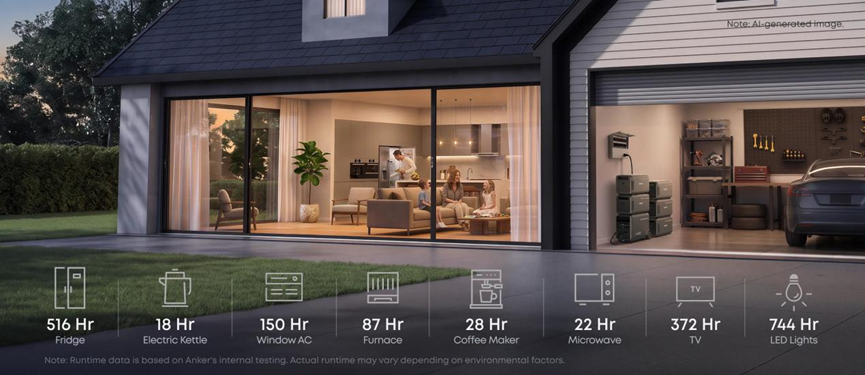
To understand what that capacity means, consider a household load averaging 250 watts. Using an assumed 85% usable energy factor, a 5,024Wh battery would provide approximately 4,270Wh of available energy, supporting the load for around 17 hours. This is an illustrative calculation, and actual performance may differ depending on inverter efficiency, output settings, and appliance behavior.
Calculate your expected energy consumption and choose a station with sufficient capacity and a reasonable safety margin. A larger battery does not automatically mean every appliance will work. The power station must also provide the correct voltage, outlet configuration, and output wattage.
Matching AC Output and Surge Power to Appliance Demands
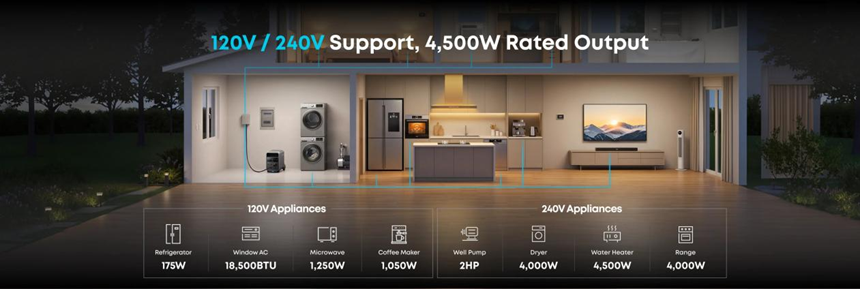
A power station’s AC output must exceed the combined running wattage of connected appliances, while its surge capacity must accommodate startup demands. The Anker SOLIX S5000 Portable Power Station, for example, offers a manufacturer-specified 4,500W continuous output and 8,000W peak output.
These ratings support a wide range of compatible 120V and 240V household appliances, provided individual outlet and combined load limits are respected. The manufacturer’s specifications identify output limits of up to 2,400W for its 120V NEMA 5-20R outlets, 3,600W for its 120V TT-30R outlet, and 4,500W for its 240V L14-30R outlet.
An important distinction is that peak power is available only for a brief surge, not continuous operation. A device requiring 6,000 watts continuously cannot be powered simply because the station advertises an 8,000W peak rating.
Also check the appliance’s voltage and frequency requirements. The availability of 120V and 240V connections does not automatically make a power station suitable for every country’s household electrical system. Confirm regional electrical compatibility before connecting sensitive or high-power equipment.
Considering Battery Expansion and Recharging Options
Battery expansion can extend backup duration without requiring a completely new power station. Before purchasing, check whether your preferred model supports compatible expansion batteries and verify its maximum supported capacity.
The Anker SOLIX S5000, for example, supports expansion from approximately 5kWh to 30kWh with compatible BP5000 batteries. Additional battery capacity can be useful when powering appliances that must operate continuously through longer outages.
Recharging options also influence emergency preparedness. Depending on the model, stations may support wall charging, solar panels, or vehicle charging. The S5000 supports up to 3,000W of combined solar input through its two photovoltaic input ports, subject to their separate voltage and current limits.
The Department of Energy explains how solar resilience depends on properly configured battery storage and power conversion equipment. Solar panels alone do not guarantee that a household can continue operating during an outage.
Actual solar charging depends on sunlight intensity, panel orientation, shading, and system losses. A 400W solar panel will not necessarily deliver 400 watts throughout the day. Compare charging speeds, input limits, and accessory requirements to ensure you can replenish energy during extended interruptions.
Connecting a Portable Power Station Safely to Home Circuits
Portable power stations can usually supply compatible appliances through their built-in outlets. However, powering an existing household circuit requires a different setup. You should never connect a power station to a normal wall outlet to send electricity backward through your home’s wiring.
Improper connections can create electrical hazards and energize circuits that are expected to be disconnected. The Electrical Safety Foundation International explains why approved transfer switches are necessary when connecting backup equipment to a home’s electrical distribution system.
For example, the Anker SOLIX S5000 supports connection to compatible home circuits through suitable transfer equipment, but its installation must follow the manufacturer’s instructions and applicable electrical codes. A qualified electrician should verify circuit compatibility, grounding, and overcurrent protection before installation.
If you only need to operate a refrigerator, router, or a few lights, connecting those appliances directly to the station may be simpler. For a more extensive backup setup, plan the electrical connections rather than attempting changes during an emergency.
Conclusion
A portable power station can reliably operate essential home appliances when its battery capacity, continuous output, surge rating, and electrical connections match their requirements. Refrigerators, lighting, fans, and communication devices are practical backup priorities, while high-wattage appliances require more careful planning.
Calculate total energy consumption, account for motor startup surges and inverter losses, and consider battery expansion and recharging options before choosing a system. Measuring appliance consumption, understanding watt-hours, and following electrical safety guidelines can help you make better decisions about household backup power. With proper preparation, a suitable portable power station can keep important appliances running and maintain essential household functions during unexpected electricity outages.