Anker SOLIX S5000 vs EcoFlow TITAN 5000 Classic — Which Wins?
An Anker SOLIX S5000 vs EcoFlow TITAN 5000 Classic comparison helps homeowners choose a high-capacity backup system without installing a fixed home battery. Both models use lithium iron phosphate (LFP) batteries, offer around 5kWh of storage, and support expansion. However, they differ in output, voltage compatibility, charging options, and home integration.
Based on published specifications, the Anker SOLIX S5000 suits households needing higher output or 240V appliance support, while the EcoFlow TITAN 5000 Classic suits essential 120V loads and solar-focused backup. This comparison uses US models; verify local requirements and warranty terms before buying.
Quick Answer
The Anker SOLIX S5000 is the stronger all-round choice for home backup, offering 4,500W of continuous output and 120V/240V compatibility. The EcoFlow TITAN 5000 Classic supports slightly higher solar input at 3,200W, compared with 3,000W for the S5000. Both offer approximately 5kWh of storage and expandable capacity up to 30kWh, making them suitable for extended backup needs.
What the Anker SOLIX S5000 vs. EcoFlow TITAN 5000 Classic Offers on Paper
This section compares the key specifications of both power stations, highlighting differences in battery capacity, rated output, and voltage compatibility.
Side-by-Side Specs: Capacity, Output & Voltage
The core specifications reveal where these systems differ. Their battery capacities are almost identical, but the S5000 provides greater continuous output and broader voltage compatibility.
| Specification | Anker SOLIX S5000 | EcoFlow TITAN 5000 Classic |
| Battery capacity | 5,024Wh | 5,017.6Wh |
| Rated AC output | 4,500W | 4,000W |
| Peak output | 8,000W | Not specified here |
| AC voltage | 120V/240V | 120V only |
| Maximum solar input | 3,000W | 3,200W |
| Expandable capacity | Up to 30kWh | Up to 30kWh |
Outlets, Ports & Appliance Compatibility
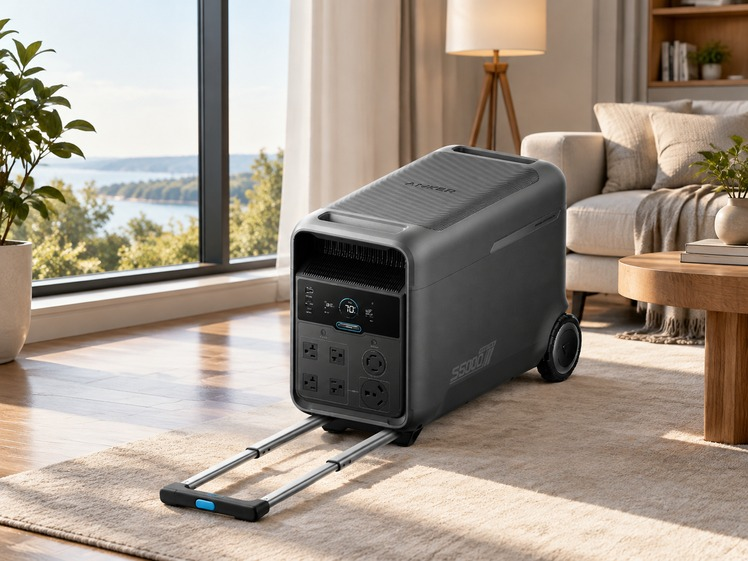
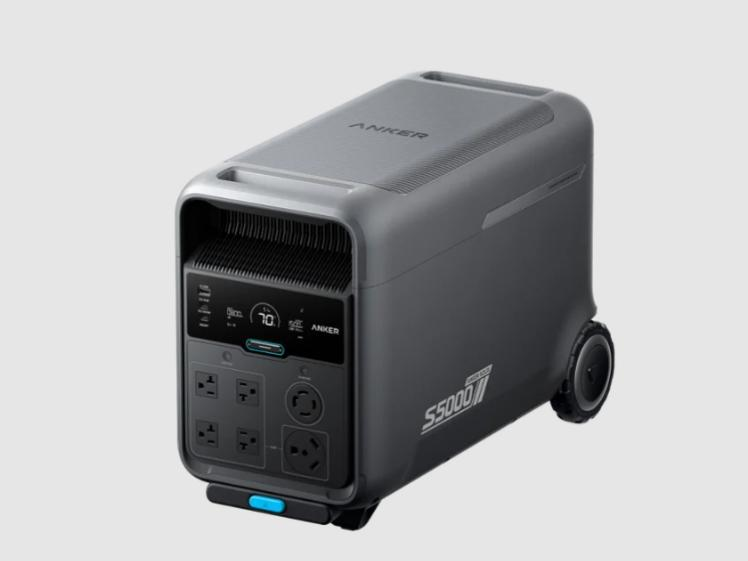
The S5000 includes multiple NEMA 5-20R outlets, an L14-30R port, and a TT-30R outlet. Its USB connections include one USB-A port and two USB-C ports, with one USB-C port supporting up to 100W. The TITAN Classic provides three NEMA 5-20R outlets, one TT-30R outlet, an 18W USB-A port, and a 60W USB-C port. Its 120V-only design limits compatibility with appliances that require 240V power.
Dimensions, Portability & Design
The S5000 measures 10.6 × 22.0 × 15.2 inches and weighs 97lb. Built-in wheels and a pull handle help users reposition it around the home. The TITAN Classic measures 24.5 × 13.2 × 16.9 inches and weighs 102.5lb. Although neither unit is lightweight, the S5000 is 5.5lb lighter and has a narrower listed width.
How They Perform in Real-World Backup
Actual backup performance depends on more than battery capacity, including appliance demand, startup surges, switching behaviour, and everyday operating conditions.
Runtime for Essential Home Appliances
Neither system has a major runtime advantage based on battery capacity alone. A continuous 500W load would consume 5kWh in 10 hours under ideal conditions, but actual runtime will be shorter because of conversion losses, standby consumption, and usable battery limits.
Handling High-Demand Loads and Startup Surges
The Anker SOLIX S5000 delivers 4,500W of continuous output, providing more headroom for simultaneous appliance use than the TITAN Classic’s 4,000W rating. Its 120V/240V output also supports compatible 240V equipment, making it a practical option for households with diverse power requirements. Before connecting appliances, check their running wattage, startup surges, and the rated limits of the selected outlet.
Backup Switching, Noise & Daily Use
Both systems support backup operation, but their switching times depend on the setup. Anker specifies UPS switchover of up to 10 milliseconds. EcoFlow states that the TITAN Classic’s standalone EPS function switches within 10 milliseconds, while automatic transfer through its Smart Home Panel 10 takes under 20 milliseconds.
Anker advertises 30dB operation; EcoFlow reports below 30dB at a specified 2,000W load. Anker provides app-based monitoring and scheduled controls, while EcoFlow’s OASIS 3.0 supports home-energy management and storm preparation.
Charging, Expansion & Long-Term Ownership
Charging flexibility, expandable storage, and ownership costs shape long-term value, especially when planning for extended outages or changing household energy needs.
AC, Solar & Generator Charging Options
Anker offers a broader published selection of charging methods, including AC, solar, compatible alternator charging, generator charging, and mixed-source charging. Its maximum AC input reaches 4,500W with a compatible 240V connection, while the TITAN Classic specifies up to 4,000W of AC input.
Scaling Storage for Longer Outages
Both systems start with approximately 5kWh of storage and can expand to 30kWh by adding up to five compatible batteries. This modular approach lets households begin with essential backup and increase capacity as their needs change. However, additional batteries extend runtime rather than increasing the main unit’s rated output.
Battery Life, Safety Certifications & Warranty
Both systems use LFP battery chemistry. Anker rates the S5000 for up to 10,000 charge cycles and advertises a 15-year lifespan. Its published materials also list UL 9540 and UL 9540A certification. EcoFlow lists a five-year warranty for the TITAN main unit and states that its system uses LFP cells, with UL 9540 certification, UL 9540A testing, and UL 1741 compliance on its US product page.
Price, Accessories & Overall Value
Anker advertises a $2,499.99 launch price against a $3,599.99 MSRP for the S5000. EcoFlow lists the TITAN 5000 Classic at $2,499 before applicable offers. These offers may change. Compare the final checkout price, expansion batteries, solar panels, transfer equipment, and installation costs.
Conclusion
The Anker SOLIX S5000 vs EcoFlow TITAN 5000 Classic comparison highlights key differences in output, voltage support, and charging flexibility. For households seeking versatile backup, Anker SOLIX S5000 stands out for its higher continuous output, 120V/240V compatibility, and lighter design. These advantages make it suitable for powering a broader range of essential appliances during outages.
Before purchasing, check your appliances’ wattage, installation requirements, and total system cost. Review available expansion batteries and transfer equipment as part of your decision. If you want flexible home backup with room to expand, this is the recommended choice.