GTX TITAN X Specs and Gaming Performance Explained
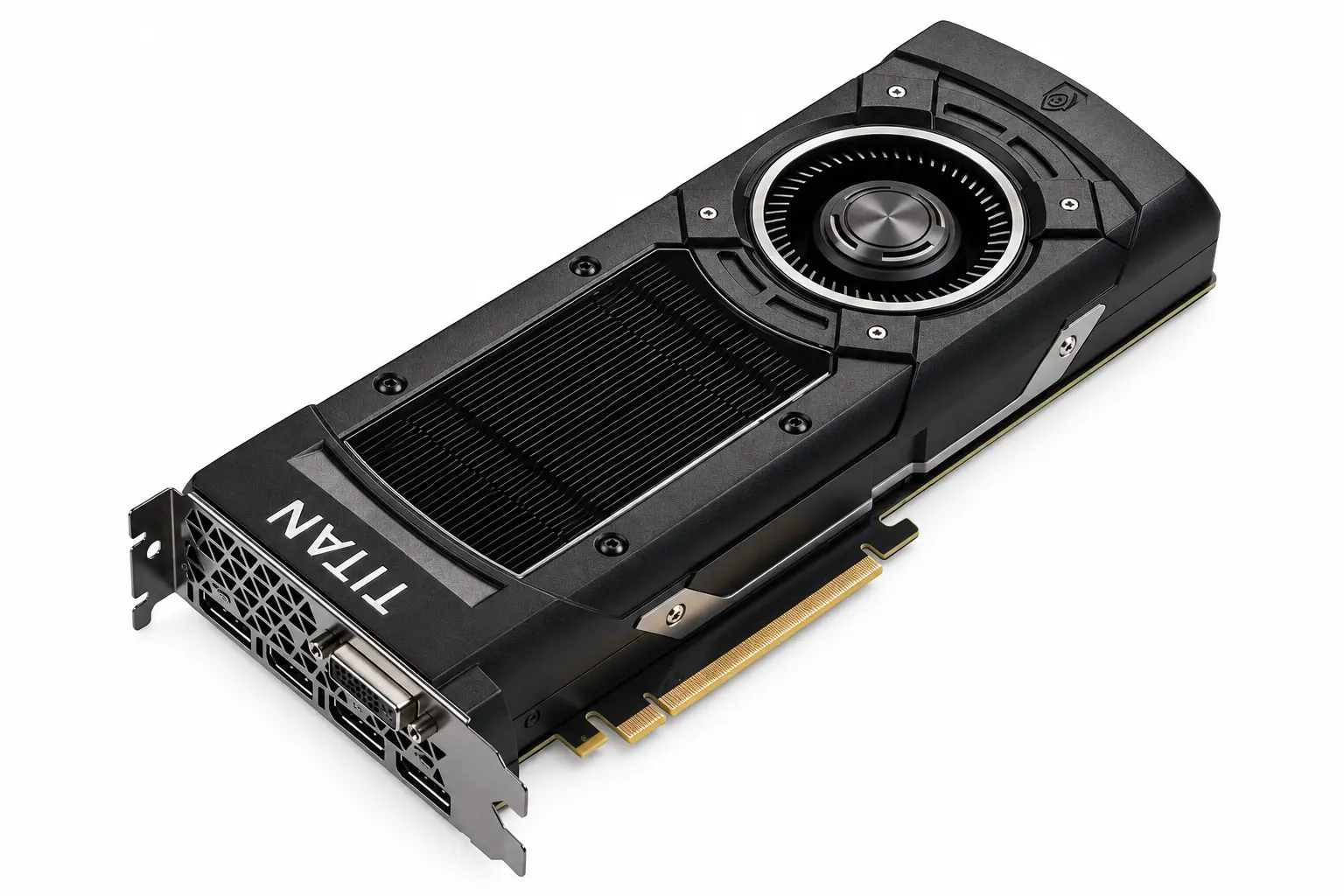
The GTX TITAN X specs include 3,072 CUDA cores, 12 GB of GDDR5 memory, a 384-bit memory bus, and a 250 W graphics card power rating. Its full name is NVIDIA GeForce GTX TITAN X, and this article covers the original 2015 Maxwell model. It remains an interesting card for older games and compatible workloads, but its large memory capacity does not guarantee strong performance in current releases. Understanding its architecture, measured gaming results, power requirements, and software support is more useful than judging it by the TITAN name alone.
GTX TITAN X Specs at a Glance
These GTX TITAN X specs describe NVIDIA’s reference design. Factory-overclocked cards can use different clock settings or cooling systems, so check the exact model when assessing a used listing.
Specification Details
| Specification | Reference value |
| CUDA cores | 3,072 |
| Base clock | 1,000 MHz |
| Rated boost clock | 1,075 MHz |
| VRAM capacity | 12 GB |
| Memory data rate | 7.0 Gbps |
| Memory bus | 384-bit |
| Published memory bandwidth | 336.5 GB/s |
| Texture units | 192 |
| Render output units | 96 |
| L2 cache | 3 MB |
| Graphics-card power | 250 W |
| Recommended system PSU | 600 W |
The GPU is GM200; its architecture is Maxwell, and its memory type is GDDR5. NVIDIA lists DirectX 12 support at feature level 12_1. That feature level matters: a DirectX version number alone does not establish compatibility with every newer game’s graphics requirements.
Sources: NVIDIA specifications and TechSpot’s original hardware review.
Original Maxwell Model Versus TITAN X Pascal
The similar names cause frequent confusion in GTX TITAN X specs searches. The 2015 card has 3,072 CUDA cores and GDDR5. The 2016 NVIDIA TITAN X, commonly called TITAN X Pascal, has 3,584 CUDA cores and GDDR5X. Both have 12 GB of VRAM, so memory capacity cannot identify the generation. Check the GPU architecture and memory type before comparing prices or benchmarks. NVIDIA documents the later model on its Pascal architecture page.
How Its CUDA Cores Are Organized
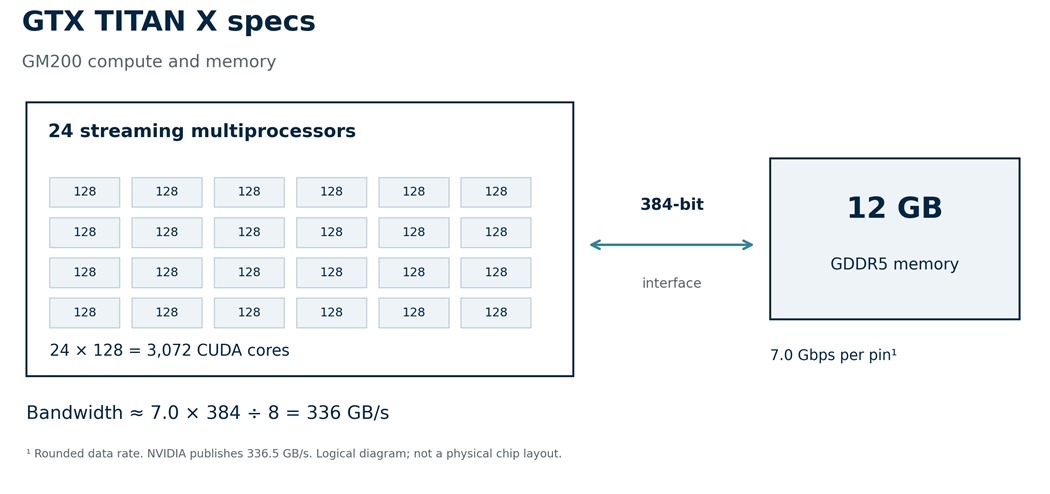
GM200 contains 24 streaming multiprocessors, each with 128 CUDA cores: 24 × 128 = 3,072. NVIDIA’s device-query example confirms this arrangement and CUDA compute capability 5.2. These processing resources handle parallel work, including shader calculations, but a CUDA core count is not a direct performance comparison across different GPU architectures.
The GTX TITAN X specs also allow a theoretical FP32 calculation. At its 1,000 MHz base clock, 3,072 cores performing two floating-point operations per cycle produce 6.144 TFLOPS. At the rated 1,075 MHz boost clock, the result is approximately 6.605 TFLOPS. These are arithmetic ceilings, not measured game performance; utilization, instruction mix, memory access, and operating clocks determine delivered speed.
Why 12 GB Does Not Guarantee Higher FPS
VRAM capacity determines how much graphics data can remain in local memory. Bandwidth describes how quickly that memory can transfer data. Neither figure independently determines how fast the GPU can render a frame.
The rounded data rate gives 7.0 × 384 ÷ 8 = 336 GB/s, close to NVIDIA’s published 336.5 GB/s. The small difference reflects precision in the quoted memory rate. This calculation helps interpret GTX TITAN X specs without treating a rounded headline number as an exact measurement.
Extra VRAM can accommodate larger texture sets when the software supports the card. However, lowering texture quality may accomplish little when shader processing is the main limit. Resolution, shadows, volumetric effects, and anti-aliasing can place separate demands on the GPU.
GTX TITAN X Specs Compared With GTX 980
The GTX 980 provides a useful comparison because both cards belong to the Maxwell generation. The table uses reference specifications; the ratios are calculated from the displayed values.
| Metric | GTX 980 | GTX TITAN X | TITAN X ratio |
| CUDA cores | 2,048 | 3,072 | 1.50× |
| VRAM GB | 4 | 12 | 3.00× |
| Memory bus bits | 256 | 384 | 1.50× |
| Bandwidth GB/s | 224.3 | 336.5 | 1.50× |
| Base-clock FP32 TFLOPS | 4.612 | 6.144 | 1.33× |
| Power rating W | 165 | 250 | 1.52× |
Source: NVIDIA’s Maxwell technical article and the reference specifications above. More hardware does not create an identical percentage increase in FPS. The TITAN X has three times the memory capacity, but games that fit within 4 GB do not automatically become three times faster.
Gaming Benchmarks at 1600p and 4K
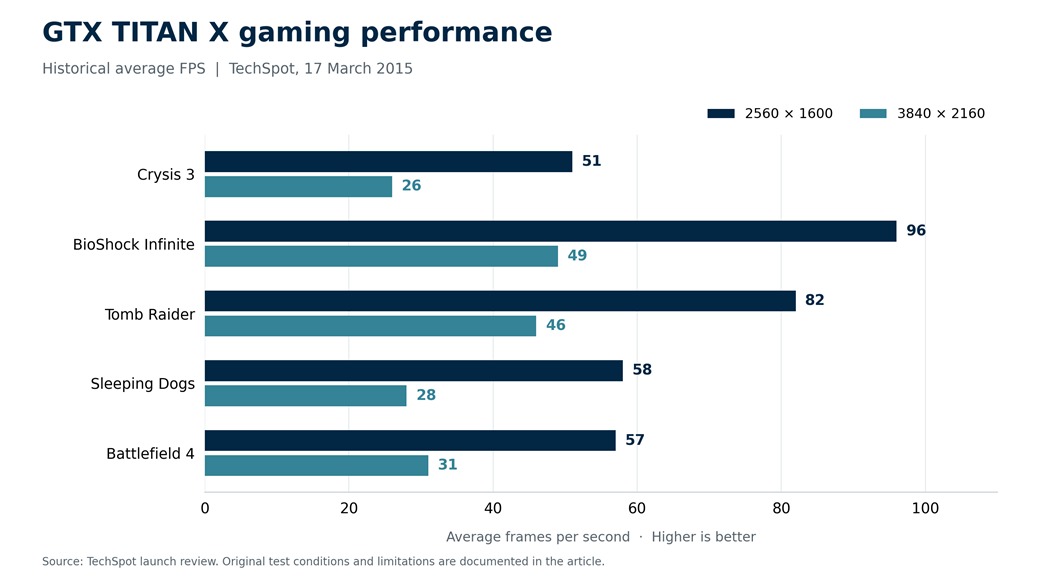
Measured results give the GTX TITAN X specs practical context. The following averages come from Steven Walton’s TechSpot review published March 17, 2015. They describe historical tests, not performance measurements taken in 2026.
Test Hardware and Conditions
The review used an Intel Core i7-5960X at 3.0 GHz, 16 GB of DDR4-2400, an ASRock X99 Extreme6, and Windows 8.1 Pro 64-bit. The methodology lists NVIDIA driver 347.52 and reference GPU clocks. BioShock Infinite used its Ultra preset; complete per-game settings and patch versions are not specified in the cited methodology, limiting exact reproduction. No 1% low results are reported in these charts.
| Game | 2560 × 1600 FPS | 3840 × 2160 FPS | FPS decrease |
| Crysis 3 | 51 | 26 | 49.0% |
| BioShock Infinite | 96 | 49 | 49.0% |
| Tomb Raider | 82 | 46 | 43.9% |
| Sleeping Dogs | 58 | 28 | 51.7% |
| Battlefield 4 | 57 | 31 | 45.6% |
Sources: test system, Crysis, BioShock, Tomb Raider, Sleeping Dogs, and Battlefield 4. Percentage decrease = (1600p FPS − 4K FPS) ÷ 1600p FPS × 100.
What the Resolution Change Shows
The 1600p tests rendered 4,096,000 pixels per frame, while 4K rendered 8,294,400: 2.025 times as many pixels. Across these five tests, average FPS fell by approximately 44–52%. The card’s 12 GB capacity did not prevent that decline because rendering more pixels also requires additional processing and data movement.
Do not relabel these results as 1440p benchmarks. A 2560 × 1600 image contains 11.1% more pixels than 2560 × 1440. The relationship also does not justify converting the results into predicted modern-game FPS. Different engines, patches, settings, and driver requirements need separate testing.
Power Requirements and Physical Compatibility
Power and dimensions are GTX TITAN X specs worth checking before installation. A compatible motherboard slot is only one part of the assessment; the case, PSU connectors, and cooling clearance must also fit.
| Installation specification | Reference value |
| Card length | 266.7 mm |
| Card height | 111.2 mm |
| Expansion-slot width | 2 slots |
| PCIe interface | 3.0 ×16 |
| Auxiliary power plugs | 1 × 6-pin + 1 × 8-pin |
| DisplayPort 1.2 outputs | 3 |
| HDMI 2.0 outputs | 1 |
| Dual-link DVI-I outputs | 1 |
| Simultaneous displays | 4 |
| Maximum GPU temperature | 91°C |
Dimensions are converted from NVIDIA’s 10.5-inch length and 4.376-inch height. The 600 W recommendation applies to the whole system; it does not mean the graphics card continuously consumes 600 W. Actual demand varies with the workload and configuration. Check NVIDIA’s installation guide and the PSU’s native PCIe cables.
The reference cooler uses a blower fan to exhaust heated air through the rear bracket. On an older card, dust, fan wear, and deteriorated thermal material can affect sustained clocks. The 91°C maximum is a specification limit, not a desirable operating target. A stability test under sustained load is more informative than an idle-temperature screenshot.
Driver Support and Modern Software Limits
As of October 1, 2026, GTX TITAN X specs need to be considered alongside Maxwell’s support status. NVIDIA ended regular Game Ready support after its final October 2025 release and schedules critical security updates through October 2028. Security maintenance does not provide the same new-game optimizations and feature development as ongoing Game Ready support. See NVIDIA’s support plan.
The card also lacks dedicated RT and Tensor cores and does not support NVIDIA DLSS. DirectX 12 feature level 12_1 does not provide the complete DirectX 12 Ultimate feature set. Check each game’s actual minimum GPU and feature requirements instead of relying on the broad DirectX label. NVIDIA explains the hardware distinction in its GTX and RTX comparison.
For compute applications, CUDA 13.0 removed offline compilation and library support for Maxwell. Compatible older software can remain usable, but developers must account for the older toolchain and application requirements. NVIDIA’s CUDA 13.0 release notes document this change.
Is a Used GTX TITAN X Worth Buying
A used GTX TITAN X can serve as a low-cost replacement in an older gaming system, provided the intended games work and the card passes testing. Its original $999 launch price has little relevance to present value.
Request evidence of the exact GPU model, clean image output, stable load temperatures, and working display connectors. Compare the total cost with newer supported alternatives, including any required PSU replacement. For a new general-purpose gaming build, my recommendation is to prioritize current software compatibility, efficiency, and warranty coverage over this card’s 12 GB label.
Conclusion
The GTX TITAN X specs describe a capable historical flagship with substantial memory, a wide bus, and strong performance in its original generation. Its practical value today depends on the games or applications you use, the condition of the individual card, and Maxwell’s software limitations. Consider it for a tested, inexpensive replacement or period-correct build; choose newer supported hardware when longevity and current-game compatibility are the priority.