Ryzen 5 7500X3D vs Ryzen 5 7600X | Full Comparison
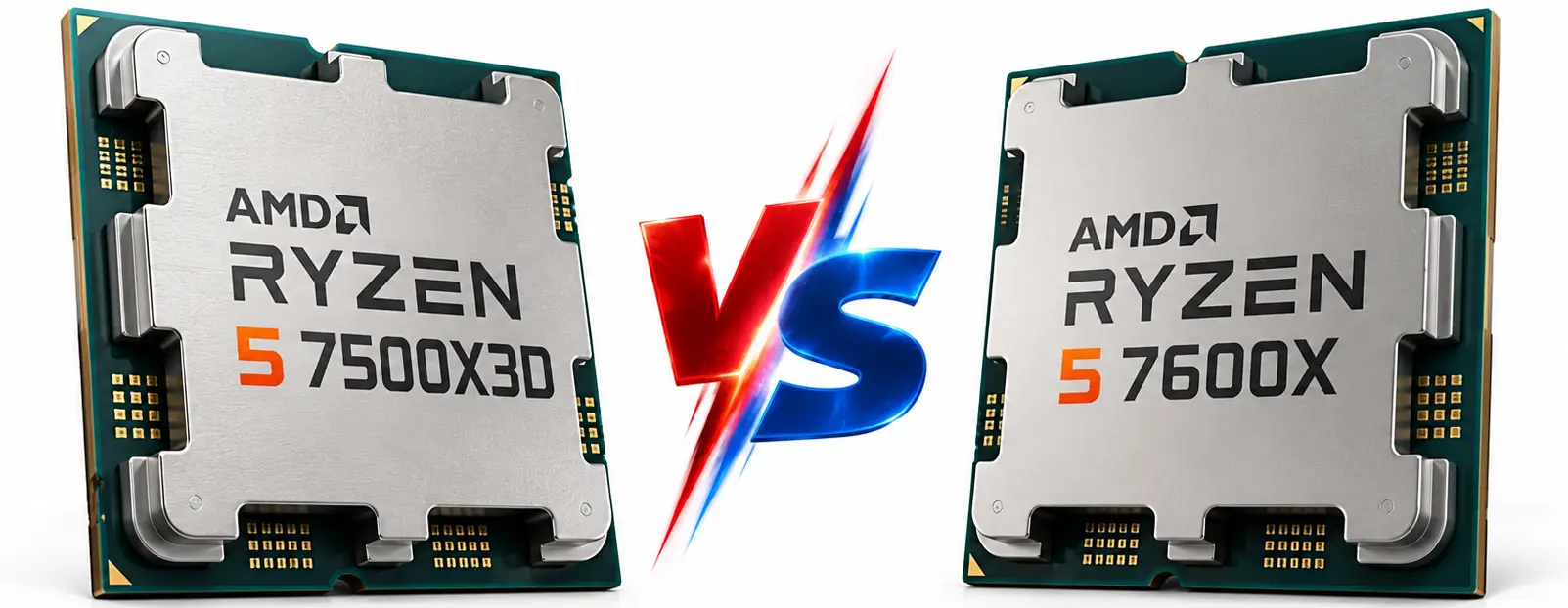
The AMD Ryzen 5 7500X3D vs Ryzen 5 7600X are two capable processors from AMD’s Ryzen 7000 series. Both offer six cores, twelve threads, and AM5 support. However, their differences become more noticeable when we look at gaming performance, processing speed, and how they handle demanding workloads.
The Ryzen 5 7500X3D comes with AMD’s 3D V-Cache technology, while the Ryzen 5 7600X relies on higher clock speeds to deliver performance. Both approaches have their advantages, depending on what you expect from your computer.
So, does having more cache make a bigger difference than having higher clock speeds? And how much does either processor affect your gaming experience?
To understand these differences, we’ll compare their specifications, gaming benchmarks, everyday performance, power consumption, and overall value. By the end, you should have a clearer idea of which processor makes more sense for your needs.
Ryzen 5 7500X3D vs Ryzen 5 7600X Specifications
Before discussing performance, it’s worth looking at what these processors offer on paper. Both use AMD’s Zen 4 architecture, but their clock speeds and cache sizes reveal where they differ.
| Specifications | Ryzen 5 7500X3D | Ryzen 5 7600X |
|---|---|---|
| Architecture | Zen 4 | Zen 4 |
| Cores | 6 | 6 |
| Threads | 12 | 12 |
| Base Clock | 4.0 GHz | 4.7 GHz |
| Max Boost Clock | 4.5 GHz | 5.3 GHz |
| L2 Cache | 6 MB | 6 MB |
| L3 Cache | 96 MB | 32 MB |
| Default TDP | 65W | 105W |
| Socket | AM5 | AM5 |
| Memory | DDR5 | DDR5 |
| Integrated Graphics | AMD Radeon Graphics | AMD Radeon Graphics |
The first noticeable difference is clock speed. The Ryzen 5 7600X can boost up to 5.3 GHz, whereas the Ryzen 5 7500X3D reaches 4.5 GHz. That gives the 7600X an advantage in tasks that benefit from faster CPU processing.
However, the situation changes when we compare their cache sizes. The 7500X3D comes with 96 MB of L3 cache, which is three times the 32 MB available on the 7600X. This additional cache can help the processor handle game data more efficiently without accessing system memory as frequently.
Although both processors share the same architecture and core count, their different designs can lead to noticeably different results.
How Does 3D V-Cache Affect Gaming Performance?
You might wonder why AMD would give the Ryzen 5 7500X3D lower clock speeds while adding so much cache. The answer lies in how games use the processor. During gameplay, the CPU constantly works with information such as player positions, character movements, physics, and other game-related calculations. Some of this information is accessed repeatedly, and keeping it close to the CPU cores can reduce delays.
This is where AMD’s 3D V-Cache technology becomes useful. The Ryzen 5 7500X3D has an additional layer of cache that allows it to keep more frequently accessed information on the processor. In games that respond well to additional cache, this can improve frame rates even though the CPU runs at lower clock speeds.
The Ryzen 5 7600X takes a different approach. Its higher frequencies allow it to process certain instructions faster, which can benefit applications that do not gain much from additional cache.
Not every game behaves the same way. Some benefit considerably from 3D V-Cache, while others show relatively small differences. That’s why published gaming benchmarks are more useful than judging either processor by specifications alone.
Ryzen 5 7500X3D vs Ryzen 5 7600X Gaming Benchmarks
Looking at gaming benchmarks gives us a better understanding of what these two processors can deliver. In its January 2026 review, TechSpot tested the Ryzen 5 7500X3D against several other processors, including the Ryzen 5 7600X. The test system used an Nvidia GeForce RTX 5090 and 32 GB of DDR5-6000 memory to help reveal differences in CPU performance.
Across 12 games, the Ryzen 5 7500X3D delivered approximately 16% higher gaming performance than the Ryzen 5 7600X at medium settings. With more demanding ultra settings, the average advantage decreased to 13%.
However, individual games tell a more interesting story. In Counter-Strike 2, the Ryzen 5 7500X3D delivered around 20% better performance than the 7600X. This is a meaningful difference for competitive players who want to maintain high frame rates on 144 Hz, 240 Hz, or higher monitors.
The results were even more noticeable in Baldur’s Gate 3. TechSpot recorded an average of 172 FPS with the 7500X3D, making it approximately 34% faster than the 7600X in that particular test. The game benefits considerably from the extra L3 cache.
In Cyberpunk 2077: Phantom Liberty, the difference was smaller. The 7500X3D achieved a 12% advantage at medium settings, which dropped to 9% when using the Ray Tracing Ultra preset.
Another interesting result came from Assetto Corsa Competizione. The 7500X3D reached 260 FPS at medium settings, outperforming the 7600X by approximately 31%.
These results show that additional cache can make a substantial difference, although the improvement depends on the game and graphics settings.
It’s also important to remember that these are results from TechSpot’s controlled test system. If you’re using a less powerful graphics card or playing at 4K resolution, the difference between the two processors may be smaller because the GPU can become the main performance limitation.
A Closer Look at Gameplay
Benchmark numbers help us compare processors, but let’s consider how their differences might matter during an actual gaming situation.
Imagine you’re playing Counter-Strike 2 on the Dust II map. You’re defending the B bombsite, watching the entrance while your teammates cover other angles. Suddenly, a smoke grenade lands near the doors, footsteps become louder, and two opponents appear as the smoke begins to clear.
Within a moment, you’re moving your crosshair, firing your weapon, and trying to track an opponent who is quickly moving across your screen. Your computer needs to keep producing frames consistently while the game handles movement, animations, and everything happening around you.
The Ryzen 5 7600X is capable of running this game smoothly when paired with a suitable graphics card. However, TechSpot’s benchmark results suggest the Ryzen 5 7500X3D can provide more frame-rate headroom during CPU-limited gameplay.
This doesn’t mean the 7600X will necessarily stutter during the gunfight, or that the 7500X3D will make your shots more accurate. Instead, higher and more consistent frame rates can make fast movement easier to follow and reduce the delay between what happens in the game and what appears on your screen.
In a competitive match, even a small improvement in visual responsiveness can be useful. The difference becomes more relevant when you’re targeting hundreds of frames per second rather than simply trying to maintain 60 FPS.
Another part of gaming performance worth considering is frame-rate consistency. In The Last of Us Part II Remastered, TechSpot found that the 7500X3D was only 6% faster in average FPS but achieved 25% better 1% lows.
The term 1% lows refers to the frame-rate performance of the slowest 1% of frames. Better results here can indicate fewer noticeable slowdowns, although other factors can still cause stuttering. This helps explain why average FPS alone doesn’t always describe how smooth a game feels.
Productivity and Everyday Performance
Gaming is only one part of the comparison. Many people also use their computers for programming, video editing, content creation, office work, and running multiple applications.
Both processors have six cores and twelve threads, so they can handle common desktop activities without difficulty. However, their different clock speeds matter when workloads depend more on raw processing speed than cache capacity.
The Ryzen 5 7600X can reach a maximum boost frequency of 5.3 GHz, giving it an advantage in many CPU-intensive applications.
For example, when compiling code, processing files, or rendering a project, the higher clock speeds can help it complete certain operations faster than the 7500X3D.
TechSpot’s testing also showed a limitation of the 7500X3D outside normal gameplay. During shader compilation, the processor took approximately 14–16% longer than the 7600X.
Similarly, PC Gamer’s Ryzen 5 7500X3D review found that its productivity performance generally trailed the higher-clocked alternatives, including the Ryzen 5 7600X.
That doesn’t make the 7500X3D unsuitable for everyday work. Web browsing, document editing, video calls, and ordinary multitasking should be comfortable on either processor.
However, if your daily routine involves compiling projects, rendering videos, or using applications that depend heavily on CPU frequency, the 7600X deserves consideration.
Power Consumption and Cooling
Power efficiency is another area where these two processors differ. AMD rates the Ryzen 5 7500X3D at a default TDP of 65W, while the Ryzen 5 7600X has a 105W rating.
These figures describe their default thermal design classifications, not the exact amount of electricity either processor consumes during every task.
In PC Gamer’s review, the 7500X3D averaged approximately 64W of CPU power consumption during gaming. The reviewer also observed relatively low temperatures, although the test system used a large 360 mm liquid cooler.
The Ryzen 5 7600X has a higher power allowance, which helps it sustain higher performance in demanding CPU workloads. However, this can also mean higher heat output and greater cooling requirements under heavy loads.
For someone building a compact PC, the lower power requirements of the 7500X3D may be appealing. A suitable air cooler can be a practical option, depending on the case and airflow.
The 7600X also works well with adequate cooling, but its higher thermal design rating is worth considering when choosing a cooler.
Neither processor includes a stock cooler, so that cost should be included in your PC build budget.
Motherboard Compatibility and Future Upgrades
Fortunately, choosing between these processors doesn’t require choosing between two different platforms.
Both the Ryzen 5 7500X3D and Ryzen 5 7600X use the AM5 socket and support DDR5 memory.
This means you can build a system around a compatible AM5 motherboard, such as a B650 or B850 model, and use either processor, provided the motherboard BIOS supports it.
If you’re purchasing an older motherboard for the 7500X3D, checking the manufacturer’s CPU support list is important because the processor was released later than the 7600X.
Both CPUs also include basic integrated Radeon graphics. These are useful for displaying an image and troubleshooting, but a dedicated graphics card is recommended for demanding games.
The shared AM5 platform also makes future CPU upgrades more convenient. You can potentially move to a more powerful compatible Ryzen processor without replacing your motherboard and memory, subject to BIOS support.
Ryzen 5 7500X3D vs Ryzen 5 7600X Price & Value
Performance matters, but the amount you’re paying is just as important. The Ryzen 5 7500X3D offers higher performance in many CPU-limited gaming tests, although it can cost more than the regular 7600X. Whether that extra performance justifies the additional expense depends on current prices in your region.
For example, if you’re building a gaming PC with a limited budget, saving money on the processor might allow you to purchase a more capable graphics card.
That upgrade could improve overall gaming performance more than spending extra on the CPU, depending on your existing components and preferred resolution.
On the other hand, if you already own a capable GPU and want to maximize frame rates in competitive games, the extra cache of the 7500X3D becomes more valuable.
Rather than comparing processor prices alone, consider the total build cost. Your graphics card, motherboard, cooling system, and monitor can all influence which processor delivers better value.
Which Processor Should You Choose?
After reviewing the specifications and benchmark results, the choice becomes clearer when we consider how each processor will be used.
The Ryzen 5 7500X3D makes more sense for gaming-focused builds. Its 96 MB L3 cache helps deliver higher frame rates in many CPU-intensive titles. It can also provide stronger 1% low results in certain games, which may improve perceived smoothness.
If you regularly play competitive shooters, simulation games, or other titles that benefit from additional cache, it offers a meaningful performance advantage.
The Ryzen 5 7600X remains a strong choice for mixed workloads. Its higher boost frequency can be useful for productivity, programming, and applications that benefit more from clock speed than cache size.
It can also make sense for a budget gaming build if its lower purchase price leaves more money for the graphics card.
Neither processor is the right purchase for everyone. The better option depends on which applications you use, the games you play, your graphics card, and the price difference when you’re ready to buy.
Conclusion
The Ryzen 5 7500X3D and Ryzen 5 7600X demonstrate how two processors with the same architecture and core count can deliver different results.
The 7500X3D uses additional cache to improve performance in games that benefit from it, while the 7600X uses higher clock speeds to perform well across a broad range of applications.
Published benchmarks show a consistent gaming advantage for the 7500X3D in many CPU-limited scenarios. However, the 7600X remains capable of delivering a good gaming experience and can offer better value for users who also prioritize productivity.
Ultimately, the decision should come down to how you plan to use your computer and how much you’re prepared to spend.
If gaming performance is your main priority, the 7500X3D deserves serious consideration. If you want a capable processor for both work and gaming at a potentially lower price, the 7600X remains a practical alternative.