Best AMD Gaming CPU in 2026 | 10 Ryzen Processors Compared
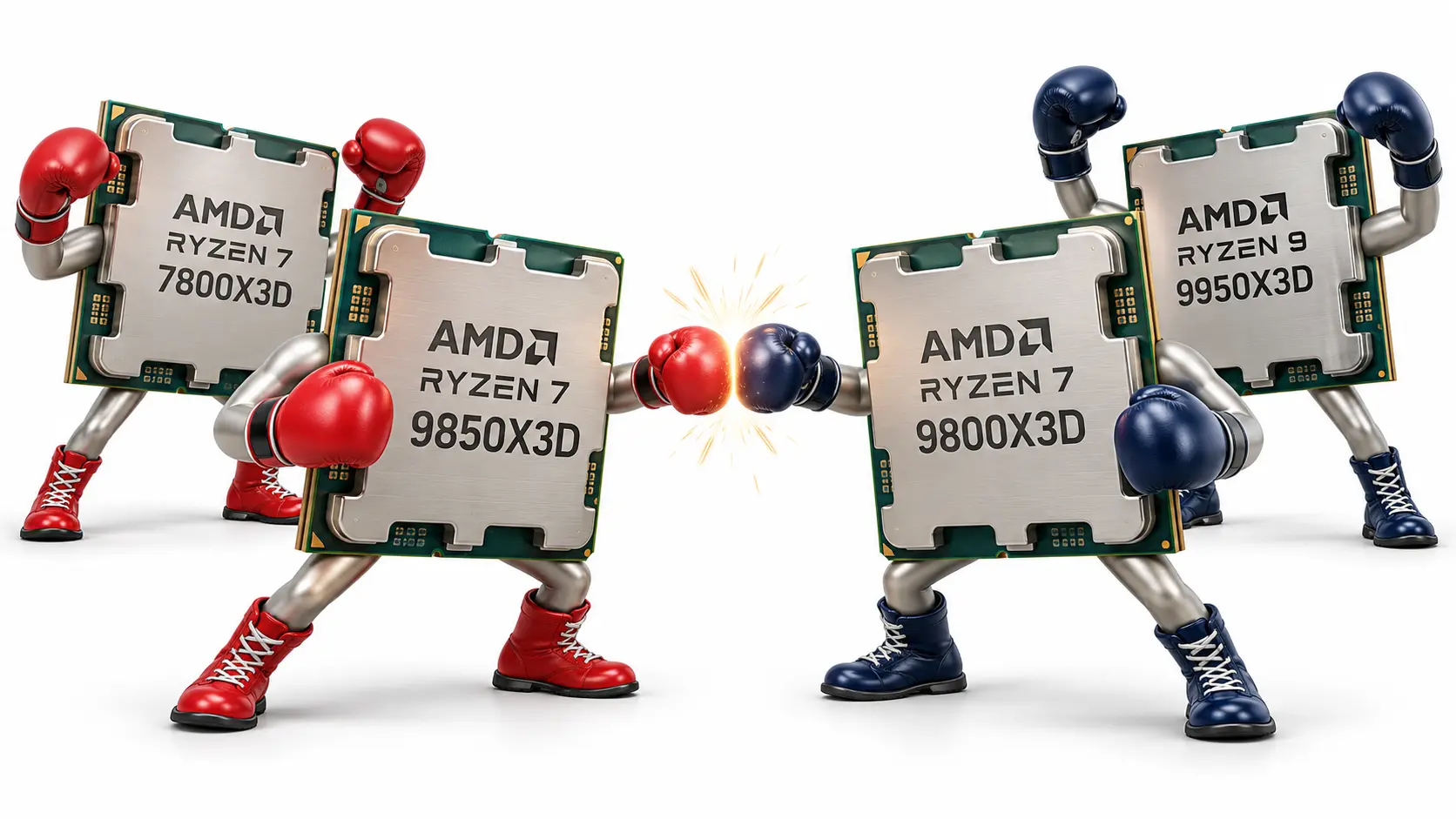
The AMD Ryzen 7 9850X3D is the strongest choice here for maximum gaming performance, while the Ryzen 7 9800X3D becomes the better high-end purchase when its discount is large enough. For a less expensive new PC, compare the Ryzen 5 9600X and 7600; for an inexpensive upgrade to an existing compatible AM4 system, consider the Ryzen 5 5600.
Your graphics card, monitor, existing motherboard, and local prices determine which of these processors makes sense. The ten options below cover different budgets and upgrade paths, with official specifications and five published game results per CPU. These are research-based recommendations using independent testing, not claims of hands-on testing by this website. Specifications and linked offers were checked on September 27, 2026; benchmark dates are stated separately.
Top 10 Best AMD Gaming CPUs
These are ten useful buying options, not a sales-volume ranking. “Best value” depends on the price available to you. AMD’s US store listed the 9850X3D at $499, the 9800X3D at $479, the 9950X3D at $699, and the 9700X at $339 when checked. Newegg separately listed a new 9800X3D sold and shipped by Newegg for $469. Taxes, shipping, bundles, seller terms, and regional availability can change the final comparison. See the AMD US processor store and the Newegg 9800X3D listing.
How to Read the Specifications and FPS Tables
3D V-Cache is AMD’s additional stacked cache: a small, fast pool of memory close to the processor cores. It can reduce trips to slower system RAM when a game’s workload benefits from the extra capacity. That benefit varies by game; adding cache does not produce a fixed percentage increase in frame rate.
FPS means frames per second. Average FPS describes throughput across a test, while the reported 1% low helps describe performance during its slower frames. A 1% low is not the single lowest frame rate, and reviewers can calculate it differently. Higher averages with weak lows may still produce noticeable interruptions.
The tables below transcribe published measurements. They do not calculate FPS from clock speed, core count, or cache size. For a comparison within the same test, the calculation is percentage uplift = (faster result ÷ slower result − 1) × 100. For example, 253 FPS versus 242 FPS is approximately 4.5% higher, not an extra 11%.
Each table identifies its review date and test setup. Compare CPUs directly only within the same benchmark set. An RTX 4090 result from 2023 and an RTX 5090 result from 2026 are not a controlled CPU comparison, even when the game names match. None of these measurements guarantees the FPS of your own PC.
TDP, or thermal design power, is a cooling and operating-design specification, not a promise of gaming power consumption or a hard maximum electrical draw. Max boost is the processor’s advertised maximum boost capability under suitable conditions, not an all-core clock guaranteed during every game. L2 and L3 cache are listed separately throughout to avoid confusing combined cache totals with L3 capacity.
1. AMD Ryzen 7 9850X3D
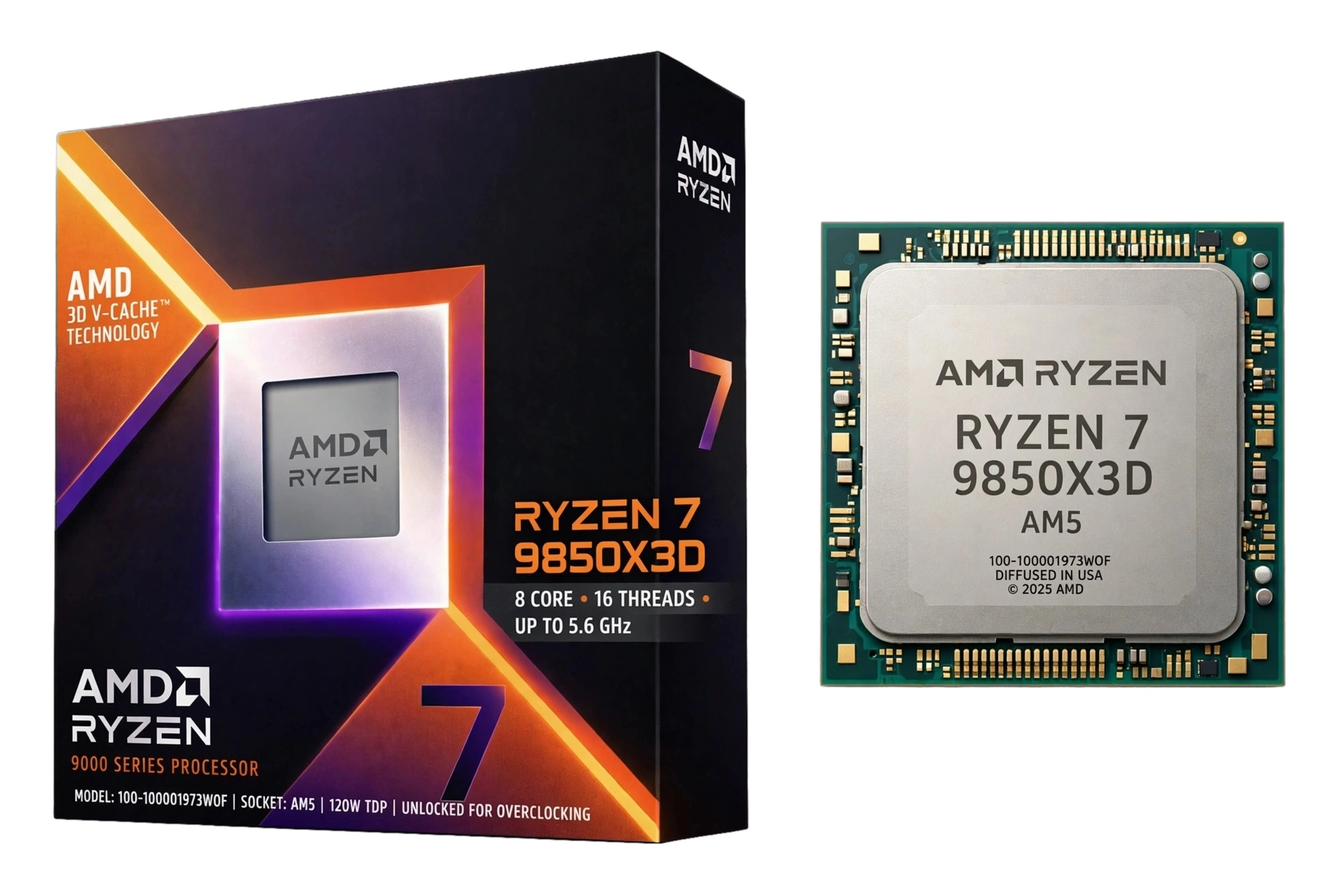
Official Specifications
| Architecture/codename | Zen 5 / Granite Ridge |
| Cores/threads | 8 / 16 |
| Base clock / max boost | 4.7 GHz / up to 5.6 GHz |
| L1 / L2 / L3 cache | 640 KB / 8 MB / 96 MB |
| 3D V-Cache | Yes |
| Default TDP | 120 W |
| Maximum operating temperature (Tjmax) | 95°C |
| CPU socket | AM5 |
| CPU core manufacturing process | TSMC 4 nm |
| I/O die manufacturing process | TSMC 6 nm |
| Memory type/channels | DDR5 UDIMM / 2 |
| Maximum memory capacity | 256 GB |
| Official two-module memory rate | Up to DDR5-5600 |
| Official four-module memory rate | Up to DDR5-3600 |
| ECC support | Yes, with motherboard support |
| PCI Express / native lanes (total/usable) | PCIe 5.0 / 28 / 24 |
| Integrated graphics | AMD Radeon Graphics, 2 graphics cores at 2200 MHz |
| Boxed cooling | Not included; AMD recommends liquid cooling |
| CPU tuning support | Unlocked; Precision Boost Overdrive and Curve Optimizer |
| AMD EXPO memory profiles | Supported; EXPO operates beyond baseline memory specifications |
| Launch | January 29, 2026 |
| Product identifier | 100-100001973WOF |
Source: AMD Ryzen 7 9850X3D specifications. Motherboard support, firmware, memory configuration, and boxed versus tray packaging can change what is available in your build.
The 9850X3D is the straightforward choice for a gaming-focused system where you want the highest CPU performance among these options and have already budgeted for a suitable graphics card. Its eight cores sit alongside 96 MB of L3 cache, and its higher boost ceiling separates it from the closely related 9800X3D. That does not make every game substantially faster: the size of the gain depends on the workload and whether the graphics card leaves room for a faster CPU to matter.
The checked $499 price puts it only $30 above the $469 Newegg offer for the 9800X3D, so the premium is worth considering in a new high-end build. However, owners of a 9800X3D have a much weaker reason to upgrade because they would pay a large replacement cost for a relatively small step forward. Choose it for a complete performance-focused build, not simply because its model number is newer.
Reasons to Buy
- Excellent fit for very high refresh-rate gaming with a powerful graphics card.
- Eight cores and a single-core die keep the gaming configuration relatively straightforward.
- Small checked price premium over the 9800X3D makes it a credible new-build option.
Reasons to Avoid
- Limited upgrade value if you already own a 9800X3D.
- No cooler included; total build cost exceeds the CPU price.
- A graphics-card-limited game may gain little from the extra CPU performance.
FPS Results
Benchmark set A — published January 28, 2026. TechSpot used a GeForce RTX 5090 and DDR5-6000 CL30 memory with EXPO. The five results below use 1080p Medium settings. The article does not provide a complete, reproducible record of the OS build, BIOS, graphics driver, and exact game builds for these results. Counter-Strike 2 used a professional-match replay; Marvel Rivals used its built-in benchmark; the other three used gameplay testing.
| Game | Resolution/settings | Average FPS | 1% low FPS |
| Counter-Strike 2 | 1080p Medium | 583 | 338 |
| Marvel Rivals | 1080p Medium | 265 | 210 |
| Baldur’s Gate 3 | 1080p Medium, DX11 | 270 | 164 |
| Cyberpunk 2077: Phantom Liberty | 1080p Medium | 253 | 172 |
| Warhammer 40,000: Space Marine 2 | 1080p Medium | 152 | 134 |
Source: TechSpot’s original benchmark review. These are measured results from that review, not calculated forecasts. Settings not explicitly documented by the source, including some upscaling, frame-generation, and ray-tracing options, should not be inferred from the preset name.
2. AMD Ryzen 7 9800X3D
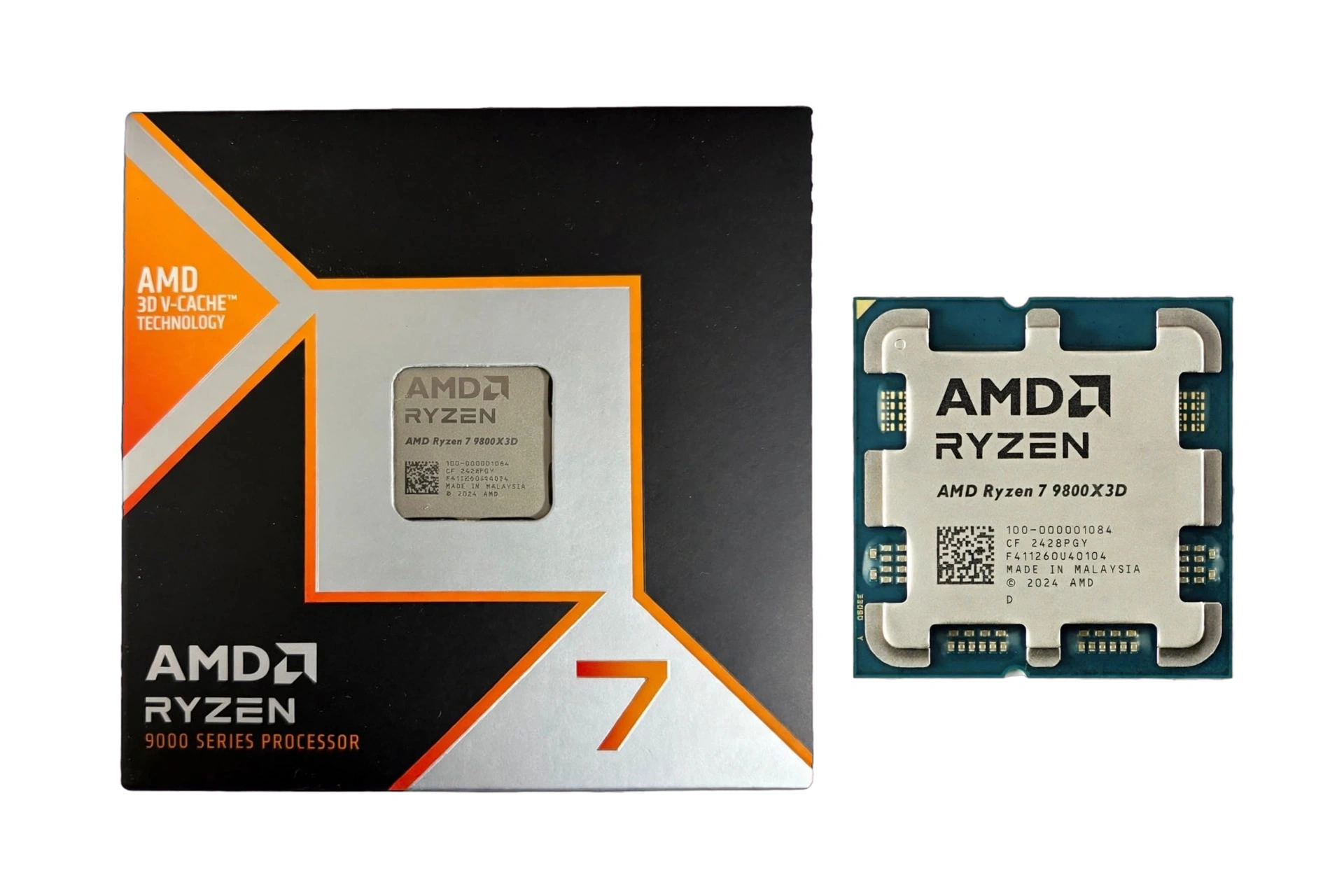
Official Specifications
| Architecture/codename | Zen 5 / Granite Ridge |
| Cores/threads | 8 / 16 |
| Base clock / max boost | 4.7 GHz / up to 5.2 GHz |
| L1 / L2 / L3 cache | 640 KB / 8 MB / 96 MB |
| 3D V-Cache | Yes |
| Default TDP | 120 W |
| Maximum operating temperature (Tjmax) | 95°C |
| CPU socket | AM5 |
| CPU core manufacturing process | TSMC 4 nm |
| I/O die manufacturing process | TSMC 6 nm |
| Memory type/channels | DDR5 UDIMM / 2 |
| Maximum memory capacity | 256 GB |
| Official two-module memory rate | Up to DDR5-5600 |
| Official four-module memory rate | Up to DDR5-3600 |
| ECC support | Yes, with motherboard support |
| PCI Express / native lanes (total/usable) | PCIe 5.0 / 28 / 24 |
| Integrated graphics | AMD Radeon Graphics, 2 graphics cores at 2200 MHz |
| Boxed cooling | Not included; AMD recommends liquid cooling |
| CPU tuning support | Unlocked; Precision Boost Overdrive and Curve Optimizer |
| AMD EXPO memory profiles | Supported; EXPO operates beyond baseline memory specifications |
| Launch | November 7, 2024 |
| Product identifier | 100-100001084WOF |
The 9800X3D remains a strong high-end choice because its gaming capability does not disappear when a faster model arrives. It combines the same eight-core, sixteen-thread layout and 96 MB L3 capacity as the 9850X3D with a lower advertised maximum boost. The purchase decision is therefore mainly about the discount and the rest of your system. If a lower price lets you buy a better graphics card, quieter cooling, or the SSD capacity you need, the 9800X3D can produce a more satisfying complete PC.
At the checked $469 offer, though, the difference from the $499 9850X3D is modest; it should not be described as an automatic value winner. Buyers with an existing capable AM5 processor should first verify a CPU limit in their own games. For owners of this chip, keeping it and upgrading another constrained component will often be the more sensible use of money.
Reasons to Buy
- High gaming performance across cache-sensitive and high-frame-rate workloads.
- Full overclocking support on the processor, subject to motherboard capabilities.
- Attractive when discounts create a meaningful gap below the 9850X3D.
Reasons to Avoid
- Weak value advantage when the 9850X3D costs only slightly more.
- Still requires a separate cooler and DDR5 platform.
- Usually unnecessary for a modest graphics card and a low refresh-rate target.
FPS Results
Benchmark set A — published January 28, 2026. TechSpot used a GeForce RTX 5090 and DDR5-6000 CL30 memory with EXPO. The five results below use 1080p Medium settings. The article does not provide a complete, reproducible record of the OS build, BIOS, graphics driver, and exact game builds for these results. Counter-Strike 2 used a professional-match replay; Marvel Rivals used its built-in benchmark; the other three used gameplay testing.
| Game | Resolution/settings | Average FPS | 1% low FPS |
| Counter-Strike 2 | 1080p Medium | 551 | 321 |
| Marvel Rivals | 1080p Medium | 249 | 197 |
| Baldur’s Gate 3 | 1080p Medium, DX11 | 262 | 159 |
| Cyberpunk 2077: Phantom Liberty | 1080p Medium | 242 | 164 |
| Warhammer 40,000: Space Marine 2 | 1080p Medium | 145 | 124 |
Source: TechSpot’s original benchmark review. These are measured results from that review, not calculated forecasts. Settings not explicitly documented by the source, including some upscaling, frame-generation, and ray-tracing options, should not be inferred from the preset name.
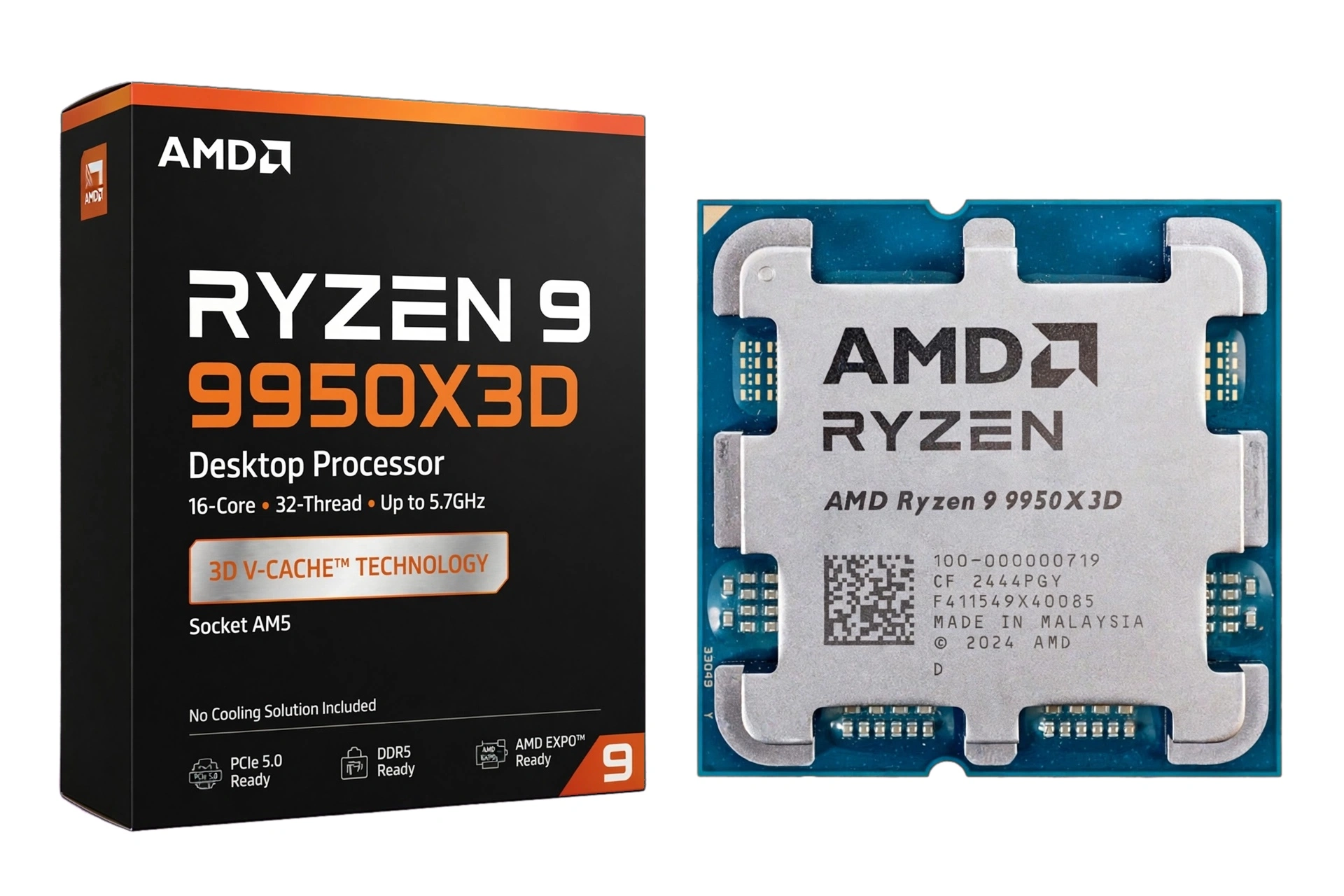
3. AMD Ryzen 9 9950X3D
Official Specifications
| Architecture/codename | Zen 5 / Granite Ridge |
| Cores/threads | 16 / 32 |
| Base clock / max boost | 4.3 GHz / up to 5.7 GHz |
| L1 / L2 / L3 cache | 1280 KB / 16 MB / 128 MB |
| 3D V-Cache | Yes |
| Default TDP | 170 W |
| Maximum operating temperature (Tjmax) | 95°C |
| CPU socket | AM5 |
| CPU core manufacturing process | TSMC 4 nm |
| I/O die manufacturing process | TSMC 6 nm |
| Memory type/channels | DDR5 UDIMM / 2 |
| Maximum memory capacity | 256 GB |
| Official two-module memory rate | Up to DDR5-5600 |
| Official four-module memory rate | Up to DDR5-3600 |
| ECC support | Yes, with motherboard support |
| PCI Express / native lanes (total/usable) | PCIe 5.0 / 28 / 24 |
| Integrated graphics | AMD Radeon Graphics, 2 graphics cores at 2200 MHz |
| Boxed cooling | Not included; AMD recommends liquid cooling |
| CPU tuning support | Unlocked; Precision Boost Overdrive and Curve Optimizer |
| AMD EXPO memory profiles | Supported; EXPO operates beyond baseline memory specifications |
| Launch | March 12, 2025 |
| Product identifier | 100-100000719WOF |
Source: AMD Ryzen 9 9950X3D specifications. Motherboard support, firmware, memory configuration, and boxed versus tray packaging can change what is available in your build.
The 9950X3D is the specialist choice for a PC that must play games and also perform substantial CPU rendering, encoding, compilation, or other heavily threaded work. Sixteen cores give it a different purpose from the eight-core gaming recommendations; they do not mean games automatically run twice as fast. Its core layout spans two core dies, with the additional 3D V-Cache associated with one of them, so current platform software and correct workload scheduling matter.
The checked $699 AMD store price is easier to justify when paid work or frequent production tasks benefit from the extra cores. A gaming-only buyer should usually compare the less expensive eight-core X3D options first. It is also worth checking application-specific benchmarks against non-X3D Ryzen 9 alternatives before buying: cache that benefits a game is not equally valuable to every production workload. This is a mixed-use recommendation, not a claim that it wins every professional benchmark.
Reasons to Buy
- Sixteen cores suit demanding work alongside gaming.
- X3D cache preserves strong gaming capability in a productivity-oriented build.
- Reduces the need to choose between an eight-core gaming CPU and a many-core workstation-style setup.
Reasons to Avoid
- Extra cost is difficult to justify for gaming alone.
- Higher default TDP raises cooling and sustained-load planning requirements.
- Dual-die scheduling adds software considerations absent from a simple single-die gaming setup.
FPS Results
Benchmark set C — published March 12, 2025. TechSpot used an Asus ROG Strix RTX 4090 OC, a Gigabyte X670E Aorus Master motherboard with BIOS F34b, and 32 GB DDR5-6000 CL30-38-38-96. The OS was Windows 11 24H2 and the graphics driver was 572.70 WHQL. These are the review’s stock CPU results with EXPO memory, not its optional PBO or Eco-mode results. All five run at 1080p. Exact game build numbers and complete scene-reproduction details were not supplied.
| Game | Settings at 1080p | Average FPS | 1% low FPS |
| Cyberpunk 2077: Phantom Liberty | High | 216 | 147 |
| Assetto Corsa Competizione | Epic | 272 | 228 |
| Counter-Strike 2 | Medium | 664 | 360 |
| Starfield | Ultra | 141 | 115 |
| Warhammer 40,000: Space Marine 2 | Ultra, native DLAA, 4K texture pack | 136 | 118 |
Source: TechSpot’s original benchmark review. These are measured results from that review, not calculated forecasts. Settings not explicitly documented by the source, including some upscaling, frame-generation, and ray-tracing options, should not be inferred from the preset name.
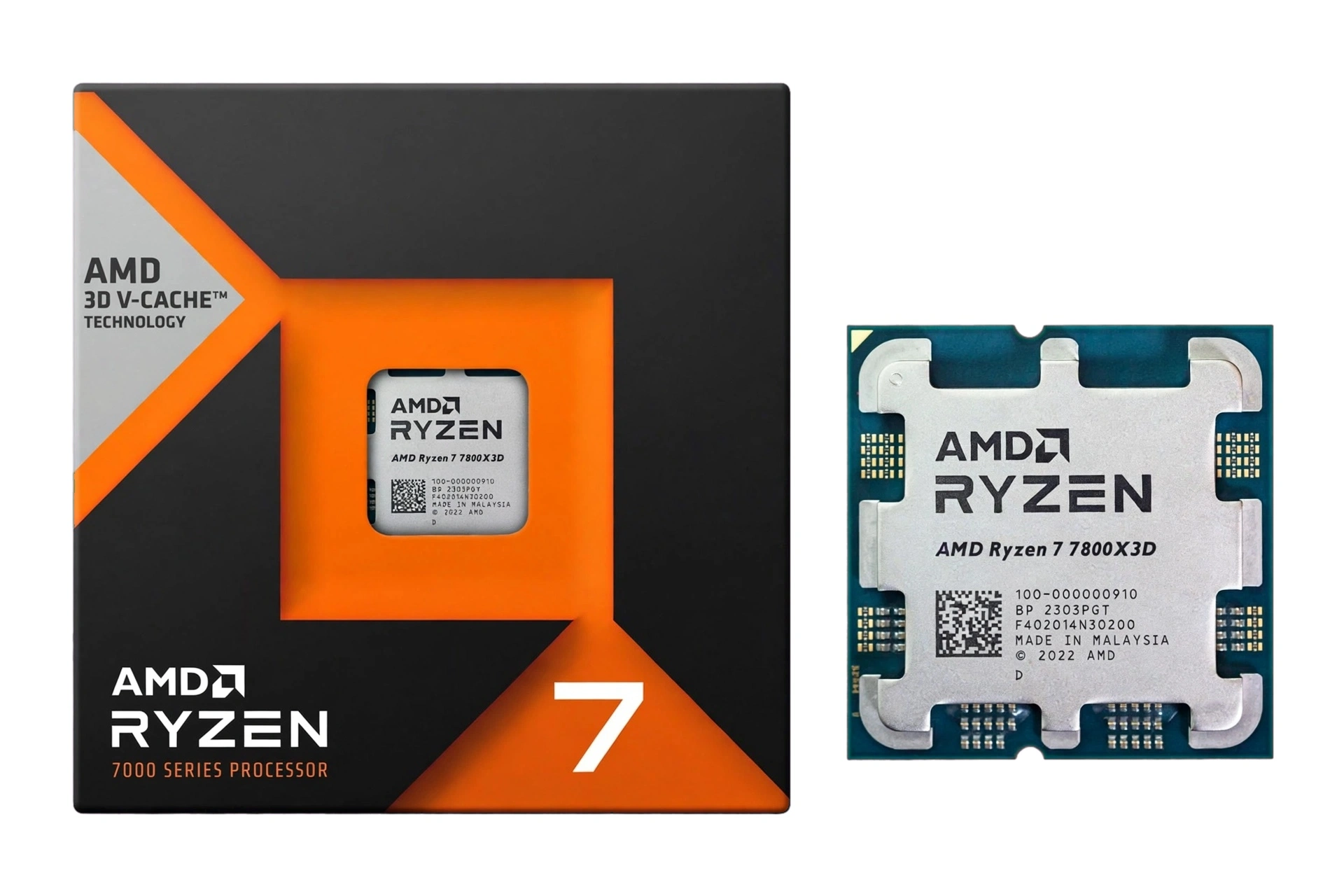
4. AMD Ryzen 7 7800X3D
Official Specifications
| Architecture/codename | Zen 4 / Raphael |
| Cores/threads | 8 / 16 |
| Base clock / max boost | 4.2 GHz / up to 5.0 GHz |
| L1 / L2 / L3 cache | 512 KB / 8 MB / 96 MB |
| 3D V-Cache | Yes |
| Default TDP | 120 W |
| Maximum operating temperature (Tjmax) | 89°C |
| CPU socket | AM5 |
| CPU core manufacturing process | TSMC 5 nm |
| I/O die manufacturing process | TSMC 6 nm |
| Memory type/channels | DDR5 UDIMM / 2 |
| Maximum memory capacity | 128 GB |
| Official two-module memory rate | Up to DDR5-5200 |
| Official four-module memory rate | Up to DDR5-3600 |
| ECC support | Yes, with motherboard support |
| PCI Express / native lanes (total / usable) | PCIe 5.0 / 28 / 24 |
| Integrated graphics | AMD Radeon Graphics, 2 graphics cores at 2200 MHz |
| Boxed cooling | Not included; AMD recommends liquid cooling |
| CPU tuning support | Precision Boost Overdrive and Curve Optimizer; not the unrestricted multiplier tuning of Zen 5 X3D |
| AMD EXPO memory profiles | Supported; EXPO operates beyond baseline memory specifications |
| Launch | April 6, 2023 |
| Product identifier | 100-100000910WOF |
Source: AMD Ryzen 7 7800X3D specifications. Motherboard support, firmware, memory configuration, and boxed versus tray packaging can change what is available in your build.
The 7800X3D belongs on the shortlist when its price reflects its age. Its eight Zen 4 cores and large L3 cache remain useful for gaming, and the January 2026 comparison gives a clearer picture than relying only on launch-era praise. A good discount can make it a worthwhile route into an X3D system, particularly if the saved money funds a better graphics card.
A small discount against a 9800X3D is less convincing because the newer chip offers a stronger overall CPU foundation for a similar platform investment. Existing 7800X3D owners should be more cautious still: replacing a capable processor requires evidence that the games they play would benefit at their actual resolution and settings. It is not obsolete, but it should no longer be priced as though newer alternatives do not exist. Check new and used offers separately, including warranty coverage and the seller’s return policy.
Reasons to Buy
- Still capable in demanding and cache-sensitive games.
- Eight cores provide more CPU capacity than the six-core X3D option.
- Uses AM5 and DDR5, allowing reuse of those components in later compatible upgrades.
Reasons to Avoid
- Unattractive when priced close to a 9800X3D.
- Older X3D tuning limitations differ from the newer Zen 5 models.
- Old stock and used listings can produce misleading price comparisons.
FPS Results
Benchmark set A — published January 28, 2026. TechSpot used a GeForce RTX 5090 and DDR5-6000 CL30 memory with EXPO. The five results below use 1080p Medium settings. Its article does not provide a complete reproducible record of the OS build, BIOS, graphics driver, and exact game builds for these results. Counter-Strike 2 used a professional-match replay; Marvel Rivals used its built-in benchmark; the other three used gameplay testing.
| Game | Resolution/settings | Average FPS | 1% low FPS |
| Counter-Strike 2 | 1080p Medium | 501 | 291 |
| Marvel Rivals | 1080p Medium | 239 | 173 |
| Baldur’s Gate 3 | 1080p Medium, DX11 | 218 | 141 |
| Cyberpunk 2077: Phantom Liberty | 1080p Medium | 219 | 156 |
| Warhammer 40,000: Space Marine 2 | 1080p Medium | 133 | 113 |
Source: TechSpot’s original benchmark review. These are measured results from that review, not calculated forecasts. Settings not explicitly documented by the source, including some upscaling, frame-generation, and ray-tracing options, should not be inferred from the preset name.
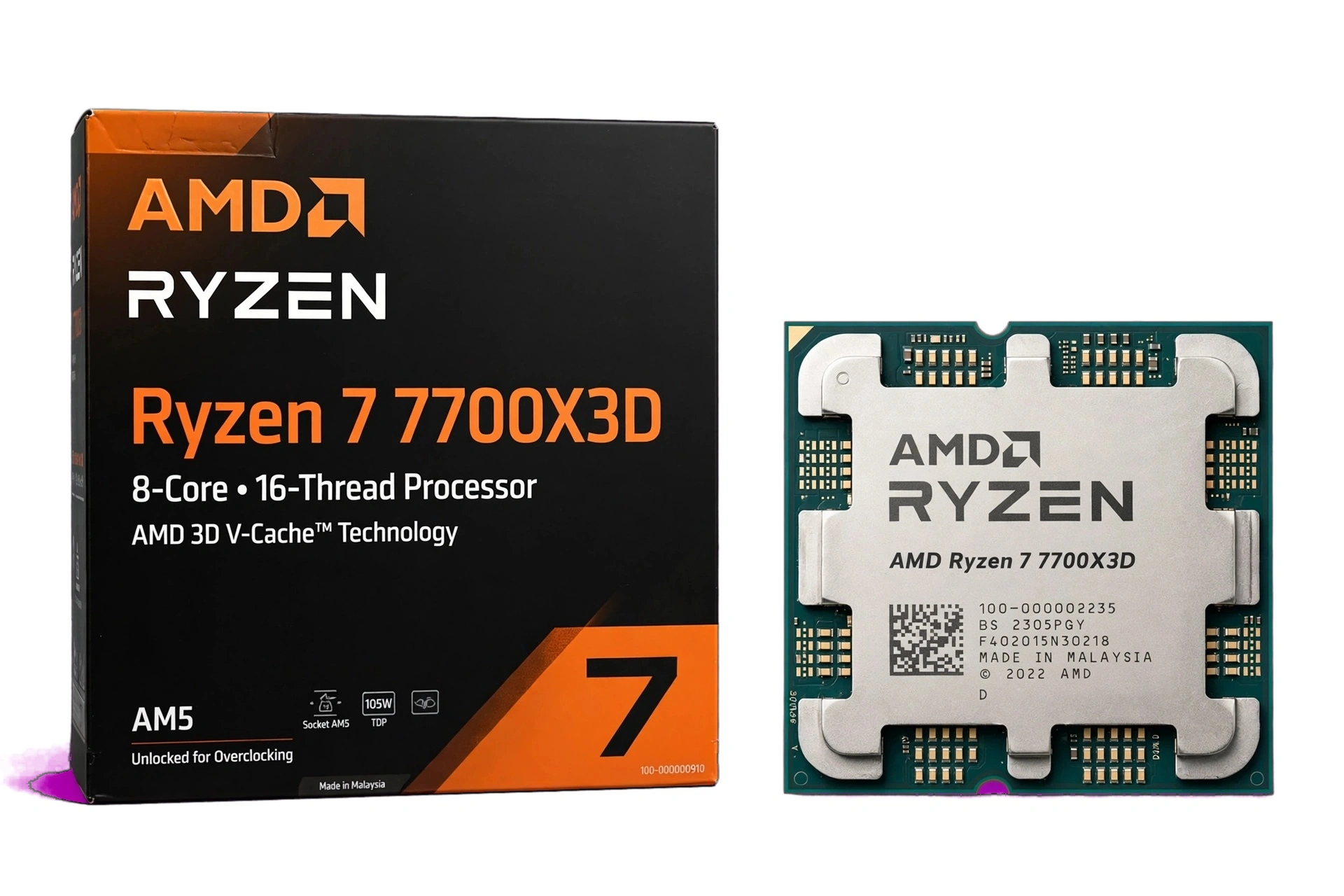
5. AMD Ryzen 7 7700X3D
Official Specifications
| Architecture/codename | Zen 4 / Raphael |
| Cores/threads | 8 / 16 |
| Base clock / max boost | 4.0 GHz / up to 4.5 GHz |
| L1 / L2 / L3 cache | 512 KB / 8 MB / 96 MB |
| 3D V-Cache | Yes |
| Default TDP | 120 W |
| Maximum operating temperature (Tjmax) | 89°C |
| CPU socket | AM5 |
| CPU core manufacturing process | TSMC 5 nm |
| I/O die manufacturing process | TSMC 6 nm |
| Memory type/channels | DDR5 UDIMM / 2 |
| Maximum memory capacity | 128 GB |
| Official two-module memory rate | Up to DDR5-5200 |
| Official four-module memory rate | Up to DDR5-3600 |
| ECC support | Yes, with motherboard support |
| PCI Express / native lanes (total / usable) | PCIe 5.0 / 28 / 24 |
| Integrated graphics | AMD Radeon Graphics, 2 graphics cores at 2200 MHz |
| Boxed cooling | Not included; AMD recommends liquid cooling |
| CPU tuning support | Precision Boost Overdrive and Curve Optimizer; do not assume Zen 5 X3D overclocking controls |
| AMD EXPO memory profiles | Supported; EXPO operates beyond baseline memory specifications |
| Launch | July 16, 2026 |
| Product identifier | 100-100002235WOF |
Source: AMD Ryzen 7 7700X3D specifications. Motherboard support, firmware, memory configuration, and boxed versus tray packaging can change what is available in your build.
The 7700X3D provides another way to buy eight X3D-equipped cores without paying for AMD’s fastest gaming models. The name needs careful reading: this is a Zen 4 Ryzen 7000 processor with a lower boost ceiling than the 7800X3D, even though its release date is later. It should be judged by its measured performance and selling price, not by the assumption that a later launch always means a newer architecture.
Its most persuasive position is between a cheaper six-core 7600X3D and a more expensive 7800X3D or 9800X3D. If those price gaps narrow, its appeal narrows with them. For buyers who play CPU-sensitive games and also prefer an eight-core configuration for background work, it is worth checking. There is no need to pay a large premium merely to move from six to eight cores if your own workloads do not use that extra capacity.
Reasons to Buy
- Eight cores with 96 MB L3 cache at a potentially lower purchase price.
- Useful alternative when other eight-core X3D models carry inflated local prices.
- Compatible AM5 systems can reuse DDR5 and, where supported, the motherboard.
Reasons to Avoid
- Lower boost ceiling than the 7800X3D.
- A later release date does not make it a Zen 5 processor.
- Requires a clear price advantage to stand out among nearby X3D choices.
FPS Results
Benchmark set B — published July 22, 2026. TechSpot used an Asus ROG Astral RTX 5090 OC, an MSI MAG X870E Tomahawk Max motherboard with BIOS 7E59v5A32, and 32 GB DDR5-6000 CL30-38-38-96. The OS was Windows 11 25H2, and the graphics driver was 610.74 WHQL. The tests below are 1080p Medium; Marvel Rivals and Horizon used built-in benchmarks, while the other three used gameplay. Exact game build numbers were not supplied.
| Game | Resolution/settings | Average FPS | 1% low FPS |
| Marvel Rivals | 1080p Medium | 216 | 165 |
| Horizon Zero Dawn Remastered | 1080p Medium | 232 | 150 |
| Baldur’s Gate 3 | 1080p Medium, DX11 | 197 | 127 |
| Cyberpunk 2077: Phantom Liberty | 1080p Medium | 203 | 148 |
| Warhammer 40,000: Space Marine 2 | 1080p Medium | 121 | 103 |
Source: TechSpot’s original benchmark review. These are measured results from that review, not calculated forecasts. Settings not explicitly documented by the source, including some upscaling, frame-generation, and ray-tracing options, should not be inferred from the preset name.
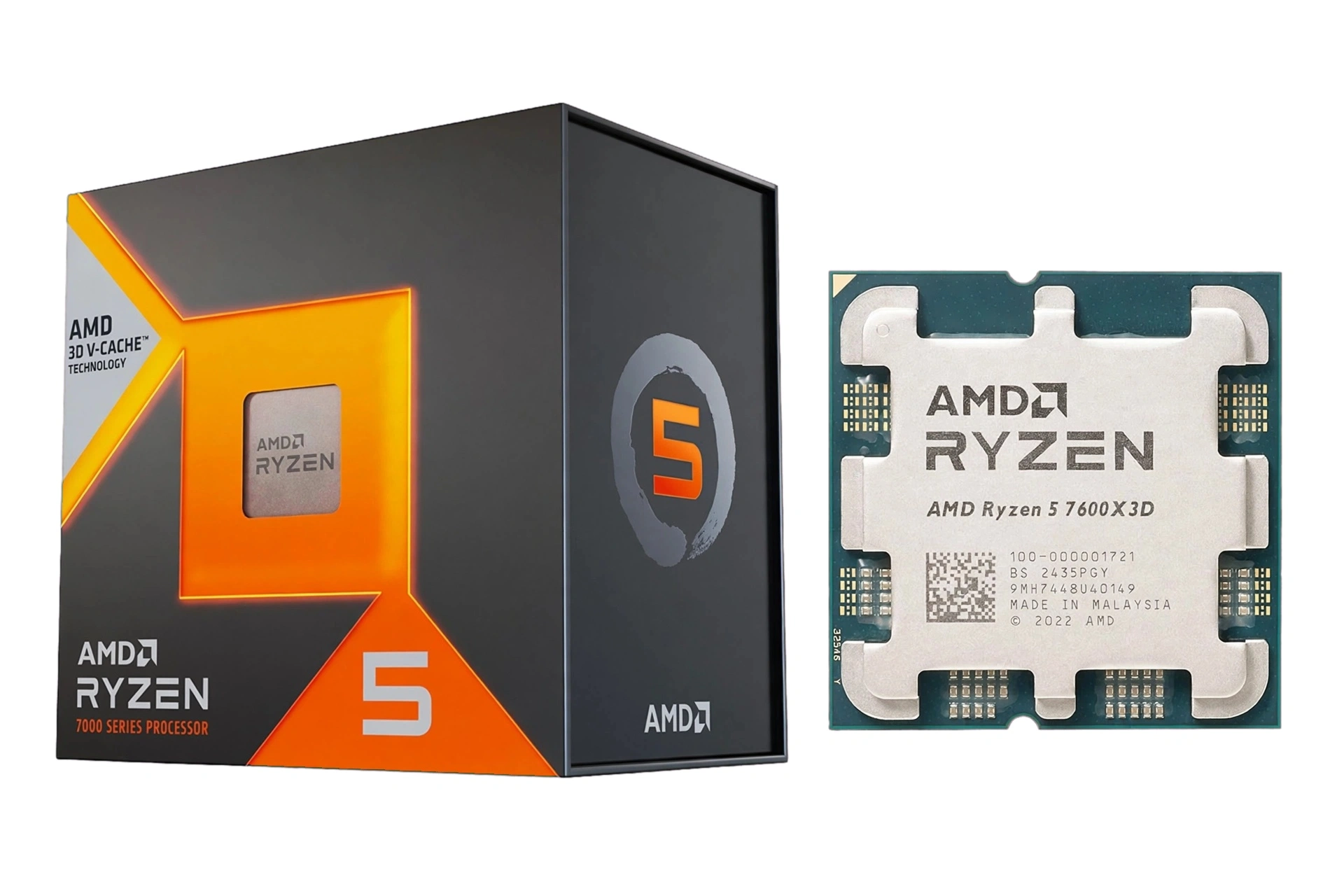
6. AMD Ryzen 5 7600X3D
Official Specifications
| Architecture/codename | Zen 4 / Raphael |
| Cores/threads | 6 / 12 |
| Base clock / max boost | 4.1 GHz / up to 4.7 GHz |
| L1 / L2 / L3 cache | 384 KB / 6 MB / 96 MB |
| 3D V-Cache | Yes |
| Default TDP | 65 W |
| Maximum operating temperature (Tjmax) | 89°C |
| CPU socket | AM5 |
| CPU core manufacturing process | TSMC 5 nm |
| I/O die manufacturing process | TSMC 6 nm |
| Memory type/channels | DDR5 UDIMM / 2 |
| Maximum memory capacity | 128 GB |
| Official two-module memory rate | Up to DDR5-5200 |
| Official four-module memory rate | Up to DDR5-3600 |
| ECC support | Yes, with motherboard support |
| PCI Express / native lanes (total/usable) | PCIe 5.0 / 28 / 24 |
| Integrated graphics | AMD Radeon Graphics, 2 graphics cores at 2200 MHz |
| Boxed cooling | Not included; AMD recommends liquid cooling |
| CPU tuning support | Precision Boost Overdrive and Curve Optimizer; not unrestricted multiplier tuning |
| AMD EXPO memory profiles | Supported; EXPO operates beyond baseline memory specifications |
| Launch | September 5, 2024 |
| Product identifier | 100-000001721 (tray ID) |
| AMD-listed regions | China, North America, EMEA; retailer stock varies |
Source: AMD Ryzen 5 7600X3D specifications. Motherboard support, firmware, memory configuration, and boxed versus tray packaging can change what is available in your build.
The 7600X3D makes sense when you want the gaming benefit of a large cache without paying for eight cores. Its six-core configuration is sufficient for many gaming-focused systems, but that is not a guarantee for every simulation, background workload, or future title. Compare it with the 9600X using the games you actually play: the X3D model’s cache and the newer chip’s architecture are different advantages, and neither can be reduced to one specification.
Regional availability is a practical part of this recommendation. AMD lists China, North America, and EMEA, but that does not guarantee ordinary retail stock in every country or store. A bundle can be worthwhile if the included board and memory are components you wanted anyway. If access requires an expensive import or an unsuitable motherboard bundle, a widely available non-X3D processor may be the better purchase.
Reasons to Buy
- Large L3 cache at the six-core end of the AM5 range.
- 65 W default TDP offers a useful starting point for a restrained build.
- Can be good value in a competitively priced local bundle.
Reasons to Avoid
- Six cores offer less capacity for heavy CPU work than eight- or sixteen-core options.
- Availability and seller conditions vary by region.
- A large markup can erase its budget-X3D appeal.
FPS Results
Benchmark set B — published July 22, 2026. TechSpot used an Asus ROG Astral RTX 5090 OC, an MSI MAG X870E Tomahawk Max motherboard with BIOS 7E59v5A32, and 32 GB DDR5-6000 CL30-38-38-96. The OS was Windows 11 25H2, and the graphics driver was 610.74 WHQL. The tests below are 1080p Medium; Marvel Rivals and Horizon used built-in benchmarks, while the other three used gameplay. Exact game build numbers were not supplied.
| Game | Resolution/settings | Average FPS | 1% low FPS |
| Marvel Rivals | 1080p Medium | 204 | 155 |
| Horizon Zero Dawn Remastered | 1080p Medium | 215 | 139 |
| Baldur’s Gate 3 | 1080p Medium, DX11 | 178 | 121 |
| Cyberpunk 2077: Phantom Liberty | 1080p Medium | 199 | 147 |
| Warhammer 40,000: Space Marine 2 | 1080p Medium | 116 | 99 |
Source: TechSpot’s original benchmark review. These are measured results from that review, not calculated forecasts. Settings not explicitly documented by the source, including some upscaling, frame-generation, and ray-tracing options, should not be inferred from the preset name.
7. AMD Ryzen 7 9700X
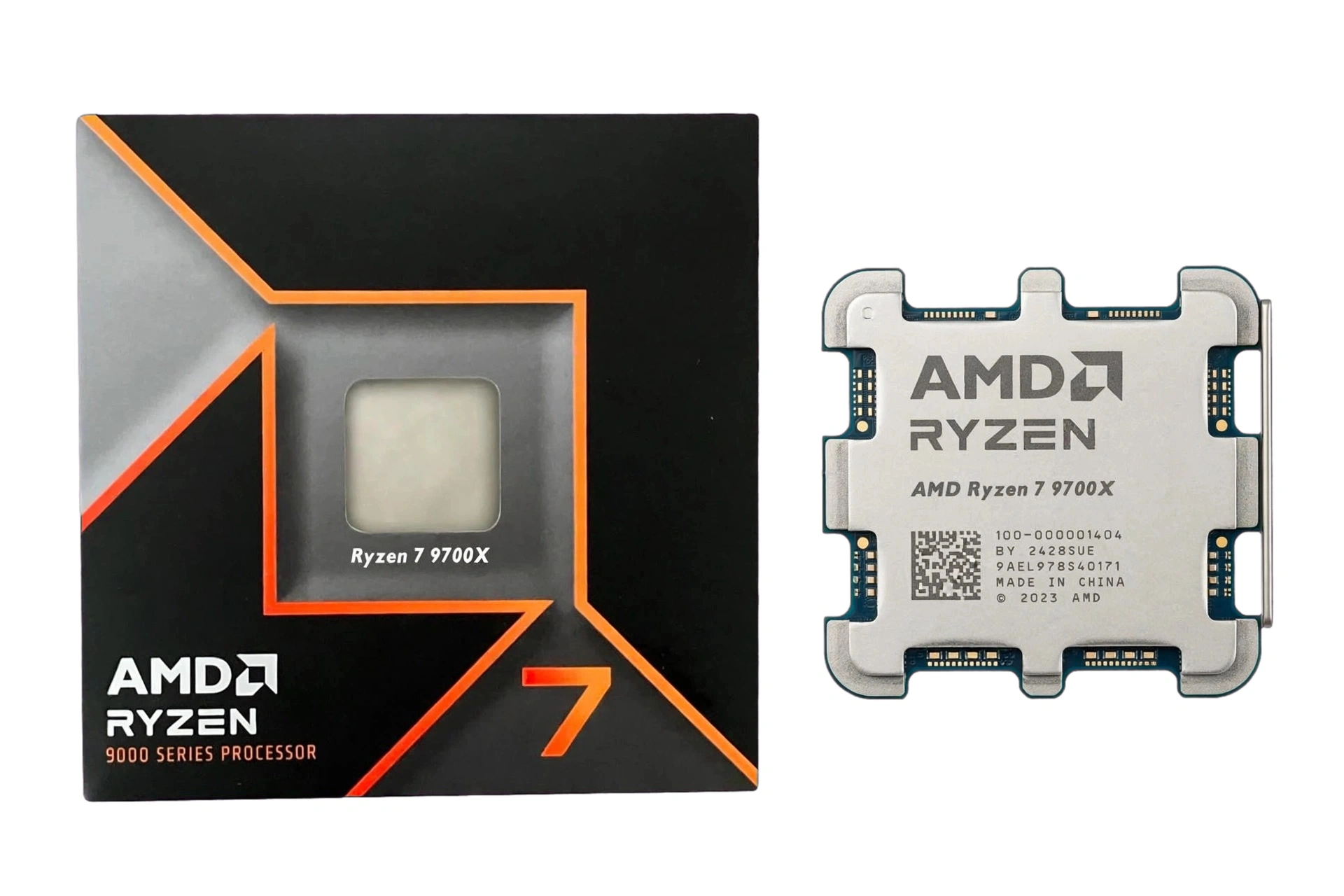
Official Specifications
| Architecture/codename | Zen 5 / Granite Ridge |
| Cores/threads | 8 / 16 |
| Base clock / max boost | 3.8 GHz / up to 5.5 GHz |
| L1 / L2 / L3 cache | 640 KB / 8 MB / 32 MB |
| 3D V-Cache | No |
| Default TDP | 65 W |
| Maximum operating temperature (Tjmax) | 95°C |
| CPU socket | AM5 |
| CPU core manufacturing process | TSMC 4 nm |
| I/O die manufacturing process | TSMC 6 nm |
| Memory type/channels | DDR5 UDIMM / 2 |
| Maximum memory capacity | 256 GB |
| Official two-module memory rate | Up to DDR5-5600 |
| Official four-module memory rate | Up to DDR5-3600 |
| ECC support | Yes, with motherboard support |
| PCI Express / native lanes (total / usable) | PCIe 5.0 / 28 / 24 |
| Integrated graphics | AMD Radeon Graphics, 2 graphics cores at 2200 MHz |
| Boxed cooling | Not included; AMD recommends a premium air cooler |
| CPU tuning support | Unlocked; Precision Boost Overdrive and Curve Optimizer |
| AMD EXPO memory profiles | Supported; EXPO operates beyond baseline memory specifications |
| Launch | August 8, 2024 |
| Product identifier | 100-100001404WOF |
Source: AMD Ryzen 7 9700X specifications. Motherboard support, firmware, memory configuration, and boxed versus tray packaging can change what is available in your build.
The 9700X is a sensible mixed-use processor for buyers who want eight cores but do not need to prioritize the highest possible game frame rates. Its strengths are easier to justify in a PC that handles gaming alongside frequent general-purpose work, rather than in a machine built solely to maximize performance in cache-sensitive titles. The eight-core count and big advertised boost should not be mistaken for proof that it outruns a lower-clocked X3D chip in games.
At the checked $339 AMD store price, local discounts on X3D alternatives deserve attention before purchase. A buyer using a moderate graphics card may nevertheless see little practical benefit from paying more for an X3D processor at their chosen settings. Start with the intended workload and total platform price. Choose the 9700X when its extra cores are useful, and its price is competitive, not simply because Ryzen 7 sounds categorically better than Ryzen 5.
Reasons to Buy
- Eight Zen 5 cores for gaming and general CPU workloads.
- 65 W default TDP; suitable for builds with sensible cooling targets.
- Useful compromise when extra cores matter more than maximum gaming FPS.
Reasons to Avoid
- Its 32 MB L3 cache lacks the gaming advantages of X3D in receptive workloads.
- Can lose its value position when eight-core X3D models are discounted.
- A cheaper six-core CPU may be sufficient for your graphics card and games.
FPS Results
Benchmark set A — published January 28, 2026. TechSpot used a GeForce RTX 5090 and DDR5-6000 CL30 memory with EXPO. The five results below use 1080p Medium settings. The article does not provide a complete, reproducible record of the OS build, BIOS, graphics driver, and exact game builds for these results. Counter-Strike 2 used a professional-match replay; Marvel Rivals used its built-in benchmark; the other three used gameplay testing.
| Game | Resolution / settings | Average FPS | 1% low FPS |
| Counter-Strike 2 | 1080p Medium | 439 | 234 |
| Marvel Rivals | 1080p Medium | 209 | 155 |
| Baldur’s Gate 3 | 1080p Medium, DX11 | 145 | 103 |
| Cyberpunk 2077: Phantom Liberty | 1080p Medium | 174 | 119 |
| Warhammer 40,000: Space Marine 2 | 1080p Medium | 109 | 93 |
Source: TechSpot’s original benchmark review. These are measured results from that review, not calculated forecasts. Settings not explicitly documented by the source, including some upscaling, frame-generation, and ray-tracing options, should not be inferred from the preset name.
8. AMD Ryzen 5 9600X
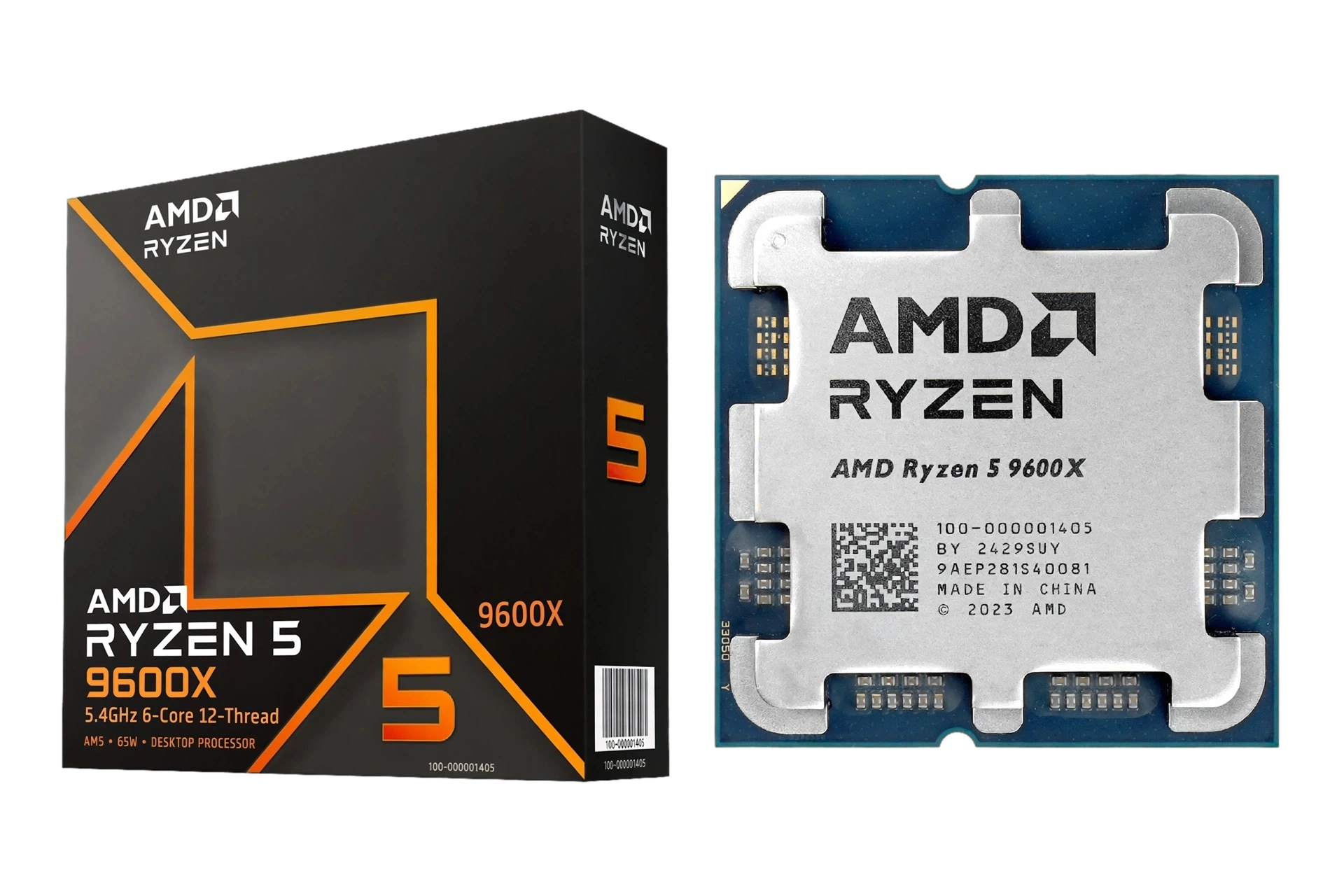
Official Specifications
| Architecture/codename | Zen 5 / Granite Ridge |
| Cores/threads | 6 / 12 |
| Base clock / max boost | 3.9 GHz / up to 5.4 GHz |
| L1 / L2 / L3 cache | 480 KB / 6 MB / 32 MB |
| 3D V-Cache | No |
| Default TDP | 65 W |
| Maximum operating temperature (Tjmax) | 95°C |
| CPU socket | AM5 |
| CPU core manufacturing process | TSMC 4 nm |
| I/O die manufacturing process | TSMC 6 nm |
| Memory type/channels | DDR5 UDIMM / 2 |
| Maximum memory capacity | 256 GB |
| Official two-module memory rate | Up to DDR5-5600 |
| Official four-module memory rate | Up to DDR5-3600 |
| ECC support | Yes, with motherboard support |
| PCI Express / native lanes (total / usable) | PCIe 5.0 / 28 / 24 |
| Integrated graphics | AMD Radeon Graphics, 2 graphics cores at 2200 MHz |
| Boxed cooling | Not included; AMD recommends a premium air cooler |
| CPU tuning support | Unlocked; Precision Boost Overdrive and Curve Optimizer |
| AMD EXPO memory profiles | Supported; EXPO operates beyond baseline memory specifications |
| Launch | August 8, 2024 |
| Product identifier | 100-100001405WOF |
Source: AMD Ryzen 5 9600X specifications. Motherboard support, firmware, memory configuration, and boxed versus tray packaging can change what is available in your build.
The 9600X is a balanced starting point for a new AM5 gaming PC when the budget must also cover a capable graphics card. Six Zen 5 cores give it a modern CPU foundation without requiring an X3D price premium. That makes it easier to allocate money according to the component actually limiting the games you play. It is less compelling as a replacement for a working Ryzen 5 7600-class system unless a measured improvement in a particular workload justifies the transaction.
Compare the complete purchase cost because the 9600X does not include a cooler, while a standard boxed 7600 does. A small processor-only price difference can become larger once cooling is included. Buyers seeking very high competitive frame rates should also compare available X3D offers, but there is no reason to pay for that extra CPU capacity if the chosen graphics settings keep the graphics card busy instead.
Reasons to Buy
- Good foundation for a gaming system that reserves budget for the GPU.
- Zen 5 architecture and AM5 compatibility.
- Six-core configuration avoids paying for unused production-oriented core counts.
Reasons to Avoid
- No included cooler.
- Cache-sensitive games can favor similarly priced X3D offers.
- Often an unconvincing upgrade from an already adequate AM5 six-core CPU.
FPS Results
Benchmark set C — published March 12, 2025. TechSpot used an Asus ROG Strix RTX 4090 OC, a Gigabyte X670E Aorus Master motherboard with BIOS F34b, and 32 GB DDR5-6000 CL30-38-38-96. The OS was Windows 11 24H2 and the graphics driver was 572.70 WHQL. These are the review’s stock-CPU results with EXPO memory, not its optional PBO or Eco-mode results. All five run at 1080p. Exact game build numbers and complete scene-reproduction details were not supplied.
| Game | Settings at 1080p | Average FPS | 1% low FPS |
| Cyberpunk 2077: Phantom Liberty | High | 154 | 110 |
| Assetto Corsa Competizione | Epic | 172 | 143 |
| Counter-Strike 2 | Medium | 521 | 260 |
| Starfield | Ultra | 96 | 74 |
| Warhammer 40,000: Space Marine 2 | Ultra, native DLAA, 4K texture pack | 107 | 89 |
Source: TechSpot’s original benchmark review. These are measured results from that review, not calculated forecasts. Settings not explicitly documented by the source, including some upscaling, frame-generation, and ray-tracing options, should not be inferred from the preset name.
9. AMD Ryzen 5 7600
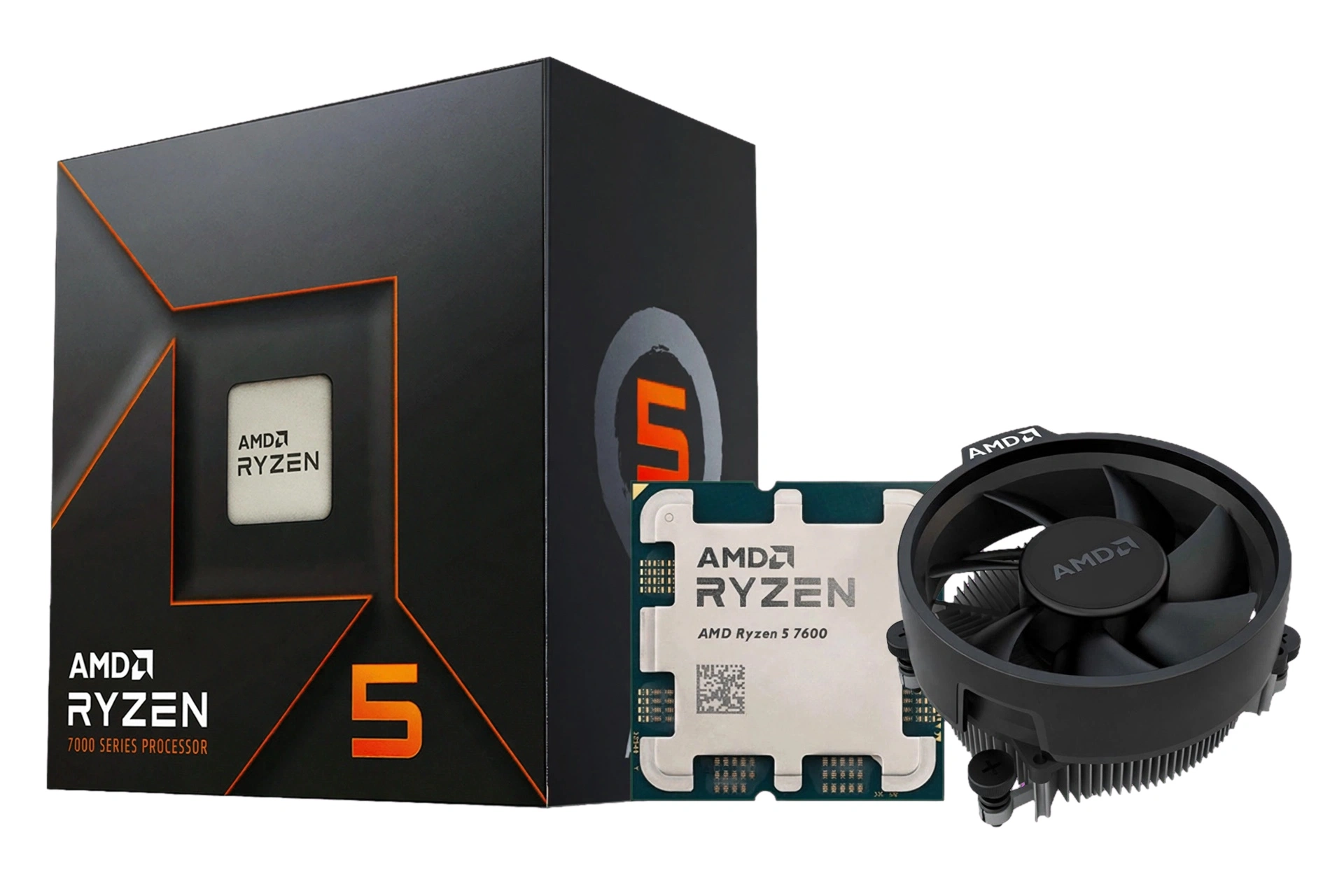
Official Specifications
| Architecture/codename | Zen 4 / Raphael |
| Cores/threads | 6 / 12 |
| Base clock / max boost | 3.8 GHz / up to 5.1 GHz |
| L1 / L2 / L3 cache | 384 KB / 6 MB / 32 MB |
| 3D V-Cache | No |
| Default TDP | 65 W |
| Maximum operating temperature (Tjmax) | 95°C |
| CPU socket | AM5 |
| CPU core manufacturing process | TSMC 5 nm |
| I/O die manufacturing process | TSMC 6 nm |
| Memory type/channels | DDR5 UDIMM / 2 |
| Maximum memory capacity | 128 GB |
| Official two-module memory rate | Up to DDR5-5200 |
| Official four-module memory rate | Up to DDR5-3600 |
| ECC support | Yes, with motherboard support |
| PCI Express / native lanes (total / usable) | PCIe 5.0 / 28 / 24 |
| Integrated graphics | AMD Radeon Graphics, 2 graphics cores at 2200 MHz |
| Boxed cooling | AMD Wraith Stealth included with the standard boxed CPU |
| CPU tuning support | Unlocked; Precision Boost Overdrive and Curve Optimizer |
| AMD EXPO memory profiles | Supported; EXPO operates beyond baseline memory specifications |
| Launch | January 2023 |
| Product identifier | 100-100001015BOX |
Source: AMD Ryzen 5 7600 specifications. Motherboard support, firmware, memory configuration, and boxed versus tray packaging can change what is available in your build.
The Ryzen 5 7600 remains useful because an affordable platform entry can matter more than owning the newest processor generation. The standard boxed model includes a Wraith Stealth cooler, which reduces the cost of getting a system running even if you later replace it for lower noise. Its basic integrated graphics also help with setup and fault-finding when a dedicated graphics card is unavailable.
For a new build, compare the total price of the CPU, motherboard, DDR5, and cooling against the 9600X rather than comparing CPU listings alone. The historical benchmark table below demonstrates how it compared with the 5600 under one controlled review, but it should not be treated as a prediction for current patches of those games. Choose the 7600 when the complete AM5 package is meaningfully cheaper. If the newer alternative costs almost the same after cooling, the decision deserves another look.
Reasons to Buy
- Included cooler lowers the initial cost of the standard boxed package.
- AM5 and DDR5 provide a route to later compatible CPU upgrades.
- Basic integrated graphics are useful for display output and troubleshooting.
Reasons to Avoid
- The stock cooler may not meet your preferred noise level.
- A small total-cost gap can favor the 9600X.
- The included graphics are not a replacement for a capable gaming graphics card.
FPS Results
Benchmark set D — published January 31, 2023. These historical TechSpot results use the GeForce RTX 4090 at 1080p, selected from a review that also tested other graphics cards. The article does not fully specify RAM timings, OS build, BIOS, graphics driver, or game build numbers for this comparison. Treat the figures as dated evidence of CPU differences under that test, not a forecast for a patched 2026 game. Horizon Zero Dawn here is the original release, not the remaster.
| Game | Settings at 1080p | Average FPS | 1% low FPS |
| Watch Dogs: Legion | Very High | 149 | 111 |
| Hitman 3 | Ultra | 211 | 109 |
| Marvel’s Spider-Man Remastered | High; ray tracing Very High (6), TAA | 111 | 94 |
| Shadow of the Tomb Raider | Highest | 228 | 181 |
| Horizon Zero Dawn | Favor Quality | 247 | 173 |
Source: TechSpot’s original benchmark review. These are measured results from that review, not calculated forecasts. Settings not explicitly documented by the source, including some upscaling, frame-generation, and ray-tracing options, should not be inferred from the preset name.
10. AMD Ryzen 5 5600
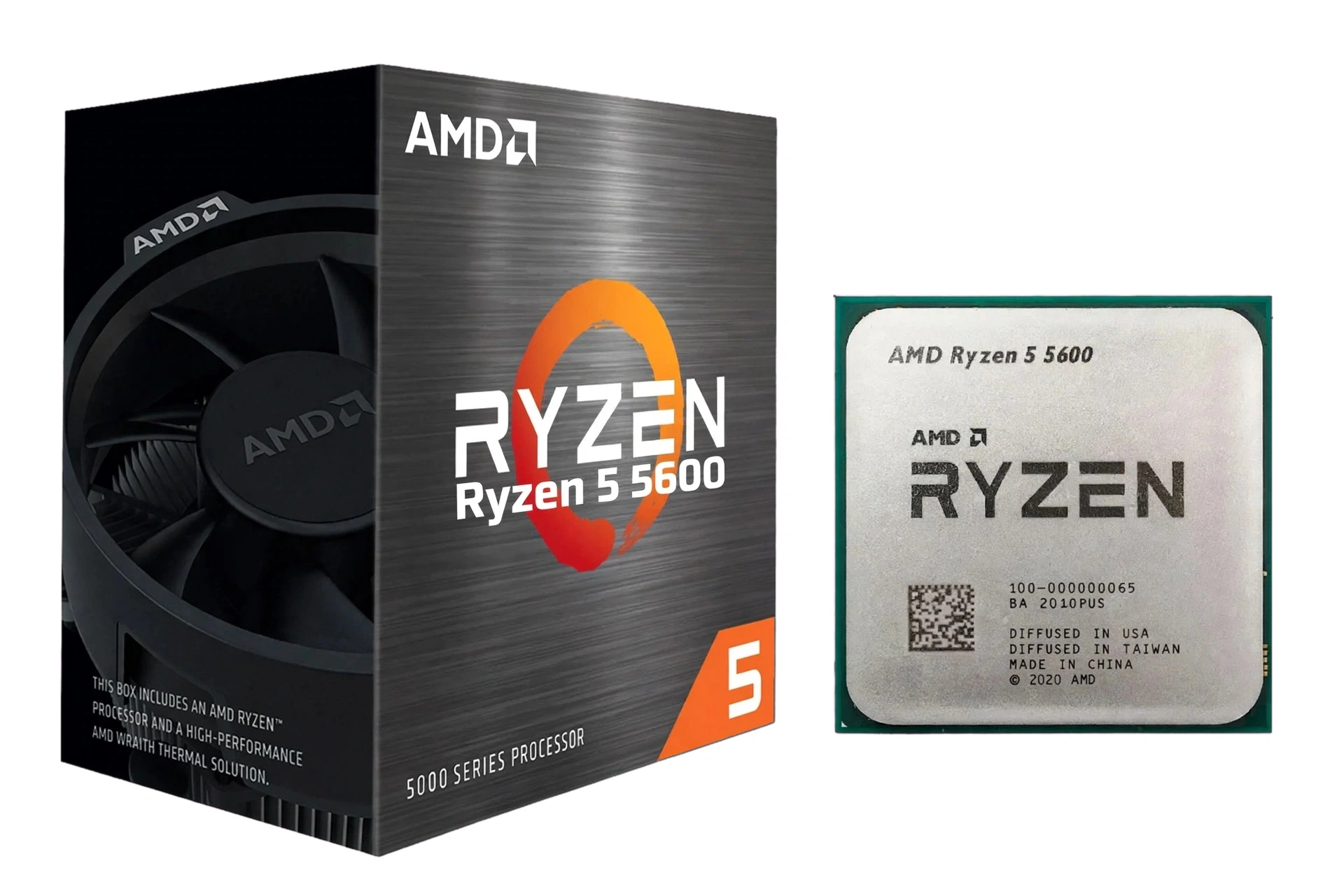
Official Specifications
| Architecture/codename | Zen 3 / Vermeer |
| Cores/threads | 6 / 12 |
| Base clock / max boost | 3.5 GHz / up to 4.4 GHz |
| L1 / L2 / L3 cache | 384 KB / 3 MB / 32 MB |
| 3D V-Cache | No |
| Default TDP | 65 W |
| Maximum operating temperature (Tjmax) | 90°C |
| CPU socket | AM4 |
| CPU core manufacturing process | TSMC 7 nm |
| I/O die manufacturing process | GlobalFoundries 12 nm |
| Memory type/channels | DDR4 UDIMM / 2 |
| Maximum memory capacity | 128 GB |
| Official two-module memory rate | Up to DDR4-3200 |
| Official four-module memory rate | DDR4-2933 with single-rank modules; DDR4-2667 with dual-rank modules |
| ECC support | Yes, with motherboard support |
| PCI Express / native lanes (total/usable) | PCIe 4.0 / 24 / 20 |
| Integrated graphics | None; discrete GPU required |
| Boxed cooling | AMD Wraith Stealth included with the standard boxed CPU |
| CPU tuning support | Unlocked; Precision Boost Overdrive |
| AMD EXPO memory profiles | No; uses DDR4, with board-specific memory tuning |
| Launch | April 4, 2022 |
| Product identifier | 100-100000927BOX |
Source: AMD Ryzen 5 5600 specifications. Motherboard support, firmware, memory configuration, and boxed versus tray packaging can change what is available in your build.
The Ryzen 5 5600 is most attractive when it lets you keep an existing AM4 motherboard and DDR4 memory. In that situation, the upgrade cost can be limited mainly to the processor, provided the exact board and BIOS support it. It is less automatically attractive for a completely new system because a cheap CPU can lead to a platform with fewer worthwhile future upgrade options.
Its six cores can still support an economical gaming PC, but buyers targeting very high frame rates should examine game-specific limits rather than relying on its historical reputation. The lack of integrated graphics also matters: motherboard display connectors will not provide a picture when this CPU is used without a separate graphics card. If you already own a 5600, moving to another inexpensive six-core AM4 chip is unlikely to be a compelling gaming upgrade. Save toward a more substantial CPU or platform change.
Reasons to Buy
- Can reuse compatible AM4 hardware and DDR4 memory.
- Standard boxed version includes a Wraith Stealth cooler.
- A low-cost route from an older supported AM4 CPU to six Zen 3 cores.
Reasons to Avoid
- No integrated graphics; a separate graphics card is required.
- Less appealing for a new build when AM5 costs are close.
- Not the right default choice for the highest competitive frame-rate targets.
FPS Results
Benchmark set D — published January 31, 2023. These historical TechSpot results use the GeForce RTX 4090 at 1080p, selected from a review that also tested other graphics cards. The article does not fully specify RAM timings, OS build, BIOS, graphics driver, or game build numbers for this comparison. Treat the figures as dated evidence of CPU differences under that test, not a forecast for a patched 2026 game. Horizon Zero Dawn here is the original release, not the remaster.
| Game | Settings at 1080p | Average FPS | 1% low FPS |
| Watch Dogs: Legion | Very High | 113 | 86 |
| Hitman 3 | Ultra | 149 | 91 |
| Marvel’s Spider-Man Remastered | High; ray tracing Very High (6), TAA | 82 | 72 |
| Shadow of the Tomb Raider | Highest | 170 | 133 |
| Horizon Zero Dawn | Favor Quality | 200 | 141 |
Source: TechSpot’s original benchmark review. These are measured results from that review, not calculated forecasts. Settings not explicitly documented by the source, including some upscaling, frame-generation, and ray-tracing options, should not be inferred from the preset name.
Things to Know Before Buying an AMD Gaming CPU
Start with the games and monitor you actually use. The best CPU for a 500 Hz competitive monitor is not necessarily the best purchase for a 60 Hz display. A player lowering graphics settings to maximize responsiveness may expose a CPU limit that another player never encounters at higher visual settings. Frame rates above a monitor’s refresh rate can still affect latency, but the useful improvement depends on the game, synchronization settings, and the rest of the system.
Look for benchmarks of your main games, including the parts that strain the CPU. A quiet benchmark scene may not represent a busy multiplayer match, a crowded city, or a late-game simulation. Average FPS alone does not answer whether the processor maintains consistent frame delivery in those situations.
Do not generalize from one particularly cache-sensitive title. If most of your gaming time goes into two or three games, those games should carry more weight in your purchase than a long average covering titles you never play. Equally, one favorable result should not be advertised as a universal victory.
Decide Whether the CPU or GPU Needs the Money
A CPU limit occurs when the processor cannot prepare work quickly enough for the graphics card to produce more frames. A GPU limit occurs when the graphics card’s rendering work becomes the constraint. The limiting component can change between scenes in the same game.
Higher resolution often increases GPU load and reduces the visible gap between processors, but “4K means the CPU does not matter” is too broad. Simulation work, high refresh-rate targets, and demanding scenes can still expose a CPU limitation. Upscaling can also reduce rendering load enough to reveal a CPU ceiling that was less visible before.
If you already own a gaming PC, use this practical check before replacing its processor:
- Select a repeatable scene in a game you actually play and note your resolution, preset, ray tracing, and upscaling settings.
- Record average FPS, frame-time behavior, GPU utilization, and individual CPU-thread activity with a trusted monitoring tool.
- Repeat with a much lower rendering resolution while keeping the scene and CPU-sensitive settings consistent.
- If performance barely rises, investigate a CPU or game-engine limit, a frame cap, synchronization, and background activity before blaming the GPU.
- If performance rises substantially, compare the cost of a GPU upgrade with the CPU purchase you were considering.
This is a diagnostic clue, not a laboratory isolation of every possible bottleneck. Low overall CPU utilization can hide one busy thread, and shader compilation, storage delays, or software faults can cause stutter that a new CPU does not solve.
Compare Complete Platform Costs
A processor price is only one part of an upgrade. Count the motherboard, memory, cooler, and any components that cannot be reused. Check whether a bundle saves money against the individual parts you would actually choose.
| Your situation | Costs to compare | Sensible starting point |
| Compatible older AM4 PC | CPU, possible BIOS update, any cooling change | Ryzen 5 5600 for a low-cost upgrade; investigate stronger AM4 options if the budget allows |
| New budget gaming PC | CPU, AM5 board, DDR5, cooler, GPU balance | Ryzen 5 7600 versus 9600X total cost |
| High refresh-rate gaming build | CPU/GPU pairing, cooler, monitor target | 9850X3D versus discounted 9800X3D |
| Existing 7800X3D or 9800X3D PC | Net replacement cost and measured improvement | Keep the current CPU unless a specific workload justifies changing it |
| Gaming plus frequent CPU production work | Application performance, time saved, cooling | 9950X3D versus other many-core alternatives |
You can compare cost per frame only when the frame rates come from the same test. Divide the relevant cost by the measured average FPS; a lower result is better for that specific calculation. However, CPU-only cost per frame omits the rest of the system and tells you nothing about whether both processors already exceed your target.
For example, the checked $499 and $469 offers make the 9850X3D approximately 6.4% more expensive than the 9800X3D. The Cyberpunk result in set A is approximately 4.5% higher. That single comparison modestly favors the 9800X3D on CPU-only cost per frame, but it does not establish the better purchase across every game. Prices and your preferred workload can reverse the outcome.
Check the Exact Motherboard and BIOS
Sharing a socket is necessary, but it is not the entire compatibility check. Open your motherboard manufacturer’s CPU-support list, locate the exact processor, and note the minimum BIOS version. Verify the board model and hardware revision rather than relying on a generic statement about its chipset.
If an update is necessary, read the manufacturer’s sequence and prerequisites before removing the old CPU. Some boards can update firmware without a supported processor through a dedicated flash feature; others need a working compatible CPU. Do not assume every board has that feature.
The Ryzen 5 5600 uses AM4 and DDR4. All nine other processors here use AM5 and DDR5. DDR4 memory does not fit an AM5 DDR5 motherboard, and an AM4 processor does not fit an AM5 socket. Cooling reuse also requires checking the cooler manufacturer’s mounting guidance.
AMD lists multiple AM5 chipsets across these processors, but chipset names alone do not guarantee a particular PCIe slot configuration, storage layout, USB implementation, or processor support. A CPU’s PCIe 5.0 capability does not mean every slot on its motherboard operates at PCIe 5.0.
Understand Memory Ratings Before Enabling EXPO
AMD’s official memory specification and an EXPO profile are different things. EXPO is a stored memory-overclocking profile intended to simplify applying a kit’s advertised settings. DDR5-6000 results in the cited reviews should not be confused with an unconditional official memory-controller guarantee for every CPU and board.
Memory transfer rates are expressed in MT/s, even though retailers often label them loosely as MHz. The CPU tables use familiar DDR5-6000-style notation to describe the effective data rate. Memory rank describes how a module’s chips are organized; it is not the same as the number of installed modules or memory channels.
For a straightforward gaming build, two matched modules are generally easier to configure than four at aggressive memory speeds. Check the board’s memory compatibility list and the kit’s capacity, timings, and profile support. If an overclocked memory profile causes instability, return to baseline settings before investigating the rest of the machine.
Maximum memory capacity is a capability limit, not a gaming recommendation. Buying 128 GB or 256 GB does not inherently increase FPS when a game and its background applications already fit comfortably in a smaller amount of RAM.
Budget for Cooling and Correct Setup
AMD’s cooling recommendation is guidance, not evidence that every compatible air cooler fails on an X3D processor. Cooler capability, case airflow, room temperature, fan settings, and workload determine the result. Check independent cooler testing and physical clearance before purchasing.
The standard boxed Ryzen 5 7600 and 5600 include a Wraith Stealth. The other processors here do not include a cooler in their standard package. Retailer bundles sometimes add one, but a temporary bundle should not be rewritten as an official CPU specification.
After installation, use the motherboard manufacturer’s current BIOS guidance and AMD’s official driver and support pages. Correct chipset software is particularly relevant to a dual-die X3D configuration such as the 9950X3D. Begin with the supported default configuration, confirm stable behavior, and only then evaluate optional tuning.
Keep Shared Platform Features in Perspective
The following details complete the practical specification picture without repeating identical rows in ten long tables. They describe processor capabilities; the motherboard determines which ports and functions you can actually use.
| Feature | Nine AM5 processors in this article | Ryzen 5 5600 |
| Native USB capability listed by AMD | Four USB 3.2 Gen 2 10 Gbps ports and one USB 2.0 port | Four USB 3.2 Gen 2 10 Gbps ports; zero native USB 2.0 ports listed |
| Basic display capability | Integrated Radeon graphics; usable outputs depend on motherboard wiring | No integrated graphics; board display outputs cannot substitute for a GPU |
| Memory error correction | ECC support depends on motherboard implementation | ECC support depends on motherboard implementation |
| NVMe RAID modes listed | Ryzen 9000: 0, 1, 5, 10; Ryzen 7000: 0, 1, 10 | Check the exact motherboard and storage implementation |
| Configuration utilities | AMD Ryzen Master support and supported motherboard firmware controls | AMD Ryzen Master support and supported motherboard firmware controls |
These are not reasons to pay more by themselves. Native port counts are different from the total connectors on a finished board, and RAID capability does not improve CPU gaming performance. Operating-system compatibility should also be checked against both current AMD drivers and the OS vendor’s support lifecycle; an old OS appearing in a product specification list is not a promise of ongoing updates.
Check Alternatives Without Losing the Budget
This selection does not imply that every omitted Ryzen processor is a poor purchase. A locally discounted 7500F or an available six-core X3D alternative may undercut the listed options, but package contents, graphics capability, regional access, and seller warranty need checking before substituting one model for another.
Owners of an AM4 system should also investigate the price and availability of compatible X3D upgrades before spending on a new platform. The correct comparison includes the CPU’s remaining warranty and whether an unusually expensive older chip approaches the cost of moving to AM5. Likewise, a specialist Ryzen 9 variant deserves application-specific evidence rather than an automatic recommendation based on its higher price.
Conclusion
Choose the Ryzen 7 9850X3D when maximum gaming CPU performance is the priority, and its premium fits the build. Choose the 9800X3D when a meaningful discount produces better overall value. The 9950X3D is the more relevant option when demanding CPU work must share the same machine.
For a less expensive new build, compare the complete Ryzen 5 9600X and 7600 platform costs. For an existing compatible AM4 PC, the 5600 can be an economical upgrade. Before ordering, verify the motherboard BIOS, cooling package, local price, and benchmarks for the games you actually play.